



What Are the Best Heat Gun in 2024?
Best Overall

Seekone’s 1800W heat gun is ideal for big and small DIY home improvements from removing paint and floor tiles to loosening rusted bolts, heating PVC, and electronics repairs. The heat gun comes with four nozzle accessories to direct heat as needed. This powerful tool has 2 heat modes with a maximum temperature of 1202℉ (650℃). In addition, it features overload protection to prevent circuit or heat gun damage from overheating. With a power cord length of 5.25ft and a weight of 1.98 lb, the gun is easy to manage. An ergonomically designed multi-grip handle minimizes hand and arm fatigue during long periods of use. Seekone offers a warranty with a full refund or return.
Pros
- Dual temperature setting
- Dual airflow setting from 190 to 500 L/min
- Built-in overheating protection
- Purchase includes 1 x deflector nozzle, 2 x concentrator nozzles, and 1 x reflector nozzle
Cons
- The heat gun has no temperature adjustment dial or variable control so you only have a choice of two temperature options
Runner Up

This dual temperature heat gun features a lasting corrosion-resistant nozzle and lightweight yet sturdy handle. Our favorite feature about this product is that it can be used hands-free for those tasks where you need an extra pair of hands. It features integrated back support so the device can be used safely without having to hold it. The heat gun has two airflow settings allowing you to use the lower setting for tasks such as shrink wrapping and the highest temperature setting for more intense jobs.
Pros
- Dual temperature setting: low 750°F and high 1000°F
- Temperature switch built into the handle
- Two fan speeds for heating control
- Integrated storage hook
- 2-Year warranty
Cons
- The heat gun has no variable temperature dial so you only have a choice of two predetermined temperature options
Honorable Mention

This dual temperature hot air gun is perfect for smaller home and craft projects as well as fixing electronics and doing mobile repairs. The low setting allows you to use the gun without messing up delicate projects while a high speed/heat setting makes the gun useful for high-volume or more heavy-duty work. Its compact size, low noise, and lightweight design make it easy to hold for long periods without hand or arm fatigue. To guarantee their safety and quality, these gadgets are UL certified to North American manufacturing safety standards.
Pros
- Two intensity settings
- Versatile use for small and big projects from automotive and electronics repairs to jewelry and candle making
- Extra-long 6-foot cord
- Features a nozzle safety shield to avoid getting burnt on the hot nozzle
- UL Certified
Cons
- Not suitable for heavy-duty building projects or large surface areas
Also Consider

This handy craft tool features a 6.56 ft long power cord for easy reach of extended areas. This hot air craft gun is designed with a high-quality stainless-steel interior and ABS plastic exterior for safe handling. Its compact design makes it easy to handle when completing delicate tasks. Additionally, it features a built-in stand for self-support and heat vents to decrease the internal temperature for extended durability.
Pros
- Ideal for delicate craft projects and small electronic appliance repairs
- 6.56-foot long power cord
- Anti-slip grip
- Integrated stand for hands-free use
Cons
- The gun cannot be used for more than 10 minutes at one time since it will overheat. It needs to be switched off and turned on again for extended use
Best Heat Guns Buying Guide
Choosing a heat gun is not too complicated, as long as you have a clear idea under which circumstances you will be using it. The intended use will determine which accessories will be most important as well as the power source for your tool. Some models have extra safety features such as anti-overheating properties, ergonomic handle designs, and a protective carry case. However, extra features usually come with an extra cost. Here is everything you need to consider when choosing the best heat gun for your DIY operation.
What Can You Use a Heat Gun For?
A heat gun is composed of a heating element, motor, and fan setting. The hot air is directed through the nozzle and the fan speed can be adjusted with temperature control and angled fittings. For DIYers and crafters however, a mini heat gun is best. Such hot air tools are best for their compact size. If you’re thinking of getting a heat gun for just household projects and wondering if it’s really worth it, here are some of the many things you can use a good heat gun for:
- Remove paint from walls, doors, timber, and furniture before sanding
- Putty removal
- Heat frozen pipes
- Heat wood before gluing or dislodging warped screws
- Heat for welding
- Faster drying of primer or paint
- Heat shrinking and shaping materials that are heat-formable such as tar for roofing and cable sleeves Desoldering circuit boards
- Car wrapping
- Hanging loop
- Thawing frozen pipes
- Remove adhesives and labels
- Wax surfboards
- Crafts, jewelry, embossing, and candle making
- Solder joints
- Heat shrink tubing
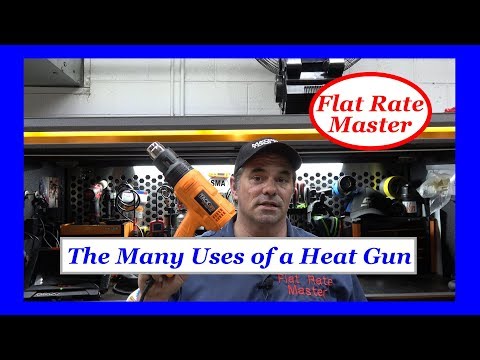
Learn more about the various uses of heat guns with this video from Flat Rate Master:
Types of Heat Guns
Heat guns are available in two main types, distinguished by their power source.
Gas heat guns
Gas guns are very handy since they don’t require electricity to work and are easy to maneuver due to being cordless. They are, however, less frequently used as they require gas cartridges to work.
Electric heat guns
These are the most commonly used type of heat gun and are safer than gas-powered heat guns. They are plugged into an electric outlet and can be used with an extension cord to provide extra accessibility. Also check dual temperature heat guns that comes with lasting corrosion-resistant nozzle and lightweight yet sturdy handle, everything that too at a great price.
What to Consider When Buying a Heat Gun
Purpose and frequency of use
As with many other tools, a portable heat gun comes in different categories for DIY use at homes such as casual hobbies, weekend home projects, and general improvements as well as for daily professional use by tradesmen. Tools for professional daily use need to be more durable to withstand work environments, may have extra features, and should carry a warranty.
While high temperature heat guns are best specialized for industrial use, a low temperature heat gun is a device for softening the paint or defrosting the pipes.
Power
The power expressed in wattage determines the maximum temperature that the gun will yield. This ranges from 1500 watts to over 2300 watts. General heat guns for home improvements are usually between 1500 and 1800 watts. Cordless hot air tools that use lithium-ion batteries or gas are also available.
Adjustable temperature control
Since different projects and materials require different temperatures, heat guns usually include at least two fixed temperature settings or a variable adjustment control for exact temperature control. Some DIY models have a fixed 932°F setting as this is the best temperature for paint stripping. If you are planning to use the device for different applications, choose a model that has at least two or three temperature options. Low temperature setting ranges from 392℉ to 482℉, while the high temperature setting ranges from 572℉ to 662℉.
Temperature Recommendations
- 120℉-300℉ – Thaw frozen pipes
- 400℉-440℉ – Bending plastics and softening dry paint
- 440℉-550℉ – Softening adhesive material
- 790℉-830℉ – Softening welding material
- 900℉-950℉ – Loosen rusted material
- 960℉-1000℉ – Paint removal
- 1000℉-1200℉ – Qualitative change
Adjustable airflow
Adjustable airflow settings allow you to adjust the fan speed, thus controlling the force of hot air expelled from the device. This can be integrated into a fixed setting with a low force and high force option or with an adjustable dial allowing you to have comprehensive control in small increments.
When working with delicate materials or near sensitive surfaces it is important to have a more subtle airflow to avoid damage. Some hardy tasks on the other hand require high heat with heavy airflow to achieve the necessary results.
LCD and LED displays
If the heat gun has variable settings, being able to see the exact temperature and airflow level is important, especially for professional craftsmen. LCD and LED displays provide exact readings enabling consistent results and precise heating conditions.
Overheating protection
A tool with a built-in thermal protection system or overload protector will automatically switch off when the internal temperature exceeds a certain threshold, especially if used for extended periods. This protects the circuit, the user, and prevents damage to the tool. Since heat is one of the main detriments to electronic devices and can lead to damage quite quickly, this is an important feature to consider.
Residual heat indicators
The nozzle where the air is expelled will remain hot long after the device has been switched off. Smaller craft heat guns feature a nozzle protector or cover which prevents direct contact with the hot front end. Heavy-duty machines however can easily cause burns if users accidentally touch a used tool, unaware of the lingering heat in the metal components. A residual heat indicator displays a warning light until the tool has cooled down sufficiently to avoid injury.
Integrated stands
For projects such as bending pipes, it is best to have the heat gun set on a work table and hold the material in front of it. Some heat guns allow hands-free use by providing an integrated stand or flat back design allowing it to remain in position without being held.
Dust filter
Dust filters are necessary for work in construction sites where tools are exposed to high amounts of fine dust from drilling, sawing, and sanding. The dust can clog and damage the internal components of the heat gun over time. Dust filters will protect the interior mechanisms, prolonging the performance of the device.
Heat gun accessories
Varied nozzle attachments and accessories increase the versatility and precision of a heat gun. Most new devices come with one or two nozzles, however, if you are using such heat tools for a very specific purpose, make sure you have the correct accessories for the task.
Deflector nozzles are used to direct a long, narrow heat pattern onto work surfaces while concentrator nozzles direct the heat in a very specific area only. Reflector nozzles are used to spread heat evenly around a wide work area. Keep an eye for special offers using which you can purchase such power tools at a reasonable price. Not only that you can also club accessories at no additional cost.
People Also Asked
Can a hairdryer be used instead of a heat gun?
Hairdryers and heat guns have similar properties so there are some instances where you could use a hairdryer such as removing adhesives or removing candle wax. For heavy-duty or intricate tasks, a hairdryer won't be of much help, and getting the proper equipment will make your task at hand much easier.
Can a heat gun be powered by a car?
Do not use a car to power a heat gun. This is highly hazardous and you will most likely blow a fuse or cause an electrical fire.
How long can a heat gun run at a time?
Good quality heat guns can run for approximately 15 minutes after which it is recommended to give them a little time to cool down before using them again. Some smaller devices for crafts can only run for 10 minutes before needing to cool.


