


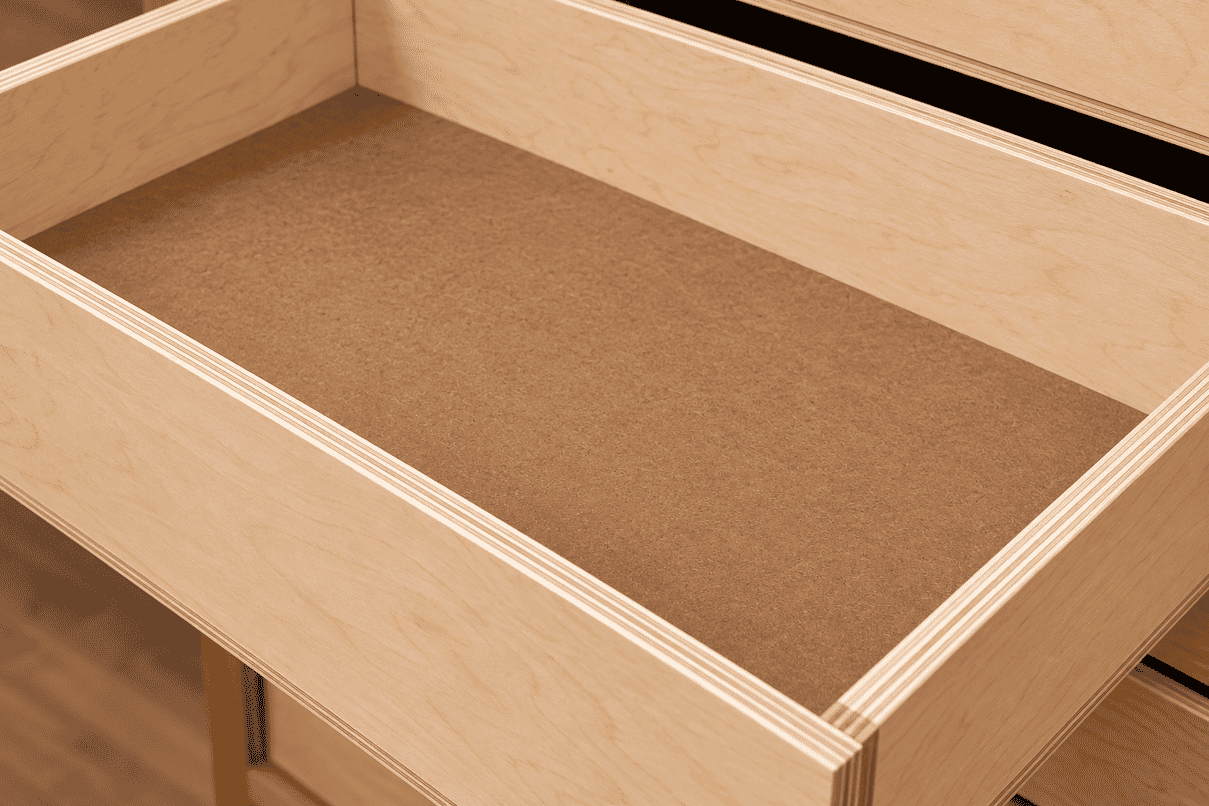
How Thick Should a Drawer Bottom Be?
When building drawers, most of the attention goes to the joinery. Dovetails, rabbets, and other drawer joints help create a strong box that can withstand years of use. But there's another important detail that's easy to overlook: the drawer bottom.
Choosing the right material and thickness for a drawer bottom makes a big difference in how well it holds up over time.
A bottom that's too thin may sag under the weight of its contents. On the other hand, using thick plywood for every drawer can add unnecessary weight and take up valuable storage space.
Fortunately, selecting the right drawer bottom doesn't have to be complicated. A few simple guidelines will help you choose the best material for the job.
Best Materials for Drawer Bottoms
The two most common materials for drawer bottoms are 1/4" hardboard and plywood.
Both work well, but each has advantages depending on the size of the drawer and how much weight it needs to support.
1/4" Hardboard for Small and Medium Drawers
Hardboard is an economical choice for small and medium-size drawers that hold relatively light items.
It's smooth, consistent in thickness, and easy to work with. For drawers holding clothing, papers, or lightweight accessories, 1/4" hardboard can provide adequate support.
However, hardboard isn't the best choice for large drawers carrying heavy tools or other dense materials.
As the unsupported span increases, the bottom becomes more likely to sag.
1/4" Plywood for Stronger Drawer Bottoms
For drawers that need to carry more weight, plywood is a good step up.
Its cross-laminated veneer construction provides stiffness and strength while keeping the bottom relatively thin.
Baltic birch plywood is one of my favorite choices. It typically has more, thinner veneer layers than conventional cabinet-grade plywood, making it a strong and stable material for drawer construction.
For many everyday furniture and cabinet drawers, 1/4" plywood offers a practical balance of strength, thickness, and weight.
When to Use 1/2" Plywood for Drawer Bottoms
Large, deep drawers are a different story.
As the drawer gets wider, the unsupported span of the bottom increases. Add heavy contents, and the risk of sagging becomes much greater.
I ran into this situation when adding drawer storage beneath my workbench.
The drawers measured 36" wide and 20" deep, and I planned to store hand planes, routers, and shop-made jigs in them.
That's a lot of weight for a thin drawer bottom.
Rather than risk having the bottoms sag over time, I chose to use 1/2" plywood.
The additional thickness provides significantly greater stiffness, making it a better choice for large shop drawers that need to support heavy tools.

Drawer Bottom Thickness Guide
There's no single thickness that's right for every drawer. The best choice depends on the drawer's dimensions, the weight of its contents, and how the bottom is supported.
| Drawer Application | Suggested Material | Thickness |
|---|---|---|
| Small drawers with light contents | Hardboard | 1/4" |
| Medium drawers with moderate loads | Hardboard or plywood | 1/4" |
| General-purpose cabinet and furniture drawers | Plywood, including Baltic birch | 1/4" |
| Large drawers for heavy tools | Plywood | 1/2" |
| Existing drawer bottom that needs added stiffness | Additional plywood layer or hardwood reinforcement | Depends on the drawer |
These are starting points rather than fixed load ratings. A wide drawer with little support may need a thicker bottom even if the contents aren't especially heavy.
How to Reinforce a Drawer Bottom to Prevent Sagging
You don't always need to replace a drawer bottom to make it stronger.
If an existing bottom needs additional stiffness, there are a couple of ways to reinforce it.
Add Another Layer of Plywood
One option is to glue an additional layer of plywood to the existing bottom.
This increases the overall thickness and stiffness of the panel.
For the best results, make sure the surfaces are clean and that the additional layer is fully bonded to the original bottom.
Install a Hardwood Reinforcing Strip

Another option is to glue a hardwood strip along the center of the drawer bottom, running from front to back.
The strip acts as a stiffener, helping the bottom resist bending under a heavy load.
It's a simple way to strengthen a large drawer without replacing the entire bottom panel.
Before adding reinforcement, check that the strip won't interfere with drawer slides, cabinet dividers, or other hardware beneath the drawer.
A Stronger Drawer Starts at the Bottom
A well-built drawer needs more than strong corner joints. The bottom has to support everything you plan to store inside.
For small and medium-size drawers, 1/4" hardboard or plywood will often do the job. For larger drawers carrying heavy tools, stepping up to 1/2" plywood can provide the additional stiffness you need.
And if a drawer bottom needs extra support, adding another layer of plywood or a hardwood reinforcing strip can make a noticeable difference.
Choosing the right drawer bottom material isn't complicated, but it's one of those small details that helps a woodworking project hold up for years.
Build Stronger Drawer Joints
A strong drawer bottom is only part of building a durable drawer. The joints connecting the front, back, and sides also need to withstand repeated use.
Learn how to cut accurate dadoes, grooves, tongue-and-dado joints, and locking rabbets at the table saw for stronger, better-fitting drawer assemblies.
LEARN TABLE SAW DRAWER JOINERY → Dadoes & Grooves: Essential Table Saw Joinery Techniques


