


How to Cut Tongue and Dado Joints on a Table Saw
Your table saw can do much more than rip boards and cut parts to length. With a dado blade and a few simple setup techniques, it's also an excellent tool for cutting strong, accurate woodworking joints.
One useful example is the tongue and dado joint. This joint combines a dado cut into one workpiece with a matching tongue on another. It's a practical choice for assembling cabinets, boxes, and other woodworking projects where accurate alignment and a snug fit are important.
Cut the Dadoes with a Table Saw
Start by installing a dado blade set in your table saw. The first step is cutting the dadoes in the side pieces.
Rather than measuring the location of each cut, use a scrap piece that's the same thickness as the mating top and bottom panels. Position the rip fence so the outside edge of the dado blade aligns with the thickness of the scrap.
With the setup complete, use a miter gauge to guide the workpiece across the dado blade. Keep the workpiece firmly supported against the miter gauge as you make the cut.
Repeat the process to cut matching dadoes in the remaining side pieces.
Cut Matching Tongues for a Snug Fit
Next, cut the mating tongues on the top and bottom panels.
For this operation, partially bury the dado blade in an auxiliary rip fence. This allows you to control the length of the tongue while using the blade height to establish its thickness.
Start with a test piece rather than cutting your finished project parts. Make a series of shallow adjustments and test the tongue in the dado until you achieve a snug, slip fit.
Once the setup is dialed in, cut the tongues on the actual workpieces using the same settings.
Accurate Table Saw Joinery Without Complicated Measurements
The advantage of this technique is that you can use matching scrap pieces and test cuts to establish the setup instead of relying on exact measurements.
By cutting the dadoes first and fitting the tongues to match, you can create consistent joints that align accurately during assembly.
It's a simple, reliable table saw joinery technique that's useful for building cabinets, boxes, and a variety of other woodworking projects.
Featured Project: Craftsman-Style Dartboard Cabinet
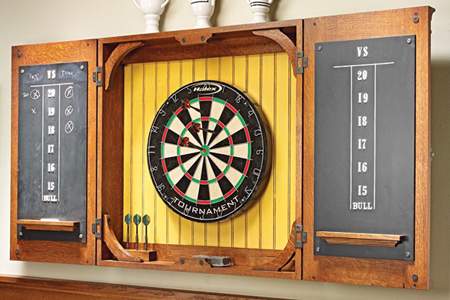
Put your table saw joinery skills to work with our Craftsman-Style Dartboard Cabinet. This classic woodworking project uses simple tongue and dado joints to create a sturdy cabinet with decorative corner brackets, frame-and-panel doors, and a beadboard back. Built-in dart holders and chalkboard scoreboards complete the design, making it a great addition to any game room or home bar. Get the step-by-step plans and build a handsome cabinet that's as enjoyable to make as it is to use.
GET THE STEP-BY-STEP WOODWORKING PLANS → Build a Craftsman-Style Dartboard Cabinet


