


A portable drill guide is a handy option when you need the accuracy of a drill press but can’t bring the workpiece to the machine. It helps keep the drill bit aligned and makes it easier to bore straight, consistent holes.
There is one thing about many drill guides that I find frustrating, though: The base is pretty small.
That narrow footprint makes the guide easier to tip as you're positioning the drill or starting a hole. If the guide shifts, the bit moves with it — potentially putting your carefully laid-out hole in the wrong place.
I solved the problem with a simple shop-made plywood base. While I was at it, I added a few extra features that make the drill guide even more useful.

Add a Wider Base to the Drill Guide
The main purpose of this upgrade is simple: Give the drill guide a larger, more stable footprint.
The particular drill guide shown here already has four tapped holes in its base designed to accept 1/4"-20 screws. That made attaching my plywood base straightforward.
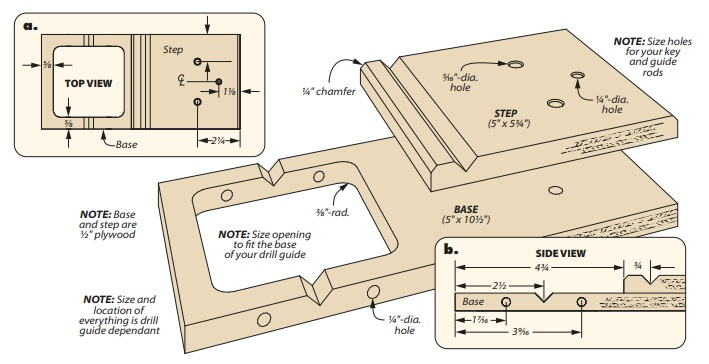
I cut a piece of plywood large enough to extend beyond the original base and fastened the drill guide to it with screws.
That extra surface area makes a noticeable difference. Instead of balancing on the relatively small factory base, the drill guide now sits securely on a much broader platform.
The wider base makes it easier to position the bit accurately on a layout mark and helps prevent the guide from tipping as you begin drilling.
Note: Drill guide designs vary, so you'll need to adapt the mounting method and screw locations to your particular model.
Add a V-Groove for Drilling Dowels & Round Stock
Once I had the larger base figured out, I added a raised step across the back.
This does more than reinforce the base. One of its main purposes is to provide a deeper V-groove for drilling round stock.
A V-shaped groove cradles a dowel and helps keep it from rolling as you position the drill guide. The added depth of this groove also allows me to work with dowels that are too large for the V-groove on the drill guide itself.
That makes the modified guide more versatile when drilling centered holes through dowels and other round workpieces.
Build Accessory Storage Into the Base
The rear step gave me another opportunity to improve the drill guide: a convenient place to store the accessories that go with it.
I drilled three holes into the back of the step. Two hold the guide rods, while the third provides a dedicated storage spot for the drill chuck key.
A slight chamfer around the top of each hole makes it easier to drop the rods and chuck key into place. I simply used a countersink bit to create the chamfers.
Now the accessories stay with the drill guide instead of disappearing into a drawer or getting buried somewhere on the workbench.
A Simple Upgrade for a More Useful Drill Guide
This is the kind of shop upgrade I like: It doesn't require much material or time, but it addresses several shortcomings at once.
The wider plywood base improves stability, helping prevent the drill guide from tipping or shifting while you work. The V-groove provides better support for drilling larger dowels, and the built-in holes keep the guide rods and chuck key organized.
Best of all, the whole modification requires little more than a scrap of plywood and a few screws.
If you use a portable drill guide for drilling dowels, installing hardware, boring joinery, or simply drilling straight holes where a drill press isn't practical, this simple base can make an already useful tool easier and more accurate to use.


