


A world powered by steam and imagination; steampunk is a subgenre that feels both familiar and alien. It combines the elegance of the Victorian era with the bold creativity of speculative technology, creating a society where steam powers impossible machines and brass gears tick beneath every surface.
It’s a world that feels concurrently ancient and futuristic; one that never existed but, somehow creates the perception that it once could, or rather should have. The term “steampunk” was coined in the 1980s by science fiction writer K.W. Jeter who was seeking a general term that represented the subgenre of science fiction he and his peers were writing at the time.
 The Walt Disney Company,1954 The Walt Disney Company,1954 |
| Captain Nemo’s submarine, the Nautilus, from the 1954 Walt Disney version of 20,000 Leagues Under the Sea is what inspired Chris Fitch’s version you see above. |
However, the aesthetic and storytelling ancestory that inspired these later works stretch back much further. 19th-century writers such as Mary Shelley, Jules Verne, and H.G. Wells laid the groundwork with visions of unorthodox science experiments, submarines, airships, time machines, and journeys to the moon long before these things were techincally feasible.
These fantastical narratives established the core tension that defines the aesthetic and genre as we know it today: advanced imagination constrained by steam-age materials.
AESTHETIC & THEMES
Steampunk’s visual identity is unmistakable. The aesthetics blend the style of the Victorian era with the grit of the Industrial Revolution, creating a look that is both nostalgic and imaginative. It’s comprised of brass, riveted iron, hand-tooled leather, polished wood, steam valves, and intricate clockwork. And unlike the technology of today, the materials and mechanics are exposed and even celebrated in their composition.
Many of the visualizations and aspects of steampunk design emphasize a balance between form and function. Garments combine period silhouettes, such as corsets and waistcoats, with functional accessories like goggles and tool belts, suggesting a world where invention was woven into the fabric of everyday life.
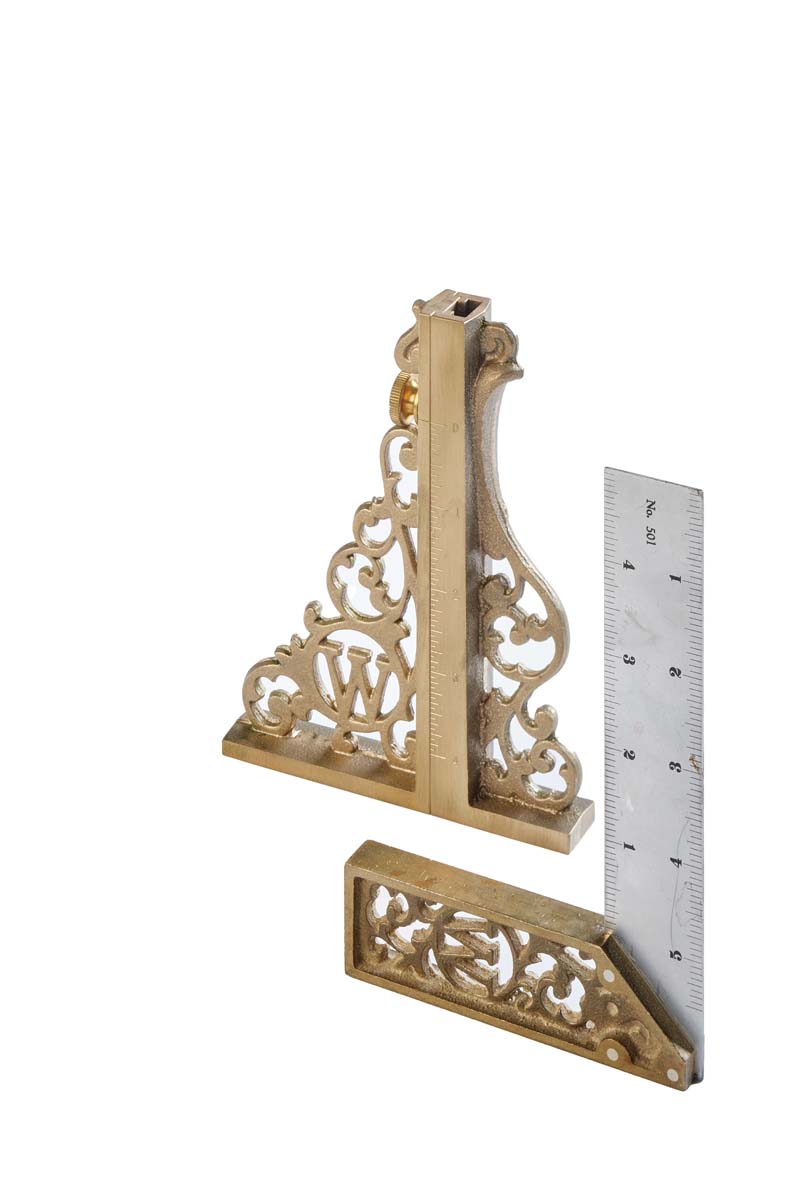 |
| The setup gauge and 6" square are reminiscent of Victorian era decorative brackets. |
Narratives present within the steampunk genre often follow a hero’s journey, which takes form as an adventure quest — think, Phileas Fogg in Around the World In 80 Days, or Captain Nemo in 20,000 Leagues Under the Sea. Themes often explore the struggle between human agency and systems of control in a rapidly mechanizing world. The societies that are depicted are usually in flux or at a crossroads. Steam-driven machines promise efficiency and power while simultaneously threatening autonomy, tradition, and moral responsibility.
Another common theme is struggle for power. Authority — regardless of its form — is frequently challenged by the benighted or “outsider” who values curiosity, freedom, and ethical restraint. Through this lens, steampunk uses imagined pasts to reflect on modern anxieties about surveillance, automation, and who ultimately controls and benefits from this progress.
INFLUENCE IN DESIGN
Beyond just a literary genre; steampunk is a visual and conceptual language that has influenced art and design across disciplines. It has offered designers a way to explore technology, nostalgia, and craftsmanship in an age dominated by digital distraction. Its influence can be seen in illustration, interior design, architecture, graphic design, fashion, industrial design, and interactive media.
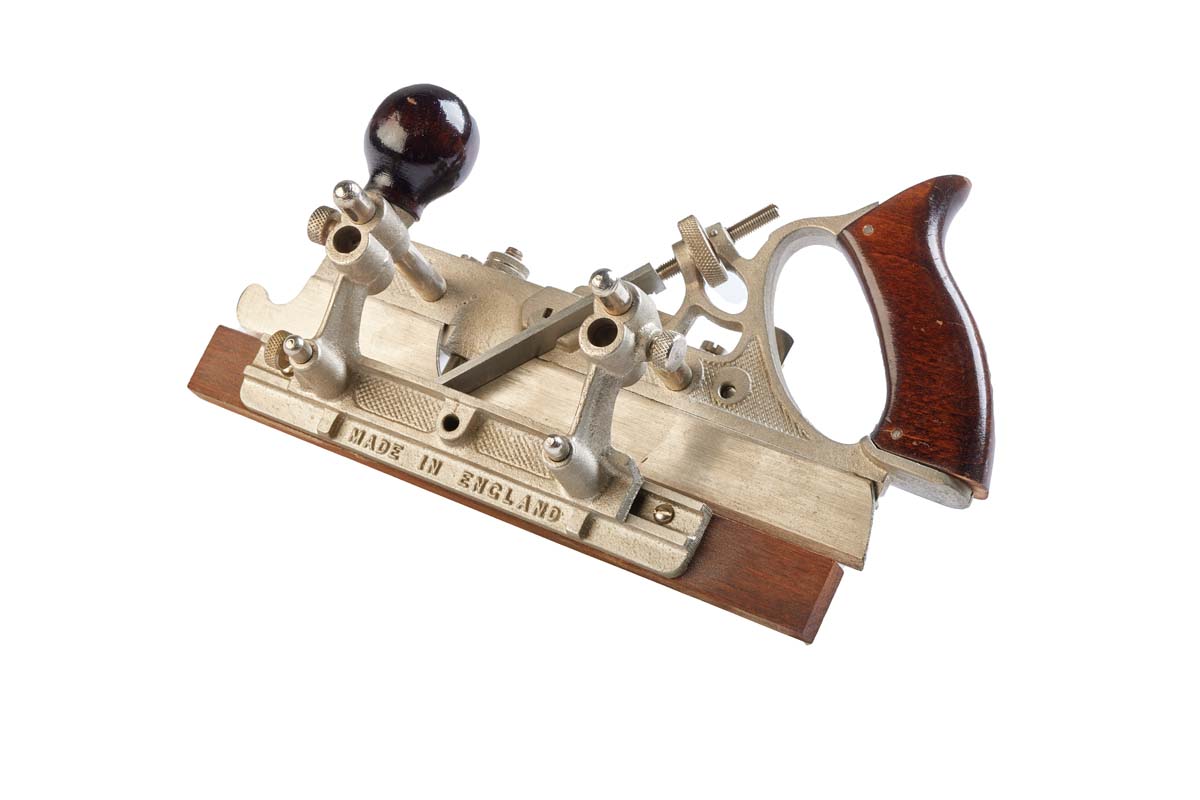 |
| The Stanley No. 45 combination plane, both iconic and versatile, isn’t shy about its material composition and functionality. |
The combination plane here, along with the setup gauge and square, above — although not direct descendants — are suggestive of steampunk tenets. The plane’s utility is on full display with its cast iron body and steel skate, contrasted by the rosewood handle. Prior to the creation of the No.45, planes were wooden and task-specific. This new, innovative modular design challenged this by introducing a single metal platform with interchangeable components.
The setup gauge and square were originally designed for a line of Woodsmith products. Although not of the era, both integrate decorative elements associated with steampunk into their construction to make something both visually interesting as well as highly functional.
While often rare at full-scale, there are examples of steampunk principles employed in architecture. Renovated interior spaces adopt steampunk-adjacent aesthetics: exposed brick, steel beams, visible duct work, piping, and mechanical fixtures act as decorative elements.
 Frédéric Beaumont, Paris Metro Station Arts et Métiers Frédéric Beaumont, Paris Metro Station Arts et Métiers |
| Métro Arts et Métiers in Paris was renovated to celebrate the bicentennial for the French National Conservatory. Inspired by the works of Jules Verne, Platform 11 is adorned with copper plated walls, rivets, massive cogs, and port holes. |
The photo here is a quintessential demonstration of these principals. Platform 11 at the Paris Métro Station looks as if it were a blueprint pulled straight from the pages of a Jules Verne fantasy.
In addition to architecture and interior spaces, steampunk’s influence can be translated into industrial objects that occupy these spaces as well. The image to the right is an example by furniture designer Chris Martin designed/built as part of a series called, Articulation.
 Chris Martin, Critter Chris Martin, Critter |
| This floor standing lamp, called “critter” by Chris Martin, was inspired by articulating toys, but, embodies steampunk aesthetics. |
This breadth of work, though inspired by the industrial environment in which Chris grew up, combines and manipulates materials in a way that hints to the genre. Not only is this piece’s functionality on full display, its construction implies a sense of motion. It reminds me of the Tripod (Martian Fighting Machine) from War of the Worlds.
THE GENRE THAT ENDURES
The question remains: why does a subgenre that is so obstenibly niche and dated continue to be a relevant one? Especially considering we have entered a technological age that seems antithetical to its ethos. In an age dominated by sleek, minimalist technology, steampunk offers something refreshingly tangible.
It reminds us of a bygone society where machines were objects of admiration that existed in tandem with their human counterparts, rather than against them. One where gears visibly turned and invention felt more Chris Martin, Critter like a personal craft rather than an opaque corporate endeavor.
Furthermore, it speaks directly to modern anxieties about technology, identity, and the future — while offering an optimistic, more human-centered alternative to what progress can look like. Steampunk continues to be culturally relevant because it taps into a universal desire: the wish to explore worlds that never were, but easily could have.
It’s a genre that celebrates curiosity, creativity, and the fundamental belief that even the most fantastical ideas can be brought to life with enough imagination and the right amount of gears.


