


Space-Saving Tool Stations for Your Workshop
Benchtop woodworking tools have two big advantages: They're generally affordable, and they don't take up much room. But there's a catch. Once you add a thickness planer, benchtop grinder, scroll saw, and a few other machines, finding enough space to store and use everything becomes a challenge.
Even though each tool only requires a few square feet, those small footprints add up quickly.
The solution isn't necessarily a bigger shop. Sometimes, it's simply a matter of making your tool stands and storage spaces work a little harder.
Here are four practical ideas for getting more use from the space you already have.
1. Flip-Top Tool Stand: Two Tools in One Space
One of the easiest ways to save workshop space is to mount two benchtop tools on a single stand.
A flip-top tool stand does exactly that.
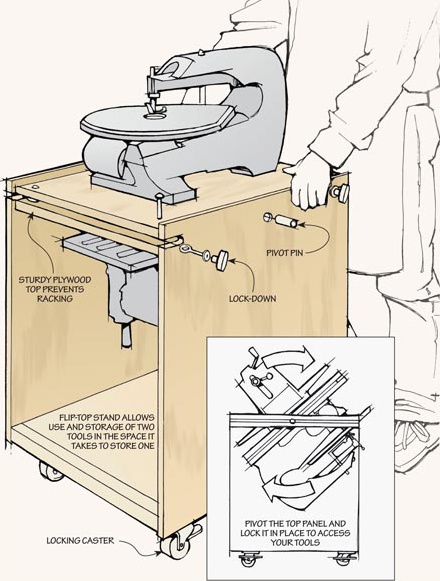
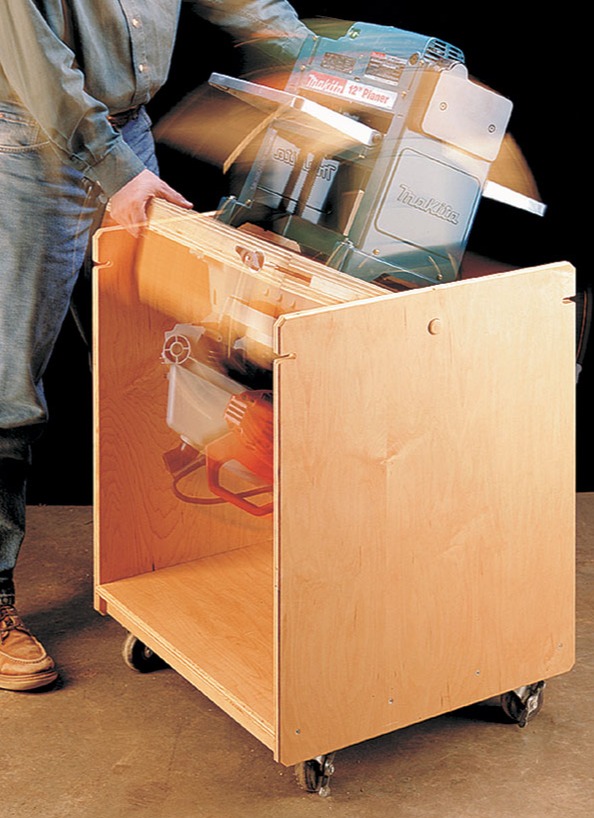
The stand features a rotating top that allows you to mount a tool on each side. When you want to switch tools, simply release the locking knobs, rotate the top 180°, and secure it again.
Locking knobs at the corners hold the top firmly in position during use.
A set of locking casters makes the stand mobile, so you can roll it into position when needed and move it out of the way afterward.
Instead of dedicating two separate stands to your benchtop tools, you get two tool stations in the footprint of one.
WOODSMITH TIP: Match the Tools to the Stand. When choosing tools for a flip-top stand, consider their combined weight, mounting requirements, and overall height. Both tools need to clear the stand as the top rotates, and the locking mechanism must hold the selected tool securely during use.
2. Pull-Out Tool Shelf: Store Heavy Tools Under Your Workbench
Not every workshop has room for another tool stand. If floor space is already limited, consider making better use of the area beneath your workbench.
A pull-out tool shelf provides a convenient place to store a heavy benchtop machine, such as a thickness planer, without having to lift it onto the bench every time you need it.
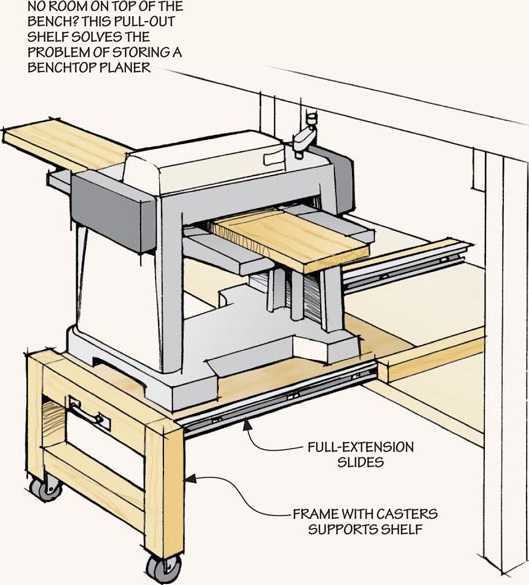
The shelf is made from 3⁄4" plywood and rides on a pair of full-extension drawer slides.
A hardwood support frame with two fixed casters at the outer end provides additional support as the shelf moves in and out.
When it's time to use the tool, simply pull the shelf into position. The workbench top remains available as a convenient staging area for workpieces.
Once you're finished, slide the tool back beneath the bench.
This arrangement is especially useful for tools that are too heavy or awkward to move by hand.
WOODSMITH TIP: Check the Weight Capacity. Make sure the drawer slides and support frame are rated for the combined weight of the tool and shelf. The extended shelf must remain stable during operation, so provide adequate support and secure the assembly against unwanted movement.
3. Add Wheels to an Existing Tool Stand
If you've already built several basic tool stands, there's no need to start over just to make them mobile.
A few simple modifications can turn a stationary stand into one that's easy to move around the shop.
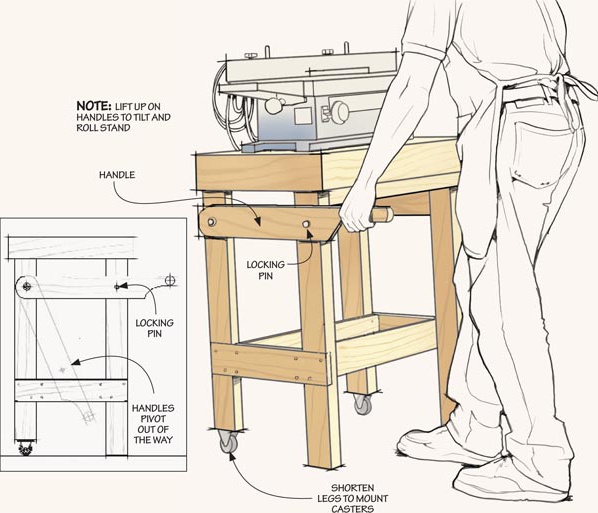
The first step is to shorten the rear legs and install a pair of fixed casters.
Next, bolt a pair of pivoting wooden handles to the sides of the stand.
The handles fold down when they're not needed. To move the stand, raise and lock the handles in the upright position, then use them to lift and roll the stand.
This arrangement lets the stand rest securely on its legs when you're using the tool, while still making it easy to move when you need more floor space.
It's an inexpensive way to add mobility without replacing a perfectly good tool stand.
4. Compact Tool Stand with Removable Shelves
Sometimes the best way to organize several benchtop tools is to give them a shared storage station.
This compact design combines a convenient worksurface with an open cabinet that holds several tools on removable shelves.
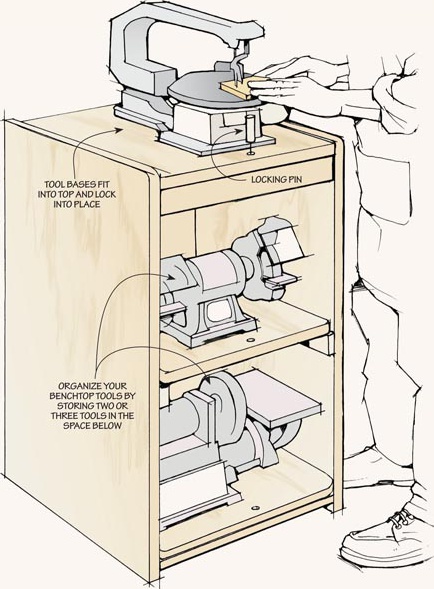
The stand is essentially an open plywood box with individual shelves sized to fit your tools.
When you need to use a machine, remove its shelf and place it on top of the stand. A locating pin locks the shelf and tool securely in position.
Larger machines, such as a scroll saw, can be mounted to a full-depth shelf.
Smaller tools, like a benchtop grinder, may only need a shelf that's half the depth of the cabinet. This allows two tools to be stored within the same compartment.
The result is a compact workstation that keeps several machines organized and ready to use without requiring a separate stand for each one.
Make Every Square Foot Count
A small workshop doesn't have to limit the number of tools you can use. The key is finding ways to share space, improve mobility, and store machines efficiently.
A flip-top stand doubles the usefulness of one tool station. A pull-out shelf takes advantage of unused space beneath your workbench. Simple casters make existing stands easier to move, while a compact cabinet organizes several tools in one location.
With a little planning and a few shop-made upgrades, you can spend less time rearranging your workshop and more time building projects.
Build a Flip-Top Tool Stand
Need a better way to organize your benchtop machines? This Flip-Top Tool Stand lets you mount two tools on opposite sides of a rotating top, so you can switch between them in seconds.
Locking knobs secure the top during use, while casters make it easy to move the stand around your workshop.
GET THE FLIP-TOP TOOL STAND PLANS → Two Tools. One Compact Workstation.
More Small-Shop Storage Ideas
From mobile tool stands to compact workbenches and clever storage solutions, a few well-designed shop projects can help you get more out of a limited space.
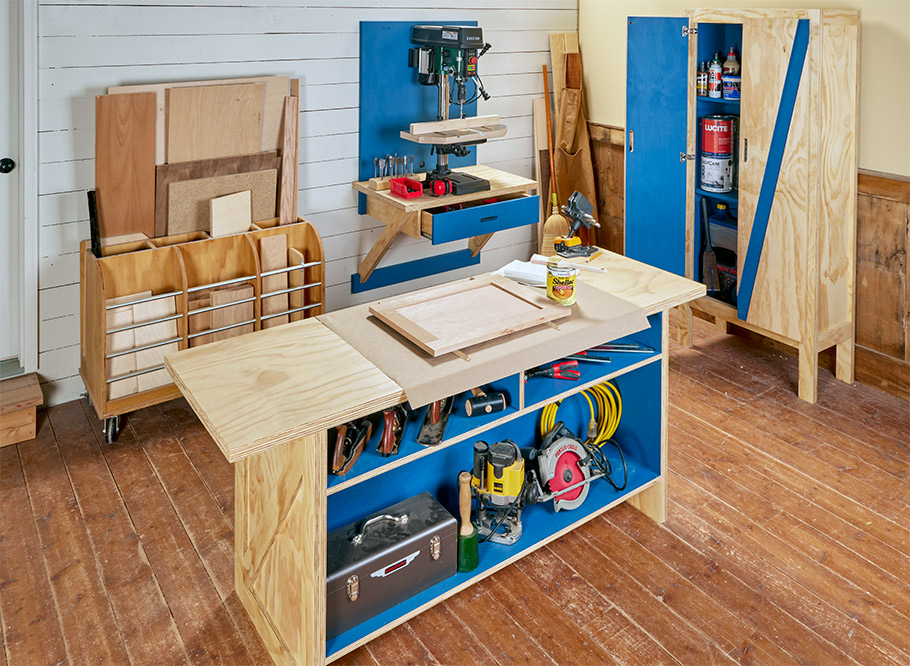
Explore more workshop organization ideas, shop-made tool stands, and space-saving storage projects to keep your tools accessible and your work area clear.
EXPLORE WORKSHOP STORAGE IDEAS → Make Your Workshop Work Smarter


