


How to Cut Identical Parts on a Table Saw with a Stop Block
Cutting project parts to the correct size is one of the first steps in building a cabinet, box, or other woodworking project. But when several pieces need to be exactly the same length, measuring and marking each one individually can lead to small differences.
A simple table saw setup using an auxiliary miter gauge fence and stop block eliminates much of that guesswork. It allows you to cut matching parts quickly, accurately, and consistently.
Start by Cutting Parts to Final Width
Most cabinet cases begin with four main pieces: a top, bottom, and two sides.
Start by cutting the parts to rough length and width, leaving a little extra material for final sizing.
Then use the table saw rip fence to cut the pieces to their finished width. Once that's complete, you're ready to crosscut the parts to their final length.
Add an Auxiliary Fence and Stop Block
Rather than measuring and marking each workpiece, attach an auxiliary fence to your table saw's miter gauge.
Next, install a stop block on the fence. This provides a consistent reference point for positioning each workpiece before making the cut.
Here's the key detail: Make a cut through the auxiliary fence to create a kerf that shows exactly where the saw blade will cut.
Instead of measuring from a mark on the workpiece, measure directly from the stop block to the edge of the kerf. This establishes the finished length accurately.
Make Accurate, Repeatable Crosscuts
With the stop block positioned, place the workpiece against the auxiliary fence and slide it firmly against the stop.
Make the cut using the miter gauge to guide the workpiece through the blade.
Repeat the process for the matching part without changing the stop block position. Both pieces will be cut to the same length.
This technique is especially useful for cabinet sides, shelves, box parts, and other assemblies where matching dimensions are essential.
Better Accuracy with Less Measuring
A stop block and auxiliary miter gauge fence are simple additions that make your table saw more versatile.
By setting the length once and using the same reference for every cut, you can eliminate repeated measuring, reduce errors, and produce accurately sized parts for your next woodworking project.
Featured Project: Craftsman-Style Dartboard Cabinet
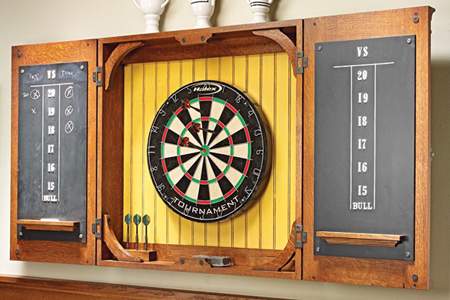
Put your table saw skills to work with our Craftsman-Style Dartboard Cabinet. This classic woodworking project uses simple tongue and dado joints to create a sturdy cabinet with decorative corner brackets, frame-and-panel doors, and a beadboard back. Built-in dart holders and chalkboard scoreboards complete the design, making it a great addition to any game room or home bar. Get the step-by-step plans and build a handsome cabinet that's as enjoyable to make as it is to use.
GET THE STEP-BY-STEP WOODWORKING PLANS → Build a Craftsman-Style Dartboard Cabinet


