



How to Sharpen Chisels and Plane Irons with Diamond Plates
Ask a dozen woodworkers about the best way to sharpen their tools, and you'll probably get a dozen different answers. Some swear by waterstones, others prefer oilstones, and plenty of woodworkers rely on powered sharpening systems.
But when it comes to convenience, speed, and consistent results, diamond sharpening plates are hard to beat.
They're ready to use without soaking, they stay flat during normal sharpening, and they can quickly restore a sharp cutting edge to chisels, plane irons, and other woodworking tools.
With the right selection of grits and a few simple techniques, you can put together a complete sharpening system using diamond plates.
Why Use Diamond Plates for Sharpening?
Diamond plates offer several advantages over traditional sharpening stones.
The first is cutting speed. Diamond is an extremely hard abrasive, allowing the particles to remove steel efficiently.
This makes diamond plates especially useful when restoring a damaged cutting edge, flattening the back of a chisel, or sharpening a plane iron that's become noticeably dull.
No Soaking or Flattening Required
Unlike many waterstones, diamond plates don't need to be soaked before use.
You can start sharpening as soon as you take one off the shelf.
Another advantage is that a quality diamond plate maintains its flat surface during normal use. There's no need to periodically flatten it to remove the hollow that develops in conventional waterstones.
In fact, a coarse diamond plate can be used to flatten other sharpening stones.
Diamond Abrasives Can Sharpen Carbide
Diamond plates are also useful for touching up carbide cutting edges.
A small diamond paddle or file can be used to carefully hone the flat faces of carbide router bit cutters.

For this kind of maintenance, use light pressure and concentrate on the flat cutting faces. Avoid changing the cutter's original geometry.
How Diamond Sharpening Plates Are Made
Traditional oilstones and waterstones are blocks of abrasive material. Diamond plates are different.
Most consist of a rigid metal backing with industrial diamond particles bonded to the working surface.
The diamond layer does the cutting, while the backing provides the flat reference surface needed for accurate sharpening.
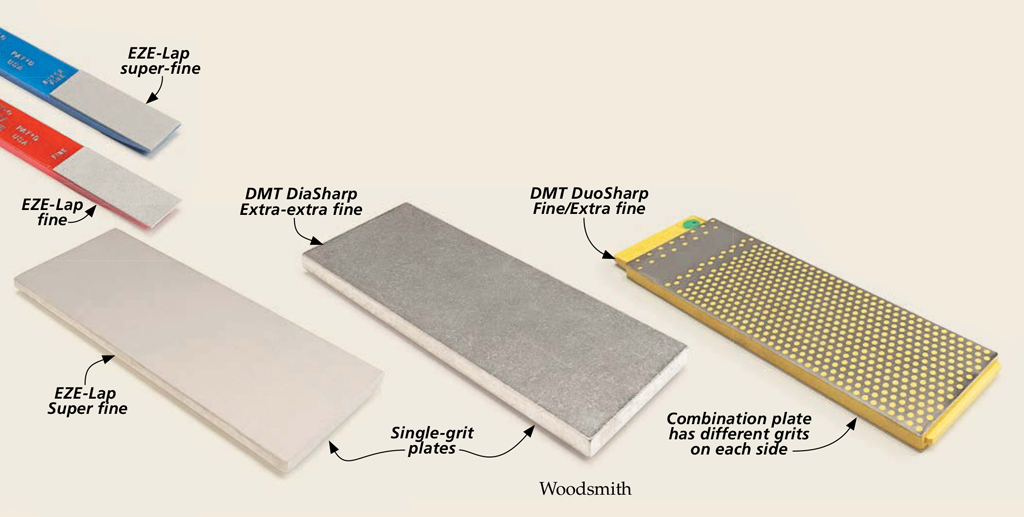
Manufacturers such as DMT and EZE-Lap offer diamond sharpening products in a variety of sizes and abrasive grades.
Choosing Diamond Plate Grits
One of the most common questions about diamond sharpening is which grits you actually need.
The answer depends on the condition of your tools and the type of edge you're trying to produce.
For most woodworking applications, it's useful to have a progression of coarse, fine, and extra-fine abrasives.
| Diamond Plate Grade | Typical Use |
|---|---|
| Coarse | Repairing damaged edges and removing material quickly |
| Fine | General sharpening and restoring a working edge |
| Extra-Fine | Refining the bevel and preparing the edge for final honing |
| Extra-Extra-Fine | Producing a finer, more polished cutting edge |
You don't necessarily need every grade.
For routine sharpening, a fine and extra-fine combination may be enough. A coarse plate becomes especially useful when restoring older tools or correcting damaged bevels.
Understanding Grit and Micron Ratings
Comparing diamond plates with waterstones and oilstones can be confusing.
That's because different abrasive manufacturers use different grading systems.
A plate labeled fine by one manufacturer may not have the same particle size as another product with the same designation.
A more useful comparison is the micron rating, which describes the approximate size of the abrasive particles.
Smaller particles generally produce finer scratches and a more refined cutting edge.
We'll look more closely at these differences in the grit comparison section below.
How to Sharpen a Chisel or Plane Iron with Diamond Plates
The basic sharpening process is much the same as it is with conventional stones.
You can sharpen freehand or use a honing guide to maintain a consistent bevel angle.
Start with the Right Grit
If the cutting edge is damaged or very dull, begin with a coarse plate.
For routine sharpening, start with a fine plate instead.
Hold the tool at its established bevel angle and move it across the diamond surface with smooth, controlled strokes.
One thing to remember is that diamonds cut aggressively.
Use light pressure. There's no need to bear down on the tool to remove metal.
Use a Marker to Check Your Bevel
Here's a simple trick that makes sharpening easier.
Before you begin, color the bevel with a permanent marker.
After a few strokes on the diamond plate, examine the edge.
The areas where the marker has been removed show where the abrasive is making contact.
If you're only removing marker near the heel of the bevel, adjust the angle slightly so the cutting edge contacts the plate.
This is particularly helpful when setting up a honing guide.
Progress to Finer Plates
Once you've established a consistent bevel and raised a small burr along the cutting edge, move to a finer plate.
Use light strokes to refine the bevel and reduce the scratches left by the previous abrasive.
Continue through your chosen grit progression.
For chisels and plane irons, carefully remove the burr by working the flat back of the blade on the appropriate fine abrasive.
A few final strokes on a fine plate or leather strop can help remove any remaining wire edge.
Should You Use Diamond Plates Wet or Dry?
One of the conveniences of diamond plates is that many can be used either wet or dry.
But I prefer using a little lubricant.
For water-compatible plates, a small amount of water with a drop of dishwashing liquid helps carry away the metal particles produced during sharpening.
This keeps the surface from loading up with swarf and makes sharpening feel smoother.
Check the manufacturer's recommendations before choosing a lubricant, particularly if your plate has a backing that could rust.
Clean and Dry the Plates After Sharpening
When you're finished, remove any accumulated metal particles with a brush or cloth.
Then dry the plate thoroughly.
This helps prevent rust from developing on steel components or on the metal particles left behind after sharpening.
It's a quick maintenance step that helps keep your sharpening equipment in good condition.
Why New Diamond Plates May Feel Rough
A new diamond plate can sometimes leave deeper scratches than expected.
That's because some of the diamond particles initially protrude farther above the surface than others.
With normal use, these high points wear in, and the plate typically begins cutting more evenly.
Avoid deliberately applying excessive pressure to speed up the process.
Getting a Finer Edge with Extra-Extra-Fine Diamond Plates

One development that expanded the usefulness of diamond sharpening systems was the introduction of extra-extra-fine plates.
For example, DMT's 3-micron plate provides a much finer abrasive surface than conventional coarse and fine diamond plates.
This allows you to continue refining the bevel without switching to a waterstone.
A 3-micron diamond plate is sometimes compared with an 8000-grit waterstone, although the two grading systems aren't directly interchangeable.
For many everyday woodworking tasks, a slightly coarser edge will perform very well. But if you're sharpening a smoothing plane iron or a fine paring chisel, additional honing can help produce a cleaner cut.
Sharpening Carving Gouges with Diamond Abrasives
Straight chisels and plane irons are relatively easy to sharpen on a flat plate.
Carving gouges present a different challenge because of their curved cutting edges.
A flat abrasive surface can't easily reach every part of the gouge's profile.
One solution is a shaped diamond sharpening tool, such as DMT's Wave.
Its curved surfaces provide both convex and concave profiles, allowing you to sharpen the outside bevel and work along the inside curve of various gouges.
Choose a section that matches the tool's curvature as closely as possible and use light, controlled strokes to maintain the original cutting geometry.
Diamond Plate Grit Comparison: What Do the Numbers Mean?

Comparing sharpening abrasives isn't always straightforward.
The terms coarse, fine, and extra-fine can mean different things depending on the manufacturer and the abrasive system.
For example, a diamond plate, waterstone, and oilstone may all carry different grit ratings even though their abrasive particles are similar in size.
Micron ratings provide another way to understand the differences.
A micron is one-millionth of a meter. The lower the micron rating, the smaller the abrasive particles.
However, particle size alone doesn't tell the whole story. The type of abrasive, how the particles are bonded, and the way the tool is sharpened can all influence the final edge.
For that reason, treat cross-system grit comparisons as approximations rather than exact equivalents.
Are Diamond Sharpening Plates Worth It?
If you're looking for a convenient, low-maintenance sharpening system, diamond plates are worth considering.
They remove metal quickly, require little preparation, and stay flat during normal use.
They're also versatile enough for sharpening chisels, plane irons, and many other woodworking tools.
Start with a couple of useful grits, develop a consistent sharpening routine, and add finer or specialty abrasives as your needs grow.
Once you get comfortable sharpening with diamonds, you may find yourself reaching for them every time an edge needs a quick touch-up.
How to Sharpen a Hand Plane Blade
A sharp blade makes all the difference when smoothing hardwood, trimming joints, or working difficult grain. Learn how to hone a plane iron, polish the back, and remove the wire edge for a clean, reliable cutting edge.
LEARN TO SHARPEN A PLANE BLADE → Get Better Results from Your Hand Planes


