


Some of the most useful shop accessories are also the simplest. Heavy-duty tape can make sanding strips more durable, an index card can help you compare measurements, and a plastic bottle cap can keep drilling debris from falling onto your face.
In this collection of Woodsmith Quick Tips, four readers share practical ideas for sanding turned workpieces, converting measurements, drilling overhead, and supporting projects while finish dries.
1. Reinforce Sandpaper Strips for Sanding Curves and Turned Workpieces

Narrow strips of sandpaper are handy for smoothing curves and sanding turned workpieces. But when you pull a strip back and forth around a curved surface, the paper backing can tear before the abrasive wears out.
Henry Wittmer of Runnells, Iowa, has a simple way to make his sanding strips last longer.
Before cutting the sandpaper into strips, he applies heavy-duty tape to the back of the sheet. The tape reinforces the paper, helping prevent it from ripping during use.
He then cuts the reinforced sheet into strips sized for the task at hand.
It's a quick modification that makes narrow sanding strips more durable and easier to handle.
Woodsmith Tip: When sanding on a lathe, keep the strip short enough that it can't wrap around the workpiece or your hands. Never loop sandpaper around your fingers, and keep loose clothing away from rotating stock.
Shop tip submitted by Henry Wittmer, Runnells, Iowa.
2. Use an Index Card to Compare Imperial and Metric Measurements

If your steel rule has inches on one edge and millimeters on the other, comparing the two scales can be awkward. Trying to line up a measurement by eye can introduce an error, especially when you're working with small dimensions.
Tom Moss of Bradenton, Florida, uses a folded index card as a simple measuring aid.
He folds the card and slips it over the rule, creating a movable reference that spans both measurement scales.

By sliding the card to the measurement he wants to convert, Tom can read the corresponding value on the opposite edge of the rule without having to estimate its position.
It's a handy trick when working from plans that use different measurement systems or checking the metric equivalent of an imperial dimension.
Woodsmith Tip: This method works best when the two scales share the same zero reference. For precise conversions, use the relationship 1" = 25.4 mm.
Shop tip submitted by Tom Moss, Bradenton, Florida.
3. Catch Overhead Drilling Dust with a Plastic Bottle Cap

Drilling overhead can be an uncomfortable job. As the bit cuts into the workpiece, dust and chips fall directly toward your face.
Leslie Nason of Waterford, Wisconsin, found a simple way to catch some of that debris.
Leslie drills a hole through the center of a plastic bottle cap, then slips the cap over the drill bit. During overhead drilling, the cap acts as a small collection cup, catching dust and chips as they fall.
It's an inexpensive accessory that's easy to make from an otherwise disposable item.
Woodsmith Tip: Wear safety glasses when drilling overhead, even when using a dust catcher. Make sure the cap fits securely without interfering with the drill chuck or the workpiece. Use an appropriate dust mask or respirator when the material or drilling conditions call for one.
Shop tip submitted by Leslie Nason, Waterford, Wisconsin.
4. Make DIY Painter's Points with Golf Tees and Pegboard
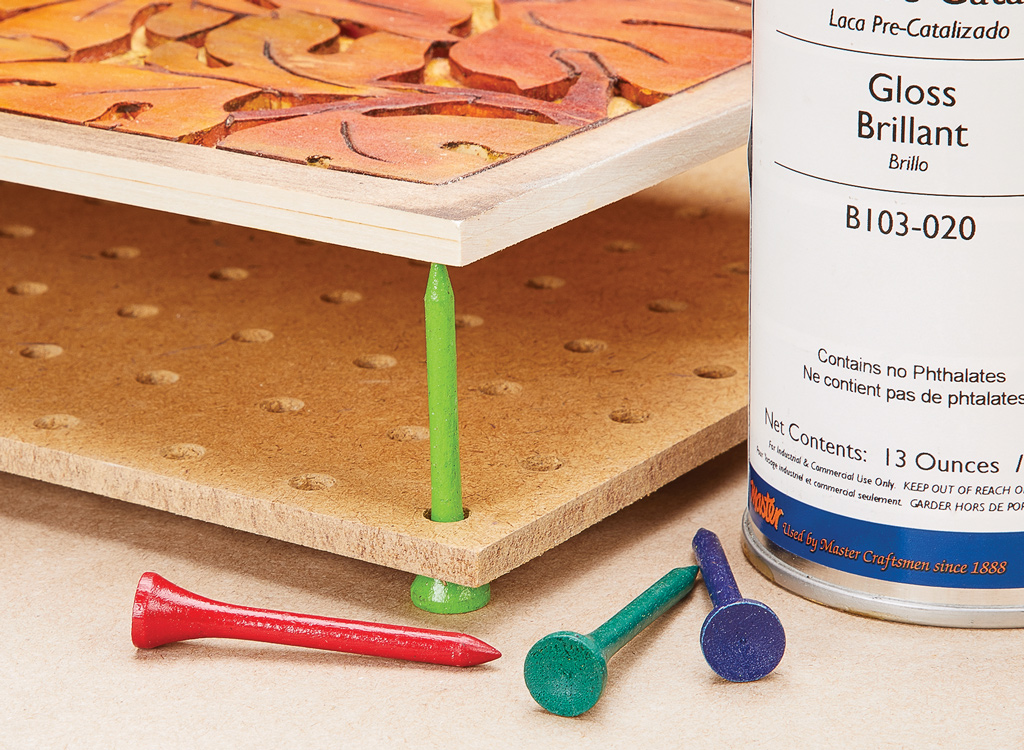
When applying finish to a woodworking project, it helps to raise the workpiece above the bench. This gives you better access to its edges and reduces contact between the freshly finished surface and the worksurface.
Roger Lynne of Bloomington, Minnesota, makes his own painter's points using golf tees and a piece of pegboard.
He inserts the golf tees through the pegboard so their heads rest on the workbench. The pointed ends extend upward, creating small contact points that support the workpiece above the pegboard.
The result is a simple finishing stand that can be adjusted by moving the tees to different holes.
It's an easy way to support small parts during finishing without buying a dedicated set of painter's points.
Woodsmith Tip: Arrange the tees so the workpiece is stable and can't tip. Allow the finish to dry as directed by its manufacturer before placing a freshly coated face against the points, particularly if you want to avoid visible contact marks.
Shop tip submitted by Roger Lynne, Bloomington, Minnesota.
Small Shop Ideas That Make Woodworking Easier
These four reader-submitted tips show how everyday materials can solve familiar woodworking problems. Tape strengthens sanding strips, an index card makes it easier to compare measurements, a bottle cap catches overhead drilling debris, and golf tees provide inexpensive supports for finishing.
They're simple ideas that don't take much time or money to try—and each can come in handy on your next project.


