


How to Make Large Holes in Wood with a Router
Forstner bits are one of the best tools for drilling smooth, accurate holes in wood. They're especially useful for larger holes because they produce clean edges and a flat bottom.
But what happens when the hole you need is larger than the biggest Forstner bit in your collection?
Rather than buying an expensive specialty bit, you can use a handheld router and two common router bits to enlarge an existing hole to the exact diameter you need.
This simple two-step woodworking technique combines a rabbeting bit and a pattern bit to create a smooth, accurately sized hole.
Start with a Forstner Bit to Drill the Hole
Let's say you need to create a 2-1/2"-diameter hole, but your largest Forstner bit is only 2" in diameter.
Start by drilling the 2" hole with your Forstner bit. This creates a clean, round opening that serves as the starting point for the router.
The goal is to enlarge the hole by 1/2" overall, removing 1/4" of material from the edge all the way around.
That's where a rabbeting bit comes in.
Step 1: Enlarge the Hole with a Rabbeting Bit
A rabbeting bit has cutting edges and a guide bearing that controls the width of the rabbet.
Normally, you'd use this bit to cut a rabbet along the edge of a board or panel. But it can also be used to enlarge an existing hole.
For this example, use a rabbeting bit that cuts a 1/4"-wide rabbet.
The bearing follows the inside edge of the original 2" hole while the cutting edges remove an additional 1/4" of material around its circumference.
This increases the diameter of the opening by 1/2", bringing it to the desired 2-1/2" size.
After routing, you'll have a stepped hole. The upper portion is now the correct diameter, but the lower portion still needs to be enlarged.
Woodsmith Tip: The amount you enlarge the hole depends on the width of the rabbet. A 1/4"-wide rabbet increases the overall hole diameter by 1/2" because material is removed from both sides.
Step 2: Finish the Hole with a Pattern Bit
Once you've cut the rabbet, it's time to remove the remaining material and make the hole the same diameter from top to bottom.
For this step, switch to a pattern bit.
A pattern bit has straight cutting edges and a guide bearing positioned near the shank. The bearing is the same diameter as the cutting edges, allowing it to follow an existing surface and duplicate its shape.
In this case, the newly enlarged upper portion of the hole acts as the pattern.
Position the router so the bearing follows the shoulder created by the rabbeting bit. As the bit moves around the opening, its cutting edges remove the remaining material below the shoulder.
The result is a smooth, straight-sided hole that's the full 2-1/2" diameter.
For thicker workpieces, you may need to remove the material in multiple shallow passes, depending on the cutting length of your bit.
Tips for Routing Large, Accurate Holes
A few simple precautions will help you get better results when enlarging holes with a router.
- Secure the workpiece. Clamp it firmly to your workbench so it can't shift while routing.
- Support the router base. Make sure the router has a stable surface to ride on throughout the cut.
- Check the bit and bearing. The rabbeting bit determines how much the hole is enlarged, while the pattern bit follows the newly cut shoulder.
- Work in manageable passes. Avoid removing too much material at once, especially in thick or dense hardwood.
- Check the finished diameter. Measure the opening before moving on to the next step of your project.
Make sure the router bit, bearing, and cutting depth are appropriate for the size and thickness of your workpiece. Keep the router supported and follow the manufacturer's recommendations for safe operation.
A Simple Alternative to Oversized Forstner Bits
You don't need a large collection of specialty drill bits to create accurate holes in wood.
By starting with a smaller Forstner bit and using a rabbeting bit followed by a pattern bit, you can enlarge an existing hole to a precise diameter with tools you may already own.
It's a handy woodworking technique for projects that require large openings, and another way to get more versatility from your handheld router.
Explore More Woodworking Tips & Techniques
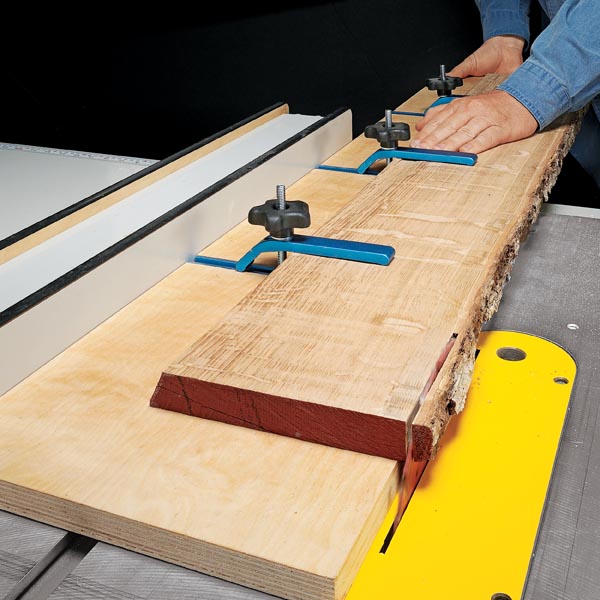
Looking for more clever ways to work smarter in the shop? Explore our collection of woodworking tips and techniques from Woodsmith readers and shop experts. From practical joinery tricks and sharpening advice to finishing techniques, tool improvements, and simple workshop solutions, you'll find plenty of useful ideas to make your next project easier and more enjoyable.
READ MORE → Explore More Woodworking Tips & Techniques


