


DIY Deep-Reach Clamps for Hard-to-Reach Glueups
Every woodworker eventually runs into a clamping job that ordinary bar clamps just can't handle. One common challenge is applying pressure near the center of a wide panel. Most bar clamps have a throat depth of only a few inches, leaving you without a way to reach the joint.
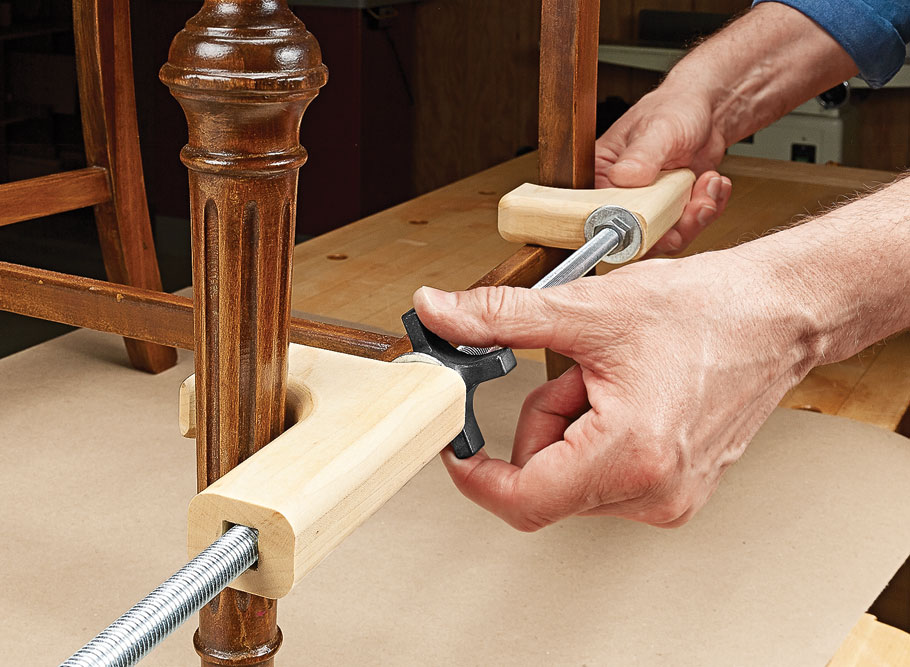
These shop-made deep-reach clamps solve that problem. With long hardwood jaws and a simple screw mechanism, they can apply clamping pressure nearly a foot from the edge of a workpiece. They're especially handy for wide panels and other awkward woodworking glueups.
Best of all, you can build them using straight-grained hardwood and inexpensive hardware-store parts.
Why You Need Deep-Reach Woodworking Clamps
Traditional bar clamps work well for most assembly tasks, but their limited throat depth can become a problem when you need pressure farther from the edge of a workpiece.
A deep-reach clamp extends that working distance, allowing you to apply pressure where an ordinary clamp can't reach.
The design combines features of a traditional C-clamp and a wooden handscrew. Two long, sturdy hardwood jaws provide the reach, while a threaded bolt draws the jaws together to apply pressure.
Unlike a conventional metal C-clamp, these shop-made clamps use wooden jaws that are easy to shape and customize.

Strong Hardwood Jaws Provide Nearly a Foot of Reach
The most important parts of these clamps are the long wooden jaws. They need to be strong enough to resist bending while applying pressure well beyond the edge of a panel.
Straight-grained hard maple is an excellent choice. Its strength and stiffness make it well suited for clamps that will see repeated use in the shop.
The two jaws are nearly identical in shape. The main difference is how they accommodate the clamping bolt.
The lower jaw has a round hole, while the upper jaw features a slot that allows the bolt to move as the jaws open and close.
Shape the Jaws After Drilling
When making the jaws, drill the bolt hole and create the slot before cutting the pieces to their final shape.
Starting with rectangular blanks makes it easier to lay out and drill the hardware openings accurately.
Once the holes and slot are complete, the jaws can be cut to shape and smoothed.

A Simple Clamping Mechanism Using Common Hardware
You don't need specialty clamp hardware to build these deep-reach clamps.
The mechanism uses a few readily available parts:
- 1/2" carriage bolt: Provides the threaded clamping mechanism.
- Coupling nut: Engages the bolt to adjust clamping pressure.
- Washer: Helps distribute pressure at the hardware contact point.
- Surface-mounted hinge: Connects the two hardwood jaws at the rear.
- Shop-made maple handle: Makes the clamp easy to adjust.
Using 1/2" hardware provides a sturdy mechanism suitable for repeated shop use.
The maple handle and coupling nut also help keep the cost down while giving the finished clamp a consistent appearance.
Connecting the Jaws With a Hinge
A surface-mounted hinge joins the two jaws at the back of the clamp.
Although the hinge allows the jaws to pivot, it doesn't have to resist the full clamping force.
When the clamp is tightened, the rear ends of the jaws press together. This reduces the stress on the hinge and its mounting screws.
The arrangement creates a straightforward mechanism that's easy to assemble and maintain.

How to Use Deep-Reach Clamps on Wide Panels
The real advantage of these shop-made clamps is their extended reach.
Position the long jaws around the workpiece, placing the clamping ends directly over the area where pressure is needed.
Turn the wooden handle to tighten the mechanism and bring the jaws together.
Because the jaws extend nearly a foot from the edge, you can apply pressure much farther into a panel than you could with an ordinary bar clamp.
This makes the clamps especially useful when assembling wide workpieces or securing parts that are difficult to reach with conventional clamps.
As with any wooden clamp, apply pressure gradually and use only as much force as necessary to close the joint. The long jaws provide additional reach, but they aren't intended to withstand unlimited clamping pressure.
Build a Set of Shop-Made Woodworking Clamps
One of the advantages of making your own clamps is that you can customize them for the work you do.
These deep-reach clamps are a practical addition to any clamp collection, particularly if you regularly build cabinets, furniture, or projects with wide panels.
And because the design relies on hardwood and common hardware, you can build a set without investing in expensive specialty clamps.
For complete construction details, dimensions, and step-by-step instructions, the 5 Shop-Made Clamps woodworking plan includes these deep-reach clamps along with four other useful clamp designs.
Get the Plans: 5 Shop-Made Clamps
Expand your clamp collection with five practical shop-made designs. These detailed woodworking plans show you how to build specialty clamps for tasks that ordinary clamps can't handle.
GET THE COMPLETE STEP-BY-STEP PLANS ➜ Build 5 Shop-Made Clamps
7 Clever Clamping Tricks for Difficult Woodworking Glueups
Not every challenging glueup requires a specialty clamp. Discover how simple wooden cauls, wedges, cleats, and handscrews can help you apply pressure in hard-to-reach places.
Explore More Clever Woodworking Clamping Tricks ➜ 7 Clever Woodworking Clamping Tricks for Tricky Glueups


