


4 DIY Dust Collection Solutions for Your Woodworking Shop
Sawdust is an unavoidable part of woodworking. Whether you're cutting parts at the table saw, routing profiles, or sanding a project, dust and chips can quickly cover your workbench, collect on the floor, and become airborne.
A good dust collector or shop vacuum helps, but sometimes the biggest challenge is getting the suction close enough to where the dust is created.
Fortunately, you don't need an elaborate dust collection system to make a difference. A few simple, shop-made accessories can help capture more dust at the source using the equipment you already have.
Here are four practical DIY dust collection solutions for some of the most common dust-producing tools in your woodworking shop.
1. Benchtop Dust Collector for Random-Orbit Sanding
A random-orbit sander makes quick work of smoothing wood surfaces, but it also produces a lot of fine dust. Even with a dust collection bag or vacuum attached to the sander, some dust can escape into the surrounding work area.
This simple benchtop dust pickup provides another way to collect that dust.
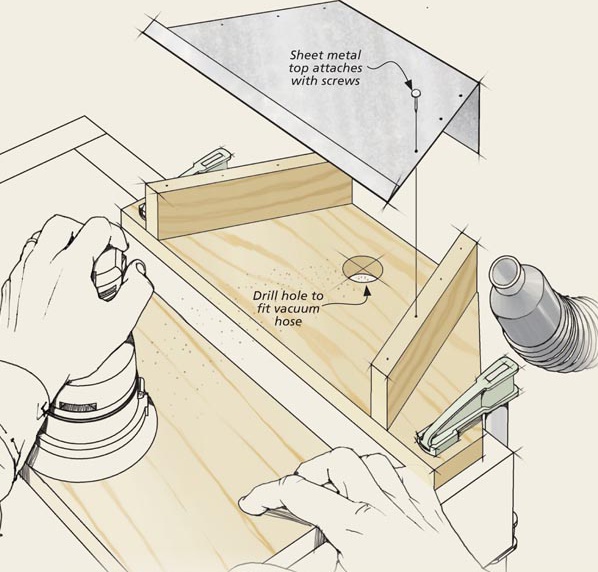
The collector works like a funnel. Two angled sides direct dust toward a vacuum connection at the back, where a shop vacuum draws it away from the sanding area.
Building the Sanding Dust Pickup
The collector consists of a flat base, two tapered side pieces, and a light-gauge sheet metal cover.
Start with a base large enough to support the pickup while leaving room to clamp it securely to your workbench.
Drill a hole near the back to fit your shop vacuum hose. Then cut and miter the ends of the side pieces so they fit against the front and back of the base.
Finally, bend a piece of light-gauge sheet metal over the sides to create the enclosed pickup.
To use it, clamp the collector to your bench, connect the vacuum hose, and position your sanding work near the opening.
The tapered design helps direct airborne sanding dust toward the vacuum inlet.
2. Table Saw Blade Guard Dust Collection
A table saw can generate an impressive amount of sawdust. While a dust collector connected to the saw cabinet captures much of the debris below the table, fine dust can still escape above the blade.
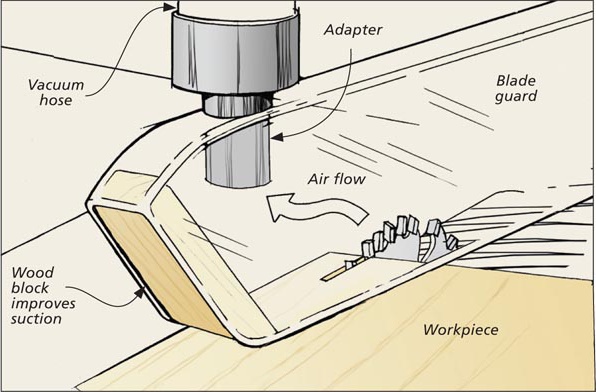
One way to improve dust collection is to add a vacuum connection to the blade guard.
Add Dust Collection Above the Blade
This shop-made modification uses a vacuum hose adapter attached to a suitable blade guard to capture dust near the cutting area.
A block at the front of the guard helps direct airflow toward the vacuum connection, improving dust pickup.
To keep the hose from interfering with your work, suspend it overhead using a hook attached to the ceiling.
The result is a dust collection setup that captures debris above the table while your saw's existing dust collection system handles the material below.
Any modification must preserve the guard's protective function and allow the blade guard to operate properly without interfering with the workpiece or blade.
If your table saw doesn't have a suitable guard, you can build a dedicated overhead dust collection cover.
RELATED PROJECT → Explore the Dust-Free Blade Cover Woodworking Plan
3. Router Table Dust Collection Box
A router table creates dust and chips in two different places. Some debris collects above the table near the fence, while the rest falls beneath the table around the router.
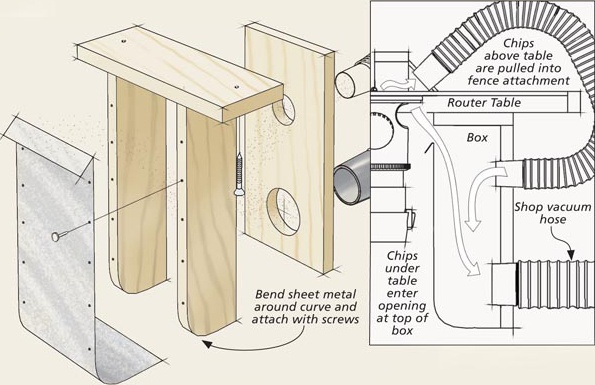
This compact dust collection box helps capture debris from both locations using a single dust collection connection.
Collect Router Chips Above and Below the Table
The box is built from plywood and sheet metal and can be sized to fit your existing router table.
A narrow opening near the top of the box draws chips and dust from around the router base.
A separate hose runs from the box to the router table fence, collecting chips generated above the tabletop.
Both collection points connect to the same dust collection system.
This arrangement provides a convenient way to improve dust pickup without needing separate vacuum connections for the router and fence.
Cut the openings to match your dust collection fittings and position the box so it doesn't interfere with router adjustments or operation.
4. Adjustable Drill Press Sanding Dust Collector
A drill press equipped with a sanding drum is a handy way to smooth curved edges and irregularly shaped workpieces.
The downside is that drum sanding produces fine dust that can quickly spread across the drill press table.
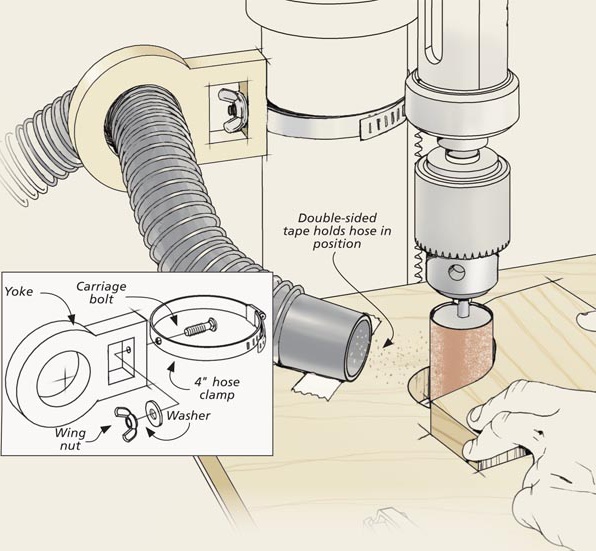
This simple adjustable vacuum hose holder positions suction close to the sanding drum, where it can capture dust as it's generated.
Make an Adjustable Vacuum Hose Holder
The holder consists of a keyhole-shaped yoke cut from 3/4" plywood.
The opening in the yoke supports the end of a shop vacuum hose, while a metal hose clamp secures the assembly to the drill press column.
A carriage bolt and wing nut connect the yoke to the hose clamp, allowing the holder to pivot.
This makes it easy to adjust the hose position for different sanding drums and workpiece shapes.
For best results, position the hose opening near the sanding area while keeping it clear of the rotating drum and workpiece.
It's a simple accessory that makes drum sanding cleaner and more convenient.
Improve Dust Collection with Simple Shop-Made Accessories
Effective woodworking dust collection isn't always about adding a larger collector or more powerful vacuum. Often, improving the way dust is captured at the source can make a noticeable difference.
These four shop-made accessories offer practical ways to control sawdust at your sanding station, table saw, router table, and drill press.
Most can be built with plywood, a few pieces of hardware, and materials you may already have in your shop.
And while better dust collection helps keep your workspace cleaner, it doesn't eliminate every airborne particle. Appropriate respiratory protection and shop air filtration are still important when working with fine wood dust.
A few simple upgrades can go a long way toward making your woodworking shop cleaner and more comfortable.
More Handy Woodworking Tips

Looking for more clever ways to make your woodworking shop work better? From simple tricks for holding workpieces securely to shop-made jigs, storage solutions, and dust collection upgrades, we've gathered some of our favorite practical shop tips. Discover easy, inexpensive ideas that help you work more efficiently, solve common workshop problems, and get more from the tools you already own.
READ MORE → Explore More In the Shop Tips & Techniques


