


Choosing a finish for a woodworking project that will come into contact with food deserves a little extra thought.
A salad bowl, serving board, wooden spoon, and cutting board all encounter food, but they don't necessarily need the same finish. Some are repeatedly washed. Others are cut on with knives. And some simply need protection from occasional spills and moisture.
Fortunately, there are several straightforward finishing options for these projects.
Mineral oil, pure tung oil, walnut oil, raw linseed oil, beeswax, and commercial finishes specifically labeled for food-contact applications are all options worth understanding.
The key is knowing what each finish does — and its limitations.

What Does "Food-Safe Wood Finish" Mean?
The phrase food-safe finish gets used pretty loosely in woodworking.
Rather than assuming a finish is suitable simply because it's fully cured, we prefer a more straightforward approach for projects intended to contact food: Check the manufacturer's current product information and make sure the finish is recommended for your intended use.
That's particularly important with commercial products because similar-sounding finishes can have very different formulations.
Also pay attention to curing time. A finish being dry to the touch doesn't necessarily mean it has reached its full cure.
For cutting boards, utensils, and other surfaces that will receive heavy wear, there's another consideration. You want a finish that's not only appropriate for food contact, but also easy to maintain and renew as the wood is washed and worn.

Mineral Oil: A Simple Choice for Cutting Boards
Food-grade mineral oil is one of the simplest finishes for cutting boards, butcher blocks, wooden utensils, and similar kitchen projects.
It's colorless, odorless, and tasteless. Unlike a drying oil, however, mineral oil doesn't cure into a hardened film.
That's both an advantage and a disadvantage.
Application couldn't be much easier. Apply the oil, allow it to soak into the wood, and wipe away the excess. When the surface begins to look dry after repeated use and washing, apply another coat.
The downside is that mineral oil requires regular maintenance. It doesn't provide the durable film protection you'd get from varnish or another film-forming finish.
For something like a cutting board, that's often a reasonable tradeoff. A finish that's easy to renew makes sense on a surface that's regularly being cut, scrubbed, and washed.
Woodsmith Tip: Look for Food-Grade Mineral Oil. Don't assume that every product labeled "mineral oil" is intended for the same purpose. For kitchen projects, choose a product specifically sold or labeled for food-contact use and follow its directions.
Walnut Oil: A Natural Drying Oil
Walnut oil offers an interesting alternative to mineral oil because it's a drying oil.
Walnut oil sold specifically as a wood finish may be polymerized through heating, which helps it cure more readily.
It's easy to apply and leaves the wood with a natural-looking appearance. Because it cures rather than remaining a non-drying oil, it behaves differently from mineral oil.
It still isn't a heavy-duty protective coating, however, so a walnut-oil finish may need to be renewed as the surface wears.
If you choose walnut oil, use a product specifically intended for finishing and check its labeling for the intended application rather than assuming a grocery-store cooking oil and a woodworking finish are interchangeable.
Raw Linseed Oil
Linseed oil is pressed from flaxseed and has a long history as a wood finish.
But there's an important distinction between raw linseed oil and boiled linseed oil.
Raw or pure linseed oil is the simple form we're talking about here. It penetrates the wood and adds a warm color, but it can cure quite slowly.
Products sold as boiled linseed oil may contain additives that accelerate drying, so don't assume that "linseed oil" and "boiled linseed oil" are interchangeable for a food-contact project.
If you want to use linseed oil, check the exact product you're buying and verify that the manufacturer recommends it for your intended application.
Pure Tung Oil
Pure tung oil is another drying oil that can work well on woodworking projects.
It penetrates the wood and cures rather than remaining permanently oily. It also provides useful resistance to moisture once properly applied and cured.
But pay close attention to the word pure.
A can labeled "tung oil finish" isn't necessarily pure tung oil. The name may describe a blended finishing product containing other oils, resins, solvents, or additives.
That doesn't automatically make it a bad finish. It simply means you need to evaluate the actual product rather than relying on the words "tung oil" on the front of the container.
Woodsmith Tip: Read Beyond the Product Name. This applies to more than tung oil. When finishing a food-contact project, read the manufacturer's instructions and intended-use information rather than judging the product solely by its name.
Beeswax and Oil/Wax Finishes
Beeswax is another traditional option for wooden kitchenware.
Rather than using it by itself, beeswax is often blended with an oil such as food-grade mineral oil. The result is an easy-to-apply finish that leaves the wood feeling smooth and provides some moisture resistance.
Application is straightforward. Work a thin coat into the wood, allow it to sit as directed, and buff away the excess.
Like mineral oil, an oil-and-wax finish is easy to renew when the wood begins looking dry. That makes it particularly convenient for cutting boards, serving boards, bowls, and wooden utensils that see regular use.
Why We Avoid Most Cooking Oils
It might seem logical that an oil that's safe to eat would automatically make a good wood finish. That's not necessarily the case.
Common cooking oils such as vegetable, corn, and olive oil aren't our first choice for finishing wood. Many don't cure into a stable finish and can deteriorate over time.
A purpose-made food-contact finish or food-grade mineral oil is a better choice than grabbing an ordinary bottle of cooking oil from the kitchen.
What About "Salad Bowl Finish"?
You'll also find commercial products marketed specifically as salad bowl finish, butcher-block finish, cutting-board finish, or similar names.
These can offer more protection than a simple mineral-oil treatment, depending on their formulation.
But the name alone doesn't tell you what's in the can or how the product should be used.
Some are oil or oil-and-wax blends. Others may contain resins, solvents, or additional ingredients that allow the finish to build more protection.
For that reason, follow the manufacturer's current directions for application, curing time, food contact, and maintenance.
Cutting Boards Are a Special Case
It's useful to separate a cutting board from a wooden serving bowl or decorative serving tray.
A knife repeatedly slices directly into the surface of a cutting board. That wear makes a thick film-forming finish less practical because the film can be scratched and damaged during normal use.
That's one reason simple, renewable finishes such as food-grade mineral oil and compatible oil/wax blends are popular for cutting boards.
They're easy to replenish as the board is washed and used.
A bowl, serving tray, or other food-contact project that isn't routinely cut on may allow other finishing options.
The intended use of the project should help determine the finish.
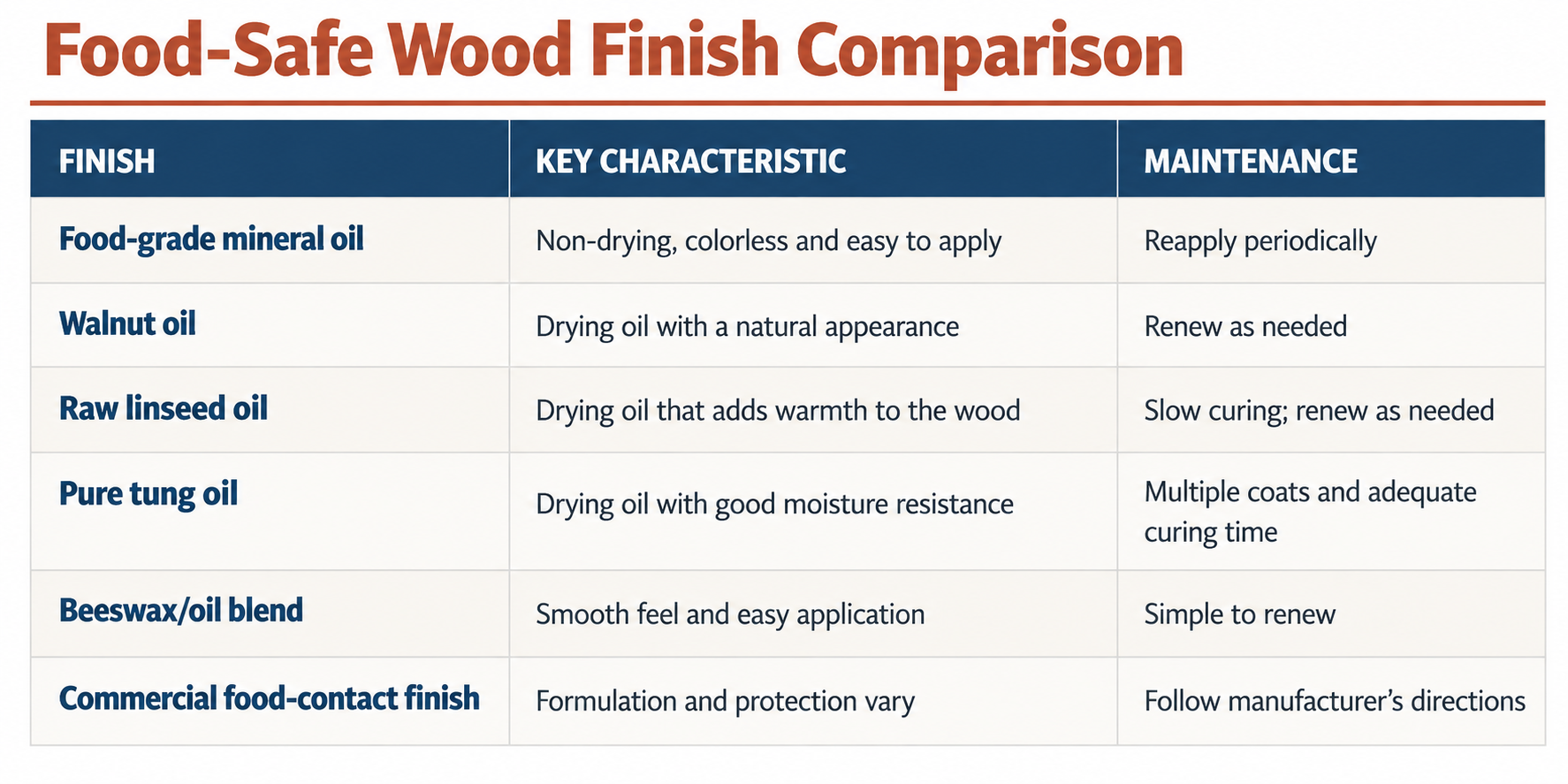
Food-Safe Wood Finish Comparison
Woodsmith Tip: Test the Finish First. Oils can noticeably change the color and figure of wood. Before finishing the entire project, apply some to an offcut from the project and let it cure. You'll get a much better idea of what the finished piece will look like.
How to Restore the Finish on a Wood Bowl
Food-contact finishes don't last forever.
Repeated handling and washing eventually leave bowls, boards, and utensils looking dry and worn. Fortunately, many of these finishes are easy to renew.

Clean the Surface
Start by thoroughly cleaning the wood.
For a bowl that's simply dirty or has accumulated grime, a gentle cleaning may be all that's required before refreshing the finish.
If the surface is badly stained or damaged, sanding may be necessary to expose clean wood.

Allow the wood to dry thoroughly before applying the new finish.
Apply a Fresh Finish
Once the wood is clean and dry, apply the appropriate food-contact finish according to its directions.

With mineral oil or an oil/wax treatment, maintenance is generally straightforward enough that there's no reason to wait until the wood looks severely dried out.
Keep Wood Out of the Dishwasher
Wooden bowls, cutting boards, and utensils generally shouldn't go in the dishwasher.
The combination of prolonged water exposure and heat can be hard on both the finish and the wood itself.
Hand wash the piece instead and allow it to dry before putting it away.
Choosing the Best Finish for a Food-Contact Project
There's no single finish that's right for every piece of wooden kitchenware.
For a cutting board or frequently used utensil, an easily renewable finish such as food-grade mineral oil or a compatible oil-and-wax blend is a practical choice.
For a bowl or other food-contact project, pure drying oils and commercial products intended for the application give you additional options.
Whatever you choose, check the product's current instructions, allow the finish to cure as directed, and consider how the project will actually be used and maintained.
That's a better way to choose a finish than simply looking for the words "food safe" on the front of the container.
Compare Your Other Wood Finish Options
Food-contact projects have some special considerations. For furniture, boxes, cabinets, and other woodworking projects, you have a much wider range of finishes to choose from.
FIND THE RIGHT WOOD FINISH → Best Wood Finish: How to Choose the Right Finish for Any Project


