


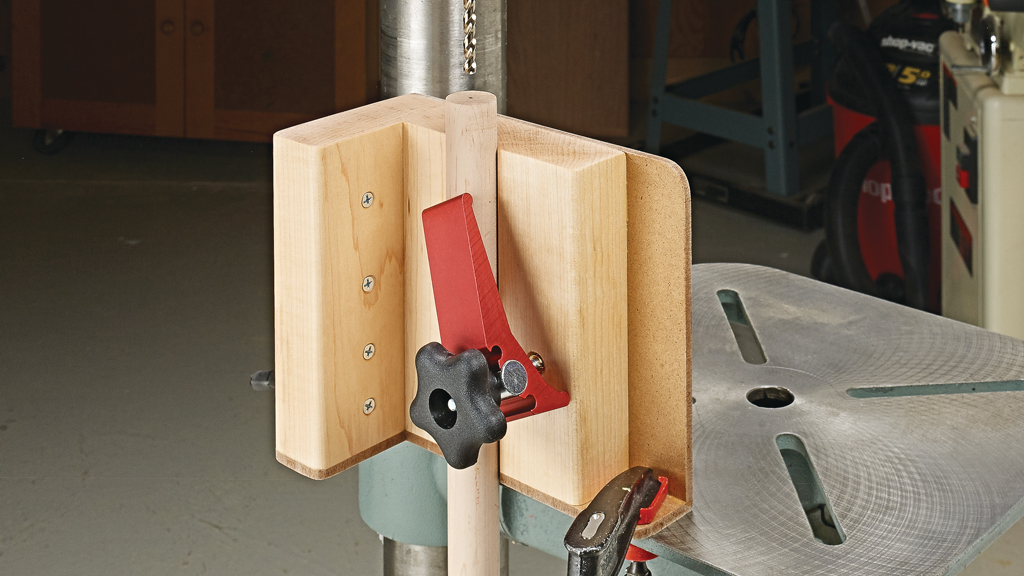
Build a Dowel Drilling Jig for Accurate Centered Holes
Drilling a hole in the center of a dowel sounds simple enough. But even after carefully marking the center, I've found that keeping the drill bit perfectly aligned can be a challenge.
That all changed when I made this handy dowel drilling jig.
The jig does two jobs. It helps locate the exact center of a dowel end and holds the dowel securely while drilling. You can also use it to drill cross holes through round stock.
Best of all, it only takes a few pieces of hardwood and hardboard to build.
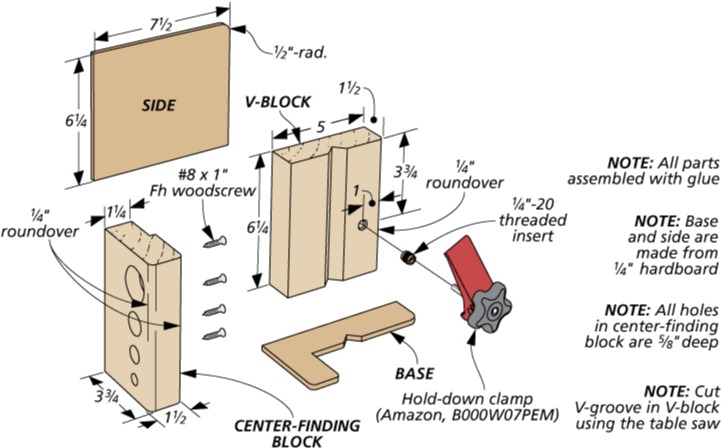
A Simple Jig for Drilling Dowel Ends
The main part of the jig consists of two pieces of thick hardwood stock that form a V-groove.
The V-groove cradles the dowel and prevents it from rolling while you drill.
Two pieces of hardboard provide clamping surfaces, allowing you to hold the dowel firmly in place.
The jig also includes a built-in center finder with four different-sized holes to accommodate the dowel diameters I use most often.
Make the Built-In Dowel Center Finder
The center-finding block is a particularly useful feature.
It has four shallow holes sized to match common dowel diameters. A screw point protrudes slightly into the bottom of each hole to mark the center of the dowel.
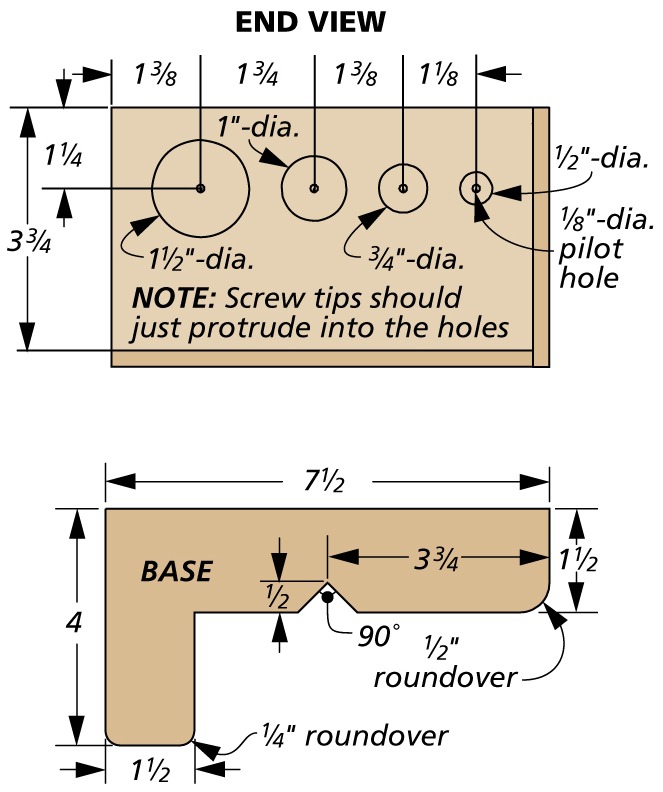
To make the block, start by drilling the shallow recesses with Forstner bits.
The center spur of each Forstner bit leaves a small divot at the bottom of the hole.
Use that divot to locate and drill a through hole for the marking screw.
Install a 1" screw in each hole, adjusting it so the tip just protrudes into the recess.
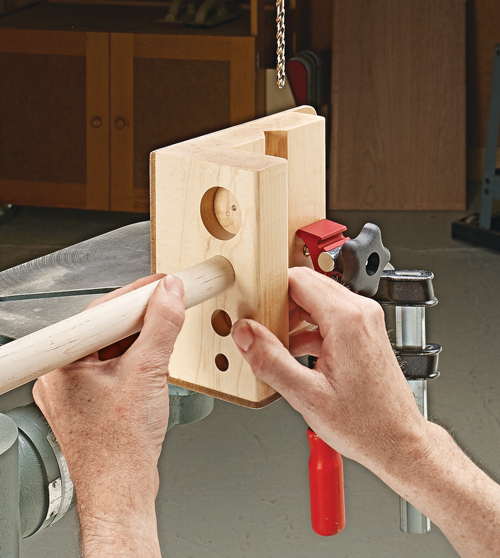
When you press a dowel end into the matching hole, the screw point leaves a small mark at its center.
How to Drill a Centered Hole in a Dowel
Using the jig is straightforward.
First, insert the end of the dowel into the matching hole in the center-finding block. Press the dowel against the screw point to mark its center.
Next, position the dowel in the V-groove and clamp it securely.
With the dowel held in place, align the drill bit with the center mark and drill the hole.
The V-groove keeps the dowel from rolling or shifting while you work.
For the best results, use the jig with a drill press and check that the dowel is properly aligned before drilling.
Drill Cross Holes in Dowels, Too
This jig isn't limited to drilling into the ends of dowels.
You can also use it to drill holes across the diameter of round stock.
Simply lay the jig on its side, clamp it securely to the drill press table, and position the dowel in the V-groove.
The jig holds the round workpiece steady while you drill the cross hole.
Just be sure the workpiece and jig are firmly clamped before starting the drill.
A Handy Addition to Your Drilling Jigs
A centered hole can be difficult to drill in round stock, especially when the dowel wants to roll or shift.
This simple shop-made jig solves both problems by combining a center finder with a secure clamping fixture.
It's an easy project to build from shop scraps, and it's one you'll appreciate whenever you need to drill accurately into the end or side of a dowel.
Horizontal Drilling on the Lathe
Drilling into the end of a long workpiece can be a challenge, even with a drill press. But your wood lathe can provide another solution.

Learn how a simple horizontal drilling jig makes it easier to bore straight, accurately positioned holes in long or awkwardly shaped workpieces.
EXPLORE HORIZONTAL DRILLING → Another Smart Way to Drill Accurate Holes


