



Best Brooms & Brushes for Your Woodworking Shop
A push broom and a bench brush are two of the most frequently used tools in my woodworking shop. Yet they're also two tools I rarely give much thought to — at least until it's time to replace one.
That's when you discover there's more to choosing a shop broom or brush than you might expect.
Some brooms are designed to collect fine sawdust from smooth floors. Others have stiffer bristles that work better on rough concrete or uneven surfaces. And when it comes to cleaning workbenches, carvings, or machinery, the shape of the brush can be just as important as the bristle material.
Choosing the right broom or brush for your woodworking shop comes down to two things: what you're cleaning and the type of surface you're cleaning it from.
Here's what to look for.
Choosing the Best Broom for Sawdust
When shopping for a new workshop broom, start by considering the bristle material and broom width.
The three common bristle materials are synthetic fibers, tampico, and horsehair. Each has advantages depending on the type of floor and debris you're dealing with.
Synthetic Brooms for General Workshop Cleanup
Synthetic brooms are commonly made with polypropylene or polystyrene bristles.
These materials can be manufactured in different stiffnesses and lengths, making them suitable for a variety of floor surfaces.
They're also resistant to many chemicals and cleaning products, which can be useful if your garage doubles as a woodworking shop.
Some synthetic brooms have stiff, blunt-ended bristles for sweeping larger debris. Others have fine, flagged bristles designed to collect smaller particles.
For a general-purpose shop broom, a synthetic model is a practical choice.
Tampico Brooms for Semi-Smooth Floors
Tampico is a natural plant fiber known for its coarse, relatively stiff bristles.
It's a good choice for sweeping semi-smooth floors, where you need enough stiffness to loosen debris without using an overly aggressive broom.
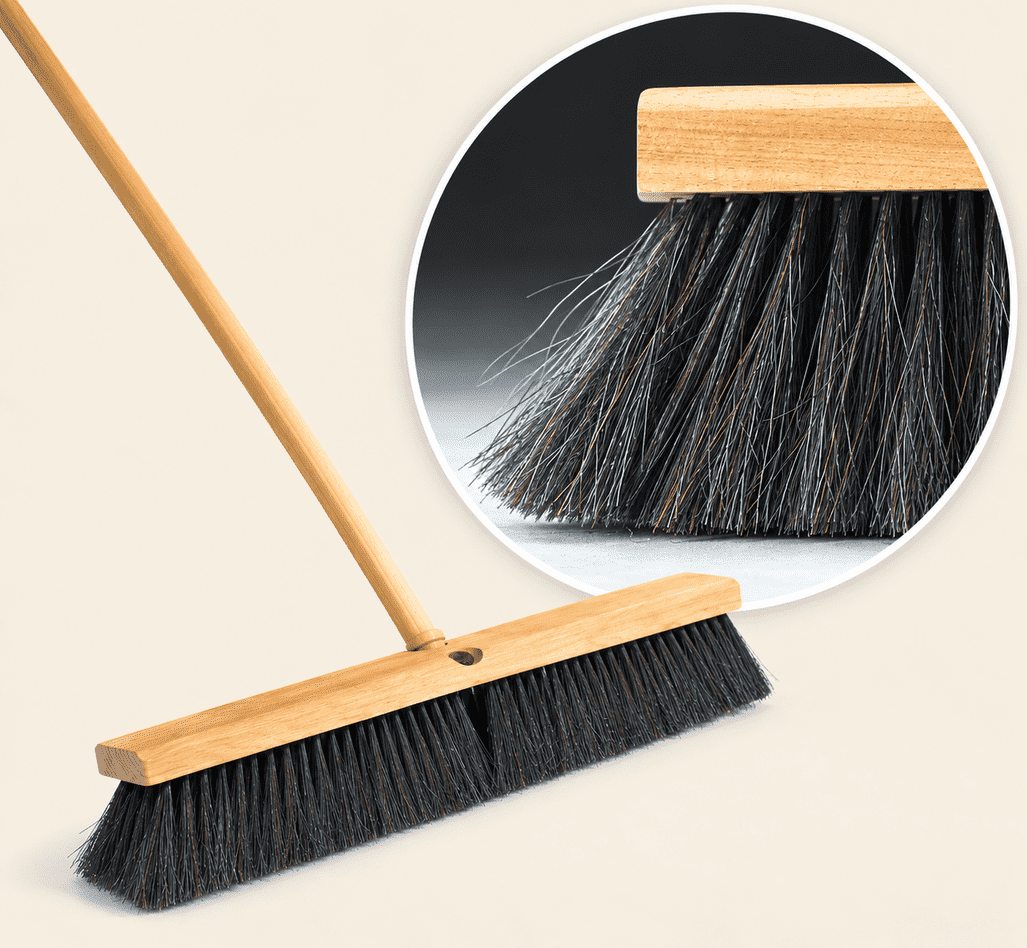
Tampico also resists mild solvents, making it useful in garages and multipurpose workshops.
Some push brooms combine tampico with horsehair or synthetic fibers.
This provides a balance of stiff bristles for larger debris and softer fibers for collecting fine sawdust.
Horsehair Brooms for Fine Sawdust
If your shop has a smooth floor and you want to collect fine sawdust, a horsehair broom is an excellent option.
Horsehair is softer and more flexible than many synthetic or plant fibers.
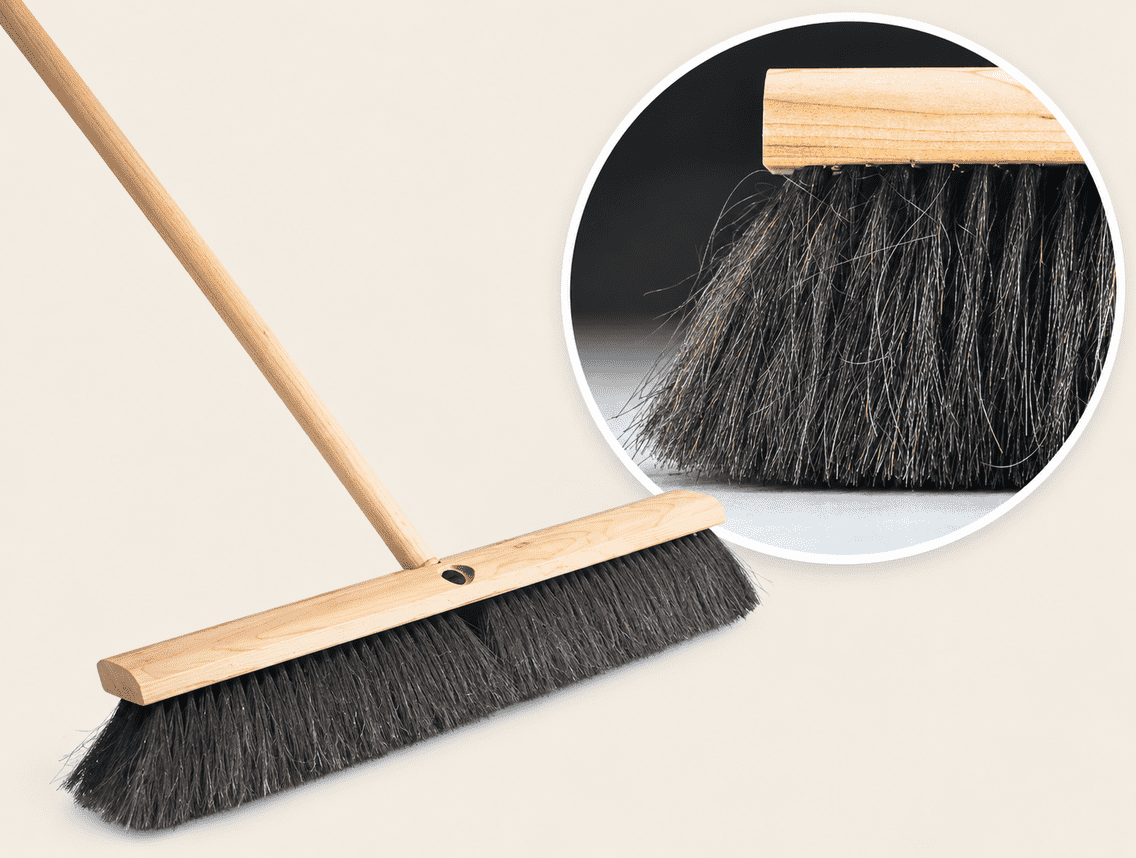
It also has a natural flare at the ends of the bristles, which helps trap small particles of dust and debris.
That makes horsehair particularly effective for sweeping smooth concrete or other finished shop floors.
The soft bristles conform to the surface, gathering fine sawdust that a stiff broom might leave behind.
Multi-Surface Push Brooms for Uneven Shop Floors
Not every woodworking shop has a perfectly smooth floor.
If your floor has cracks, seams, or uneven areas, consider a multi-surface push broom.
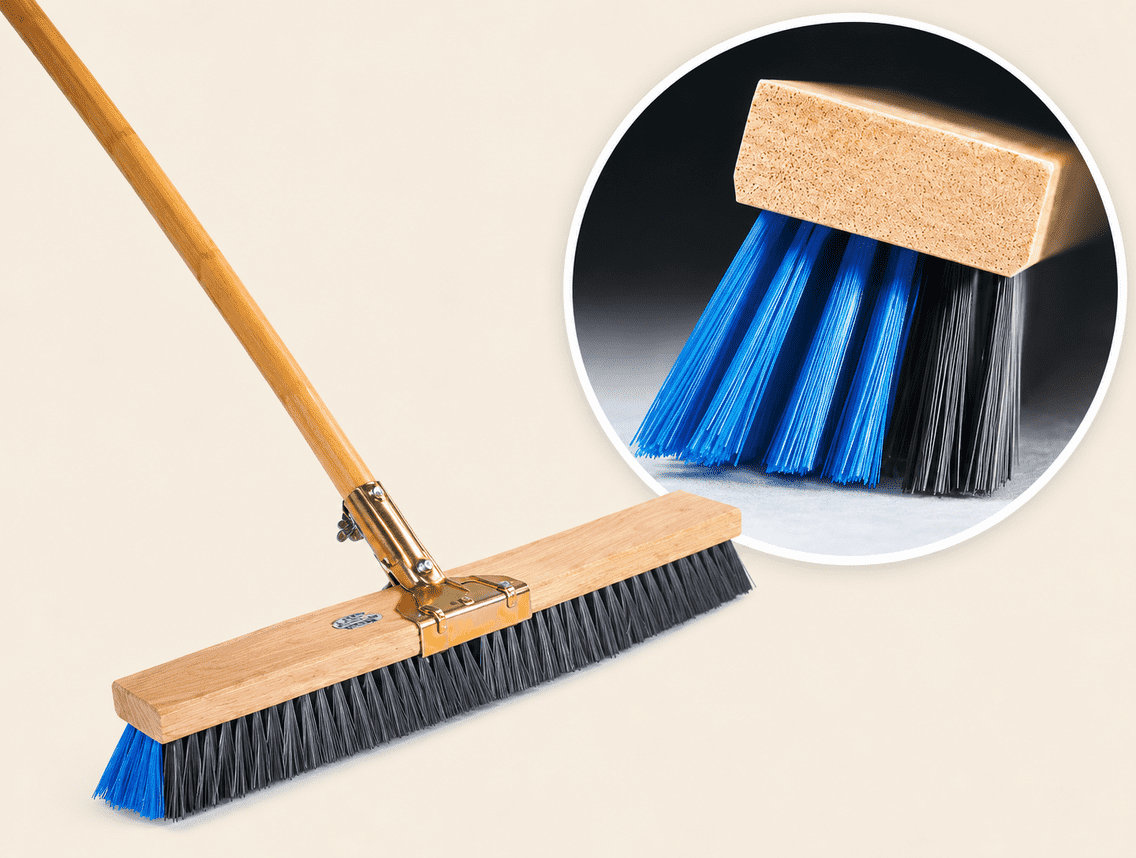
These brooms combine different bristle types to handle both coarse and fine debris.
The front bristles are typically stiffer to loosen larger particles and sweep material out of cracks.
The rear bristles are often longer and flagged to collect fine sawdust.
This combination makes a multi-surface broom a good choice for workshops with older concrete floors or other uneven surfaces.
What Size Push Broom Is Best for a Woodworking Shop?
A wider broom might seem like the obvious choice for cleaning a workshop.
But bigger isn't always better.
For most woodworking shops, I recommend a push broom that's 18" wide or smaller.
An 18" broom is large enough to clean open floor areas efficiently but still manageable around workbenches, machinery, and storage cabinets.
A larger broom can become awkward when you're trying to maneuver between closely spaced tools.
Angle Brooms for Tight Spaces
For cleaning around machinery or between storage cabinets, an angle broom is especially useful.
These brooms typically have a sweeping width of about 9" to 12".
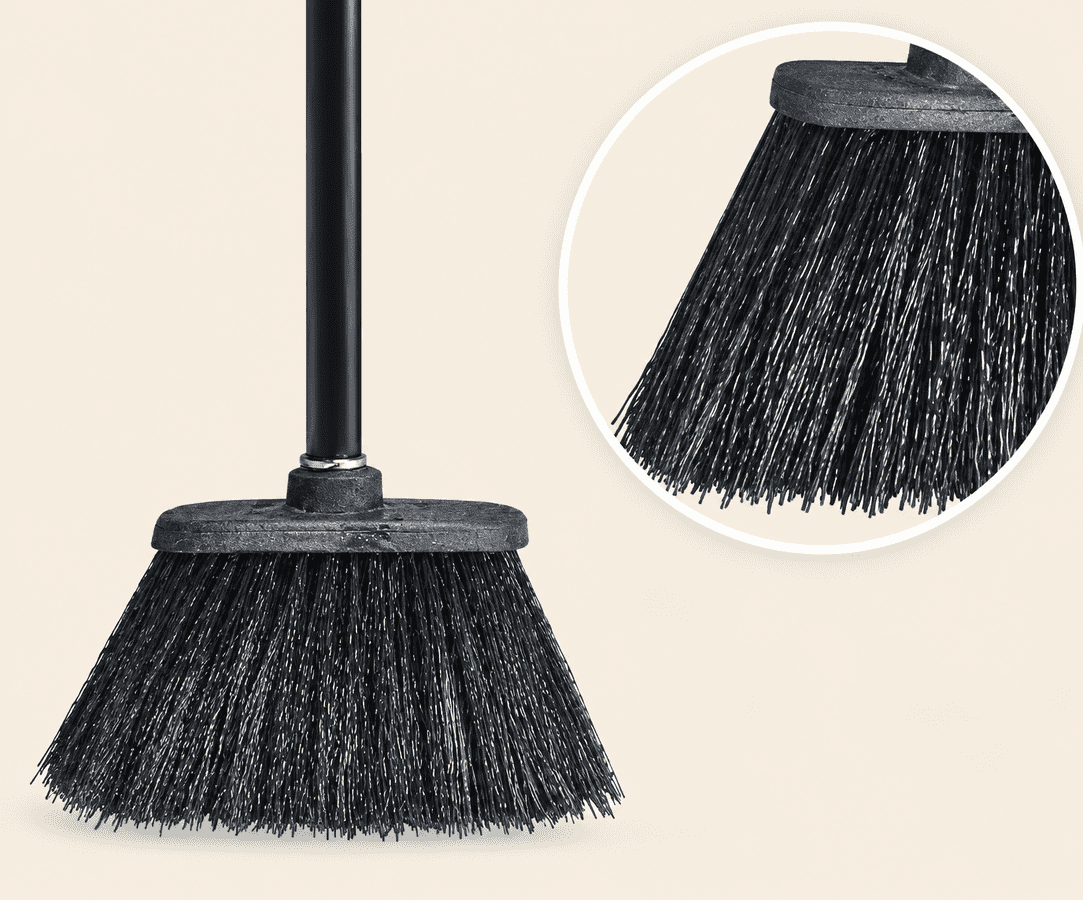
Their angled heads and longer bristles make it easier to reach into corners and narrow spaces.
Most angle brooms use synthetic bristles because the material can provide the stiffness needed at longer lengths.
Choosing the Best Bench Brush for Woodworking
A bench brush is one of those simple tools that quickly becomes indispensable.
It's handy for sweeping sawdust and wood chips off your workbench, cleaning up after hand-tool operations, and removing debris before laying out a new project.
Unlike floor brooms, bench brushes are often distinguished more by their shape than by the type of bristles.
Horsehair and goat hair are popular choices because they're soft enough to use around finished or delicate wood surfaces.
Standard Horsehair Bench Brush
A typical woodworking bench brush measures about 11" long and 2" to 2½" wide.
This size provides a comfortable grip and enough bristle coverage to clean a workbench quickly.

Horsehair is a common choice because its naturally flared bristles pick up fine sawdust effectively.
Synthetic bench brushes are also available. Many use flagged bristles to improve their ability to collect small particles.
For everyday benchtop cleanup, a standard horsehair brush is hard to beat.
Flare-Tip Brushes for Corners and Crevices

A flare-tip brush is particularly useful when cleaning inside corners or other hard-to-reach areas.
The bristles spread outward from the handle, allowing them to reach into places a conventional bench brush might miss.
Soft horsehair bristles help remove sawdust without scratching wood surfaces.

I find this style especially useful for cleaning inside cabinets, around assembled joinery, and in the corners of woodworking projects.
Detail Brushes for Carvings, Inlays & Machinery
Sometimes even a small bench brush is too large for the job.
That's where a dedicated detail brush comes in.
These brushes are designed to clean intricate surfaces, narrow recesses, and small components.
Horsehair Detail Brushes
A small horsehair detail brush, approximately 1" in diameter, is a useful tool for cleaning carved surfaces and decorative details.

The flared bristles are soft enough for delicate woodworking but have enough stiffness to reach into narrow crevices.

They're particularly useful for removing dust from:
- Relief carvings
- Inlays
- Decorative profiles
- Small woodworking parts
- Machinery components
I recommend keeping a separate detail brush for machinery rather than using the same brush on fine woodworking surfaces.
That way, oil and grease picked up from a machine won't be transferred to a project.
Goat Hair Brushes for Delicate Woodworking
Goat hair is even softer and finer than horsehair.
That makes it a good choice for delicate surfaces, including fine carvings and marquetry.
The original brush shown here features a bamboo handle with bristles arranged at varying lengths.
This creates a naturally flagged profile that helps lift fine dust from detailed work.
Goat hair brushes are especially useful when you want to remove dust without disturbing a delicate surface.

Plain vs. Flagged Bristles: What's the Difference?
One detail worth understanding when choosing a broom or brush is the difference between plain and flagged bristles.

Plain Bristles
Plain bristles have relatively blunt ends.
They're generally better suited to scrubbing and moving larger debris, particularly from cracks and crevices.
Many synthetic brooms use plain bristles when stiffness is more important than collecting fine dust.
Flagged Bristles
Flagged bristles have fine, split, or naturally tapered ends.
These ends increase the bristle's ability to collect small particles, making flagged brushes especially useful for sweeping sawdust.
Horsehair and goat hair naturally have fine, tapered ends, while synthetic bristles can be mechanically split to create a similar effect.
For cleaning fine sawdust from smooth surfaces, flagged bristles are usually the better choice.
A Few Shop Cleaning Tools Worth Having
You don't need a large collection of brooms and brushes to keep your woodworking shop clean.
For most shops, a few well-chosen tools will handle the majority of cleanup tasks.
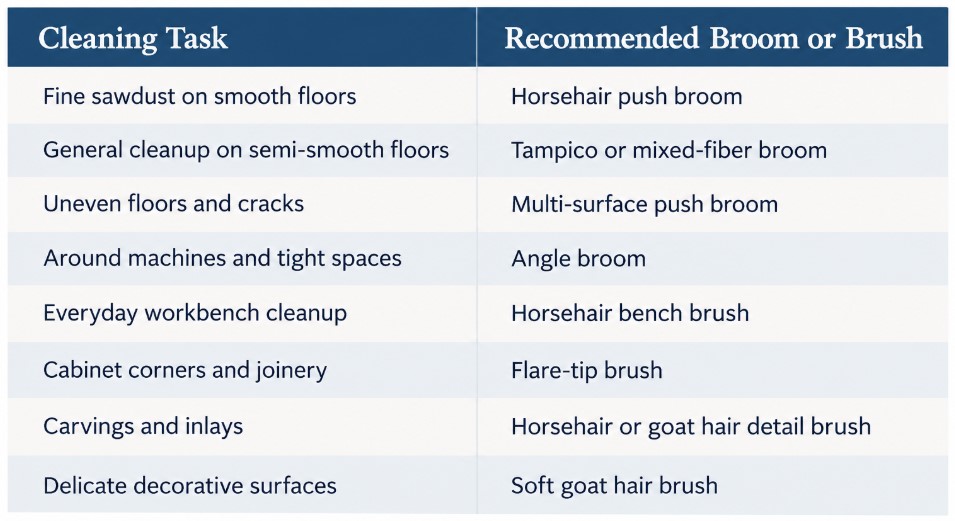
For everyday cleanup, I like having a push broom for the floor and a horsehair bench brush close to my workbench.
A smaller detail brush is also worth keeping in a drawer for cleaning carvings, tight corners, and machinery.
One important reminder: Sweeping and brushing can stir fine wood dust into the air. Use dust collection and a vacuum equipped with suitable fine-dust filtration for thorough cleanup, especially when dealing with very fine sanding dust.
Keep Your Woodworking Shop Clean with the Right Brush
A good broom or brush isn't complicated, but choosing the right one can make shop cleanup much easier.
Horsehair excels at collecting fine sawdust, tampico works well on semi-smooth floors, and synthetic bristles provide versatility for different surfaces.
For workbenches and detailed woodworking, the shape and softness of the brush become especially important.
The next time you need to replace a shop broom or bench brush, take a closer look at the bristles and think about the surfaces you clean most often.
A small investment in the right cleaning tools can make your shop a cleaner, more pleasant place to work.


