



7 Specialty Woodworking Clamps That Solve Tricky Clamping Problems
Most woodworking shops have a collection of bar clamps, pipe clamps, and C-clamps. These everyday workhorses handle everything from panel glue-ups to furniture assembly. But some woodworking tasks are difficult to tackle with conventional clamps.
Gluing up a mitered picture frame, holding an angled joint square, or attaching hardwood edging to plywood can leave you wishing for an extra set of hands.
That's where specialty woodworking clamps come in.
These clamps are designed to solve specific workholding problems. Some apply pressure in unusual directions, while others hold awkwardly shaped parts or keep assemblies aligned during glue-ups.
Here are seven specialty clamps worth considering when standard clamps aren't quite up to the job.
1. Band Clamps for Mitered Boxes and Frames
Gluing up a mitered box can be frustrating. Applying pressure with ordinary bar clamps often causes the pieces to slide out of alignment.
A band clamp provides a simple solution.
Instead of pressing against individual pieces, a band clamp wraps a nylon strap around the entire assembly.
Turning the tightening mechanism draws the strap snug, applying pressure around the perimeter.
This makes it especially useful for assembling boxes with mitered corners.
Band clamps are available in several styles, including versions with corner blocks that help distribute pressure evenly.
Best uses: Mitered boxes, picture frames, polygonal assemblies, and other projects requiring pressure around multiple corners.
Why it's useful: A single clamp can apply pressure around an entire assembly.
2. Cam Clamps for Quick, Light-Duty Clamping
Sometimes you need to hold a workpiece securely without applying a great deal of pressure.
A cam clamp is ideal for these situations.
Instead of using a threaded screw, a cam clamp relies on a lever-operated cam to tighten the jaws.
Simply flip the lever to apply pressure and release it when the job is complete.

This makes cam clamps fast and convenient for repetitive work.
Another advantage is that they're relatively easy to make with deep-reach jaws.
A shop-made cam clamp can provide access to areas that would be difficult to reach with conventional clamps.
Best uses: Light-duty glue-ups, holding delicate parts, and clamping areas that require extra jaw reach.
Why it's useful: Quick operation and the ability to provide deep-reach clamping without complicated hardware.
Want to make your own? Explore our 5 Shop-Made Clamps woodworking plans.
3. Spring Clamps for Temporary Workholding
Spring clamps are inexpensive, simple, and surprisingly versatile.
Their spring-loaded jaws make them easy to operate with one hand, which is especially convenient when you're positioning a workpiece or setting up a jig.
They're useful for everything from holding small parts during glue-ups to securing a temporary stop block on a miter gauge fence.

Spring clamps also come in a wide range of sizes, from small 2" clamps to large models with jaws measuring 10" or more.
Although they don't provide the clamping pressure of a screw-operated clamp, they're excellent for tasks where speed and convenience matter most.
Best uses: Temporary stop blocks, small glue-ups, templates, jigs, and lightweight assemblies.
Why it's useful: Fast, one-handed operation makes it easy to hold parts in place while you work.
4. Frame Clamps for Square Picture Frame Glue-Ups
A band clamp is handy for assembling mitered frames, but a dedicated frame clamp offers another important advantage: individual control over each corner.
Frame clamps typically use threaded rods connected to right-angle corner cauls.

The cauls support the corners while the threaded rods draw the frame together.
By adjusting the clamping pressure at each corner, you can bring the mitered joints together while keeping the frame square.

This is particularly helpful when assembling larger picture frames or other rectangular projects where maintaining accurate 90° corners is essential.
Best uses: Picture frames, mitered rectangular assemblies, and projects requiring precise corner alignment.
Why it's useful: Individual corner adjustments help maintain square during glue-up.
5. Angle Clamps for Holding Joints Square
Keeping two boards aligned at a right angle can be difficult, especially when you're working with large or heavy pieces.
An angle clamp helps solve this problem by gripping each workpiece independently.
The clamp holds the two pieces at 90° while you assemble the joint.

Unlike a conventional bar clamp, an angle clamp isn't designed to pull the mating pieces tightly together.
Instead, its primary purpose is to maintain alignment.
Many designs also leave the ends of the joint accessible, allowing you to install screws or nails while the pieces are held in position.
This makes an angle clamp particularly useful during cabinet and case construction.
Best uses: Cabinet assembly, right-angle joints, and fastening large or awkward workpieces.
Why it's useful: Holds mating pieces square while leaving access for mechanical fasteners.
6. Handscrew Clamps for Odd-Shaped Workpieces
A traditional wooden handscrew clamp is one of the most adaptable workholding tools in the shop.
Unlike most clamps, a handscrew has two independently adjustable threaded screws.
This allows you to position the wooden jaws at different angles.

As a result, a handscrew can grip tapered, angled, or irregularly shaped workpieces that would be difficult to hold with conventional clamps.
Handscrews are also useful for supporting cabinet sides during assembly or holding small parts while routing.
Because the wooden jaws provide a broad gripping surface, they're well suited to a variety of woodworking tasks.
And with a few simple shop-made accessories, a handscrew can serve as a temporary vise, work support, or holding fixture.
Best uses: Tapered parts, odd-shaped workpieces, small routing operations, and cabinet assembly.
Why it's useful: Independently adjustable jaws accommodate shapes that conventional clamps can't easily grip.
7. Edge Clamps for Attaching Hardwood Edging
Gluing hardwood edging to a plywood panel presents a unique clamping challenge.
You need pressure to hold the edging against the plywood edge, but a conventional clamp doesn't always apply that pressure in the right direction.
An edge clamp solves this problem with a three-screw arrangement.
Two screws secure the clamp to the workpiece, while a third screw applies pressure directly against the hardwood edging.
This arrangement allows you to position and tighten the edging without struggling to balance several conventional clamps.

Using three or four edge clamps along a panel can make the glue-up much easier.
They're especially useful for cabinet shelves, tabletops, and other plywood components that receive solid-wood edging.
Best uses: Gluing hardwood edging to plywood shelves, cabinet panels, and furniture components.
Why it's useful: Applies clamping pressure directly against the edge while gripping the panel securely.
Which Specialty Clamp Should You Use?
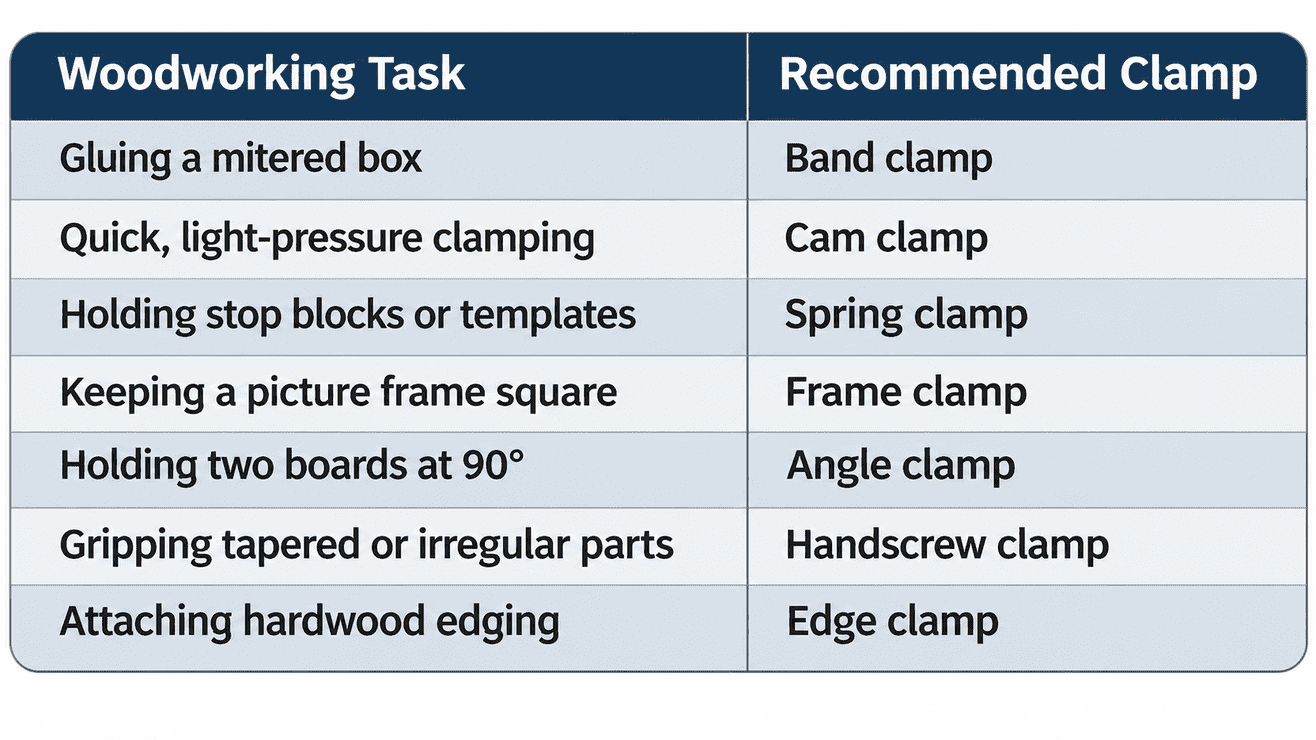
Each specialty clamp solves a different woodworking problem. Here's a quick reference for choosing the right one.
Add Specialty Clamps as Your Projects Demand
You don't need every specialty clamp in your shop. The most useful additions depend on the kinds of projects you build.
If you make a lot of boxes or picture frames, a band clamp or frame clamp can simplify assembly.
For cabinet construction, angle clamps and edge clamps are particularly useful.
And if you frequently work with small, tapered, or unusual parts, a wooden handscrew clamp is hard to beat.
The best approach is to start with a reliable collection of everyday clamps, then add specialty clamps when you encounter a task that requires a different kind of workholding.
Having the right clamp for the job can make tricky glue-ups easier, improve accuracy, and save time in the shop.
Essential Woodworking Clamps for Beginners: What to Buy First

Just getting started in woodworking? Learn which basic clamps belong in your first collection, including F-style bar clamps, pipe clamps, and other everyday workholding essentials.
WATCH THE VIDEO ➜ Explore Essential Woodworking Clamps


