



5 Workshop Task Lighting Ideas for Better Visibility
Good lighting is one of the most overlooked features of a woodworking shop. You can have a well-equipped workshop with plenty of overhead lights and still struggle to see what you're doing when working on detailed joinery, adjusting a machine, or finishing a project.
That's because general shop lighting and task lighting serve different purposes.
Overhead fixtures illuminate the entire workshop, but they can't always reach into the shadowed areas around machinery, inside cabinets, or directly onto a workpiece.
That's where workshop task lighting comes in.
A well-placed task light puts illumination exactly where you need it, making it easier to see layout lines, inspect surfaces, and perform detailed woodworking operations.
Here are five practical lighting options that can make a big difference in your shop.
Why Task Lighting Matters in a Woodworking Shop
Even a shop with good overhead lighting can have dark spots.
The position of a machine, the angle of a workpiece, or even your own body can cast shadows across the area where you're working.
Adding a dedicated task light helps eliminate these problem areas.
For woodworking, task lighting is especially useful when:
- Following layout lines during detailed cutting or shaping
- Setting up machines and checking blade or bit alignment
- Inspecting joints and finished surfaces
- Working inside cabinets or other enclosed spaces
- Carving, sanding, or performing close-up work
LED lighting is especially practical for modern workshops because it provides efficient illumination with relatively little heat.
But the best light isn't necessarily the brightest one. Adjustability, placement, and control over shadows are just as important.

1. Magnetic LED Work Light
One of the most useful task lights in my shop is an adjustable LED lamp with a magnetic base.
The original Rockler LED work light shown here uses a flexible gooseneck that allows you to position the light exactly where you need it.
The gooseneck holds its position, so once you've aimed the light at a workpiece or machine setup, it stays put.
The lamp features 14 LEDs that distribute light across the work area without creating pronounced hot spots.
Why a Magnetic Base Is Handy
The base uses three rare-earth magnets to attach to ferrous metal surfaces.
That makes it especially convenient around woodworking machinery, including the band saw, drill press, and other cast-iron machine tables.
The original light also includes a clamp for attaching it to nonmetallic surfaces.
And because it can operate on batteries or an AC adapter, it offers flexibility in how and where it's used.
Modern magnetic LED work lights offer similar advantages, often with rechargeable batteries, adjustable brightness, and compact designs.
Best use: Machine setup, drill press work, detailed cutting, and other tasks where you need an adjustable light aimed at a specific area.
2. LED Magnifying Work Light
Sometimes you need more than additional light. You also need a closer look at the workpiece.
That's where an illuminated magnifier comes in.
The original Rockler light shown here features an interchangeable head that allows the standard LED lamp to be replaced with a magnifying lens.
The magnifier is surrounded by 18 LEDs that illuminate the work area while enlarging the details you're inspecting.

Better Visibility for Fine Detail Work
A magnifying lamp can be especially useful for detailed woodworking operations, including carving, inlay work, and inspecting small joints.
It's also handy for tool maintenance, where you may want a closer look at a cutting edge or small component.
One drawback I noticed with the original magnifier was that the circular arrangement of LEDs could leave a darker area in the center of the viewing field.
Repositioning the lens helped concentrate the light where I needed it.
When choosing a modern magnifying lamp, look for a stable mounting system, an adjustable arm, and lighting that evenly illuminates the viewing area.
Best use: Carving, inlay work, fine joinery, tool maintenance, and other close-up tasks.
3. Adjustable Gooseneck Work Light
An adjustable gooseneck lamp is one of the simplest ways to add task lighting to a woodworking shop.
The Delta work light shown here uses a traditional incandescent bulb and a flexible neck that allows the light to be directed toward the workpiece.
The magnetic base attaches to ferrous metal machinery, while the gooseneck holds the lamp in position.

A Versatile Light for Machines and Workbenches
The biggest advantage of a gooseneck lamp is its adjustability.
You can bring the light closer to the work, change the angle, and reposition it as needed.
Although incandescent work lights were common when this article originally appeared, LED versions are generally a better choice for most workshops today.
They use less electricity and produce less heat, making them more comfortable to use near your work area.
A clamp-mounted or magnetic LED gooseneck light can be a practical addition to a workbench, drill press, or sharpening station.
Best use: General workbench lighting, machine setup, sharpening, and tasks that benefit from an adjustable light source.
4. Cordless Work Light for Cabinets and Tight Spaces
Some areas of a woodworking project are difficult to illuminate with a fixed light.
For example, when installing hardware inside a cabinet, working beneath a bench, or inspecting an enclosed assembly, overhead lighting may not reach the area at all.
A cordless work light solves that problem.

Many cordless tool systems include compatible work lights that use the same rechargeable batteries as their drills and other power tools.
A swiveling head lets you aim the light into tight spaces, while a freestanding base allows you to position it nearby.
Some models also include hooks or magnetic mounts for additional flexibility.
The main advantage is portability. You can move the light wherever it's needed without worrying about an extension cord.
Best use: Cabinet assembly, hardware installation, machine maintenance, and working in enclosed or hard-to-reach areas.
5. Headlamp for Hands-Free Workshop Lighting
For jobs where you need both hands free, a headlamp is hard to beat.
Originally designed for outdoor activities, headlamps are also useful woodworking accessories.
The Rayovac headlamp shown here features an adjustable headband and a light that pivots to direct illumination toward the work.

Light That Follows Your Work
The biggest advantage of a headlamp is that the light moves with you.
Whether you're adjusting a machine, inspecting a cabinet interior, or searching for a dropped screw, the beam stays directed toward the area you're looking at.
The original Rayovac model featured three brightness settings and operated on three AA batteries.
Modern headlamps offer additional options, including rechargeable batteries, adjustable beams, and multiple brightness levels.
For shop use, I prefer a lightweight headlamp with a comfortable strap and an adjustable beam.
A headlamp is especially useful for occasional maintenance tasks where setting up a separate work light would be inconvenient.
Best use: Machine maintenance, working beneath benches, cabinet installation, and other hands-free tasks.
How to Choose the Best Workshop Task Lighting
The right lighting setup depends on the type of work you do.
A magnetic gooseneck lamp may be ideal for machine setup, while a magnifying light is better suited to detailed carving or inlay work.
For general woodworking, there are a few features worth considering.
Adjustable Positioning
Choose lights that can be aimed directly at the workpiece.
Flexible arms, swiveling heads, and adjustable mounts make it easier to control shadows.
Brightness and Glare
More light isn't always better.
A light that's too bright or aimed directly toward your eyes can create glare that makes detailed work harder to see.
Adjustable brightness is especially useful when switching between different tasks.
Color Accuracy
For finishing and wood selection, look for lighting with good color rendering.
A light with a high color rendering index (CRI) helps you judge wood tones, stains, and finishes more accurately.
Mounting Options
Magnetic bases work well on ferrous metal machinery, while clamps are useful for workbenches and wooden surfaces.
Cordless lights and headlamps offer more flexibility when you need portable illumination.
Always position lights, cords, and magnetic mounts so they cannot interfere with guards, moving parts, or safe machine operation.
Make Your Workshop Brighter Where It Counts
You don't necessarily need to replace all your overhead lighting to improve visibility in the shop.
Often, adding one or two well-positioned task lights can make a noticeable difference.
A magnetic LED light near a machine, a magnifier at the workbench, or a cordless light for cabinet work can help you see details more clearly and work more comfortably.
The key is to put the light where you need it most.
A few smart lighting additions can make your woodworking shop a more practical and enjoyable place to work.
Space-Saving Tool Stations for Your Workshop
Good lighting is just one way to make your woodworking shop more efficient. A well-organized workstation keeps essential tools close at hand and gives you more room to work.
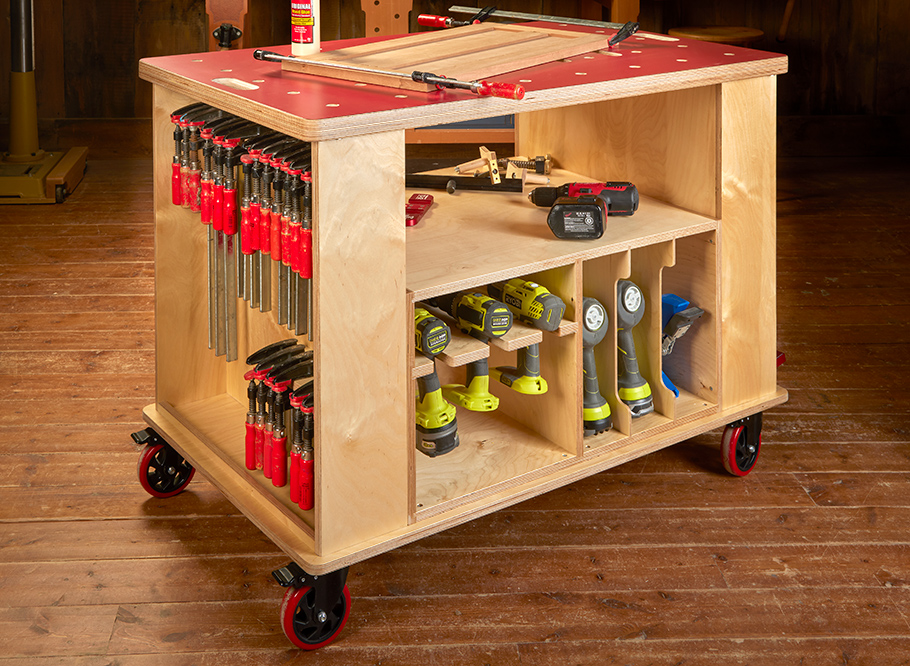
Explore practical space-saving tool stations that help you organize your equipment and make better use of your available shop space.
EXPLORE SPACE-SAVING TOOL STATIONS → Make Every Inch of Your Workshop Work Harder


