



Shop vacs are synonymous with the terms heavy-duty, tough, and rigid. Built to withstand almost anything in their path, these powerful vacuums are vital tools for any woodworker or DIY enthusiast to keep their space at least somewhat tidy.
We asked our tool junky, Deven, to compare his beloved 16-gallon RIGID NXT shop vac with a handful of others and report back with his analysis. Each vacuum was reviewed with candid commentary and his likes and dislikes. Our goal is to help you decide which shop vac is worth your hard-earned money and will bring you the most effective experience.
Our Top Picks
Detailing the Top Picks
Best Overall

Regardless of brand loyalty, I’ve always gone with RIDGID for my shop vac, and their NXT series only confirms my decision.
Offering dual functionality as both a shop vac and a blower, this product, with its large capacity drum and RIDGID’s most powerful motor, promises efficient cleaning performance, which it undoubtedly delivers. The vacuum also boasts a detachable blower, adding to the convenience of its use.
The combination of raw power, versatility, and convenience in one robust package, backed by a lifetime warranty for ensured reliability puts this number one in my garage and on my list!
Pros
- Delivers outstanding suction and blowing capabilities
- 16-gallon drum allows for extensive cleaning without the need for frequent emptying
- Included accessories make cleaning tasks more convenient and efficient
Cons
- Given its large capacity and powerful motor it is bulky and heavy, making it difficult to maneuver in tight spaces
- Like most high-powered vacuums, it is quite noisy during operation
Key Features
Wet/Dry: Yes | Capacity: 16 gallons | Air volume: 161 CFM | Power Source: Corded Electric | Total Reach: 27 feet (20-foot power cord, 7-foot hose) | Product Weight: 27.5 lb
Best Heavy-Duty Vac

Vacmaster’s 12-gallon vacuum is an excellent runner-up pick for someone looking for a shop vac. While I always believe in “the bigger the better” I can’t lie: The 12-gallon size of this vacuum is a great size and still comparable in operation to our top pick.
Featuring 5 Peak HP motors and 210 MPH of blower speed, I noted how well the Vacmaster stood up to the harshest tests like barn and pole barn cleanups. I do wish the extension cord or the hose was longer, but otherwise, there was little that I didn’t appreciate.
Pros
- Excellent suction and blower strength
- Lighter than the first and third options in our list
- When using it, I did notice a little less noise than my RIGID shop vac
Cons
- I wish the power switch was in a different place
- The included flat accessory doesn’t do very much
Key Features
Wet/Dry: Yes | Capacity: 12 gallons | Air volume: 143 CFM | Power Source: Corded Electric | Total Reach: 19 feet (12-foot power cord, 7-foot hose) | Product Weight: 20.5 lb
Best for Homeowners

While not what they once were, I was still happy with the performance of the Craftsman 16-gallon shop vac and still think it’s worth recommending.
The dual flex 180-degree hose that prevents it from kinking is a nice, unique feature that had me considering this vacuum for the number two spot. While these hoses don’t kink as often as a garden hose might, it’s definitely still a reality and a personal fear of mine: If kinked too hard, the plastic might break and lead to the hose being inoperable.
Pros
- More quiet than our number 1 and 2 picks
- No-kink hose allows for optimal performance
- Large liquid export for post-wet vac
Cons
- Like I said before, Craftsman isn’t what it once was
- Would like to see stronger material used
Key Features
Wet/Dry: Yes | Capacity: 16 gallons | Air volume: 130 CFM | Power Source: Corded Electric | Total Reach: 27 feet (20-foot power cord, 7-foot hose) | Product Weight: 26 lb
Best on a Budget

Hard to go wrong with the DeWalt name and hard to find fault with this shop vac when it’s less than $80. With a 5-gallon capacity, I found that it was much easier to maneuver than the top three picks on this list and felt more confident porting it around my shop.
Another shop vacuum with a rotating motion to prevent kinks, I was happy overall with this DeWalt shop vac. I think the lack of suction is negligible when accounting for price and size.
Pros
- Smaller size allowed for easy moving
- Love the washable filters, makes it feel even more bang-for-your-buck
- Makes less noise (but has less suction/blowing power)
Cons
- Not having any on-board storage feels like a huge miss
- Know that you’re getting a less powerful vac!
Key Features
Wet/Dry: Yes | Capacity: 5 gallons | Air volume: 80 CFM | Power Source: Corded Electric | Total Reach: 17 feet (10-foot power cord, 7-foot hose) | Product Weight: 13 lb
Honorable Mention

An extremely affordable option on our list, the workshop is lightweight (under 8 lb) and carries a 2.5-gallon capacity. I always go for the big guns (see the best overall) but I get it: Not everyone needs commercial capability.
I’d define this shop vac as a great tool for those looking for something more heavy-duty than their stick vacuum but not needed in their garage; maybe their basement or indoor patio. I do want to note that there is onboard storage for accessories and attachments, which is key to a great shop vac.
Pros
- Lightweight and was easy to carry
- More capacity than a handheld unit
- Had great success sucking everything from drywall to woodchips
Cons
- Didn’t do as well with carpets and pet hair
Key Features
Wet/Dry: Yes | Capacity: 2.5 gallons | Air volume: 49 CFM | Power Source: Corded Electric | Total Reach: 14 feet (10-foot power cord, 4-foot hose) | Product Weight: 7.25 lb
Also Consider

Stanley built a shop vac that works great indoors and in the car. What stood out about this vacuum is how much more quiet it was than every other selection on this list. While appreciate the portability and low dB levels, the length of the cord leaves a lot to be desired.
While now I have hundreds of feet of extension cords, I think back to my apartment and renting days when I didn’t have a shop vac. Needing to go out and buy something else is a real downer and why it’s my last selection on this list. Still, I like how lightweight the vacuum is and thought that it did a fantastic job sucking up whatever I threw at it.
Pros
- No caster wheels ensure it’s not running off
- Used on the back of a radial arm saw and sucked up the sawdust instantly
- Loved how easier it was to transport
Cons
- The power cord and hose lengths leave a lot to be desired; tough to critique at the price, though
Key Features
Wet/Dry: Yes | Capacity: 3 gallons | Power Source: Corded Electric | Total Reach: 10 feet (6-foot power cord, 4-foot hose) | Product Weight: 8 lb
Finding the Right One for You
Whether you own a workshop in your backyard or work professionally, shop vacs are a must-have. With so many models available, you might get confused about which product will work best for you. Major brands manufacture cordless shop vacs and stackable wet-dry vacuums for various levels of heavy-duty cleanup. Keep reading to choose the shop vac that fits your needs.
Key Considerations for Heavy-Duty Shop Vacs
Size
Large models deliver the quickest and most thorough cleanups, in part because they can hold greater dust, debris, and fluid. Consider the space available and choose the size accordingly.
Don’t believe capacity-claims
It is a common practice that manufacturers overstate the capacity of the shop vacuums, so don’t rely solely on these claims.
Hearing protection
Wet/dry shop vacuums are notoriously loud and can affect your hearing. For example, the Dewalt DXV05P has a noise rating of 75 dBA, which compares to a loud restaurant or your home vacuum. We recommend wearing ear protection to prevent hearing damage and paying attention to noise ratings.
Extra accessories
If you are looking for a shop vacuum for professional and personal use, you should look for models that include accessories. Useful attachments may include a crevice tool to reach tight spots or an extended hose for greater reach. The Vacmaster VBV1210 has the best options and accessories package on our list.
Features to Look For
Here are some basic specs to give you an idea of what you should look for in a wet-dry shop vac.
Power usage
A typical shop vac defines power in terms of horsepower. If you are looking for a shop vac for personal use, it should be at least 1.5 to 3 HP. For a powerful, professional vac, aim for 6+ horsepower.
Sealed suction
Suction capability is measured by the amount of liquid that a wet/dry vac can pull in against certain water pressure. The hose takes a toll on motor performance when submerged in water. We recommend a water lift suction power of around 50 inches.
Noise levels
Shop vacuums will only add to the noise of your workshop. However, there is a misconception that loud or noisy shop vacs are more efficient and powerful. You can find a lot of shop vacs that are powerful and quiet, and low noise levels are a convenient perk of smaller models.
Cord length
Unless you go cordless, you’ll need to plug your shop vac into a power outlet. Therefore, you’ll want a long cord for a hassle-free cleaning experience. Some options on this list include extension cords with your order.
CFM
Shop-vac motors are built to demonstrate performance in terms of CFM or cubic feet per minute. This measures how much air the vacuum cleaner can suck in over a period of time. A non-commercial shop vac should have an airflow rating of around 90 CFM.
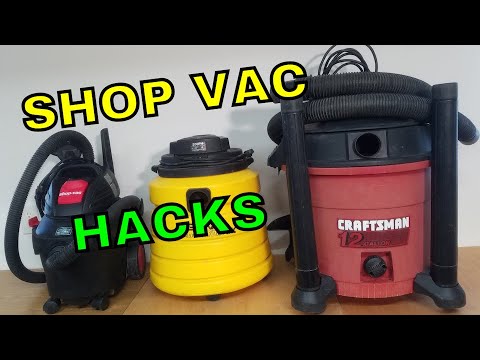
Just like with every machine, a shop vac also needs regular maintenance. You can increase the life of your shop vac with simple modifications that make your machine quieter and save you money on filters. Check the video from House Doctor Ray on some easy DIY upgrade hacks.
How We Chose the Shop Vacs on this List
The best way to choose a shop vac is to do in-depth research, read customer reviews, and check our guide. We strive to provide you with recent and updated information on the products. Here is what we considered while choosing the best shop vacuum.
- Brand reputation
- Customer reviews
- Average price points
- Personal Experience
Common Questions
Is there a difference between a dry and wet vac?
Yes, there is a significant difference between a dry and wet shop vac. A dry vacuum cleaner is primarily used for picking up dry materials like dust, dirt, and small debris. They are often used in residential settings and in areas where there isn't a lot of liquid mess to clean up. Dry vacuums also tend to have enhanced particle filtration systems, making them suitable for dealing with allergens and microscopic particles. On the other hand, a wet vacuum cleaner is designed to pick up wet messes, such as spilled liquids or water from a leak or flood. These types of vacuums can suck up water or other liquids without damaging the vacuum itself. Wet vacuums are also more powerful and provide a larger storage capacity. They can be particularly useful in more industrial settings or for specific jobs that involve a lot of liquid waste. There are also wet/dry vacuum cleaners, which combine the features of both types. These versatile machines can handle both dry debris and liquid messes, making them a great tool for a variety of cleaning tasks. For example, they can efficiently suck up water, sawdust, nails, and screws.
Can shop vacs clean up water?
Yes, a wet/dry shop vac will clean almost any type of liquid, be it water, soda, feces, urine, or anything. However, you must ensure that you have switched it to dry vacuuming. Also, your vacuum should have the necessary filters and other accessories to do the job. A HEPA filter is the best one for this purpose as HEPA filtration offers a special design to filter out harmful allergens.
Are shop vacs and regular vacuums the same?
No, shop vacs are designed for heavy-duty suctioning containing larger pieces of debris, while normal vacs are primarily designed to clean carpets or floors. The regular vacuum will collapse if you try to suction up wooden or metal objects with it, but a shop vac is designed for this type of job.
What is a good horsepower for a shop vac?
It is wiser to look for higher horsepower as it translates to the shop vacs’ overall performance. Cheaper models can also boast a higher horsepower, but they will come with low-quality bearings and windings. A horsepower of 2 is the minimum requirement for a shop vac.


