


During this episode, my big question for listeners is how to organize the inside of a tool chest I built last year. It's based off a plan from Woodsmith. Called Grandpa's Tool Chest, it was modeled after one that belonged to the grandfather of Woodsmith founder Don Peschke.
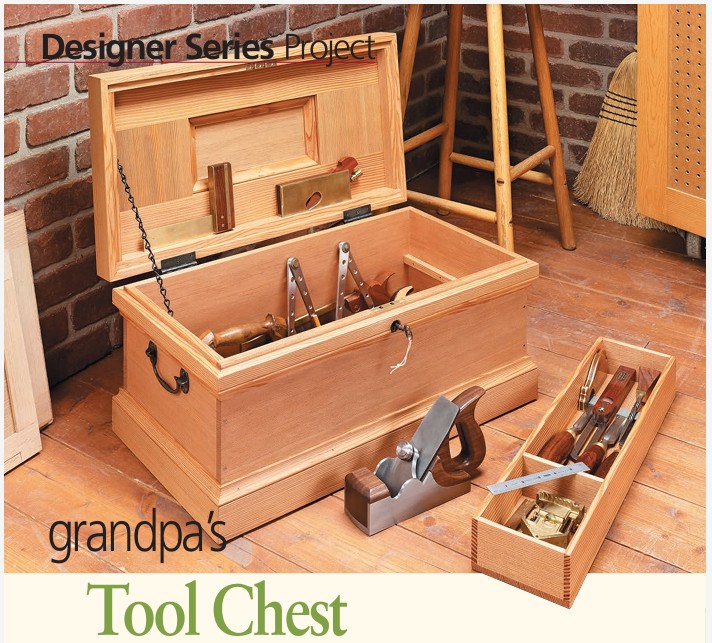
Right now, it's an empty pine box, which sounds a lot like some kind of tool coffin. I'd like to organize the tools and gear I need for easier access. The tools should be protected from incidental damage, too. The interior measures 22" long x 10.5" wide and 9" deep. It's light weight and the size is just right in many ways for the needs I have:
Events: For events like Woodworking In America, presenations, or classes I teach, I like to bring along a set of my own tools, props, and other gear.
Shop On the Go: I also like to help friends and family with projects away from my workshop. In those cases, a select group of tools makes me feel more comfortable and to work better. Additionally, I take tools from my home shop for lunch time projects here at Woodsmith or for particular photos or video projects.
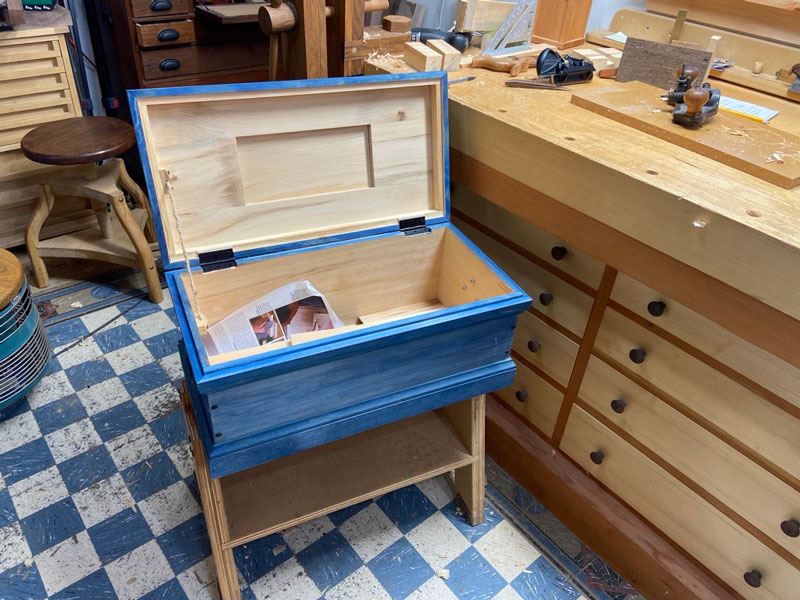
In my shop, my tools live in a large, rolling tool cabinet, so the tool chest isn't a permanent home for anything. A lot of times, chests like these become alters to hand tools. Many woodworkers use both unpowered tools and small power tools interchangeably. Mike Pekovich's new book Benchwork outlines a couple small tool chests. He offers plans and advice for creating custom tool holders and organizers. Reading his book gave me a kick to fit out my chest.
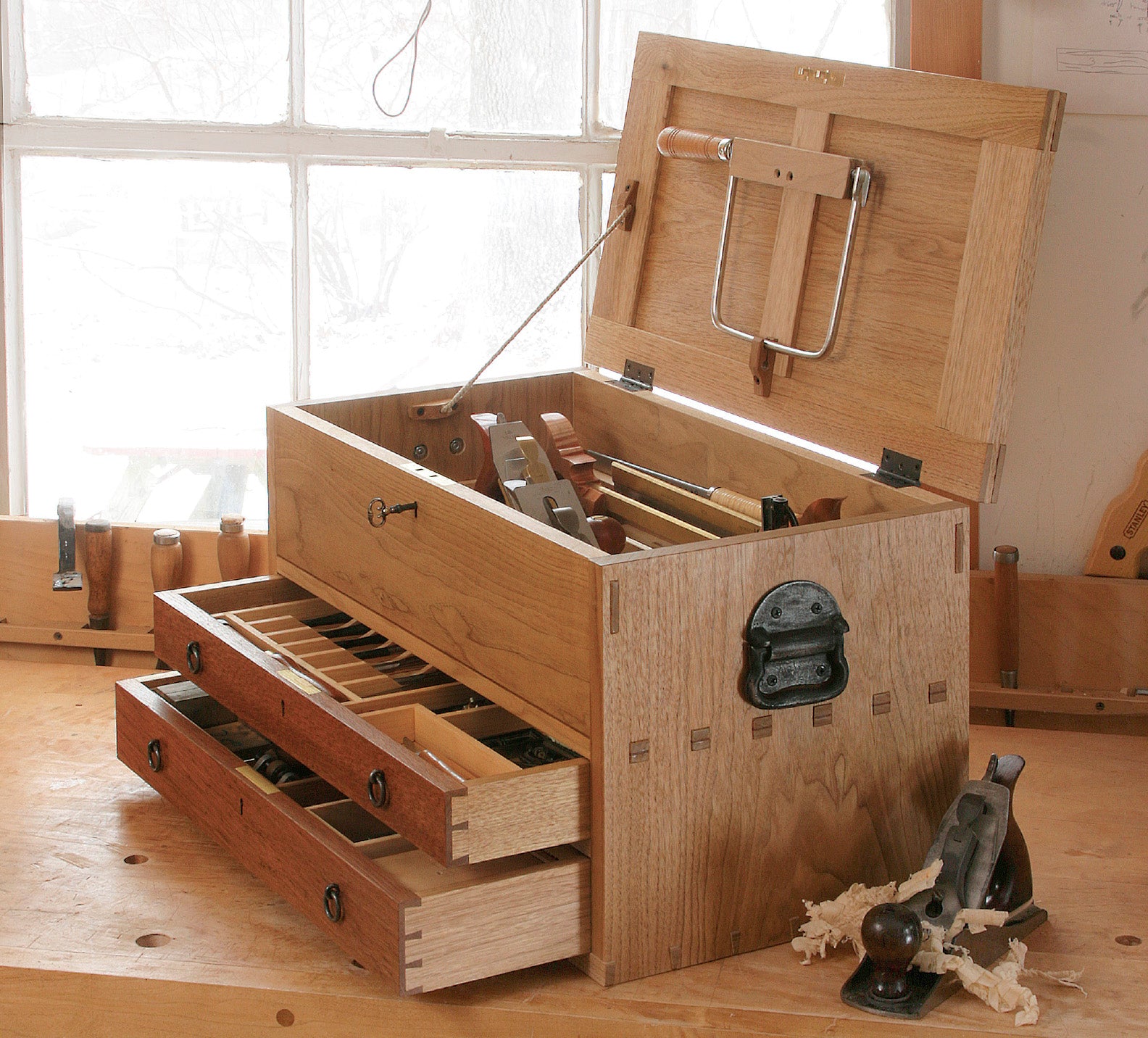
This vagabond arrangement complicates the organization opportunities. Over time, I've found that several tools seems to always find their way inside. It makes sense to have semi-fixed homes for these tools.
While I get that my TV and teaching needs are somewhat unique, I do think that woodworkers are a helpful bunch who like to have familiar tools even when working on away games.
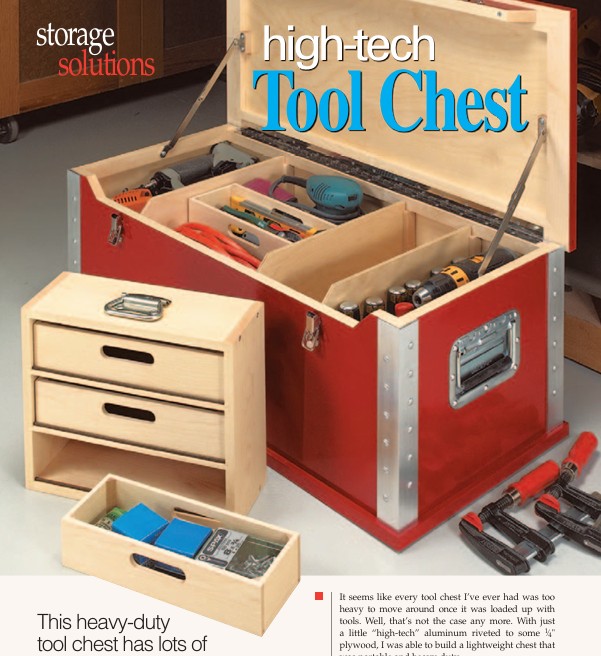
We've built quite a few chests like these over the years at Woodsmith and ShopNotes. The High-Tech Tool Chest divides the space inside with partitions as well as some totes, trays, and drawer boxes.
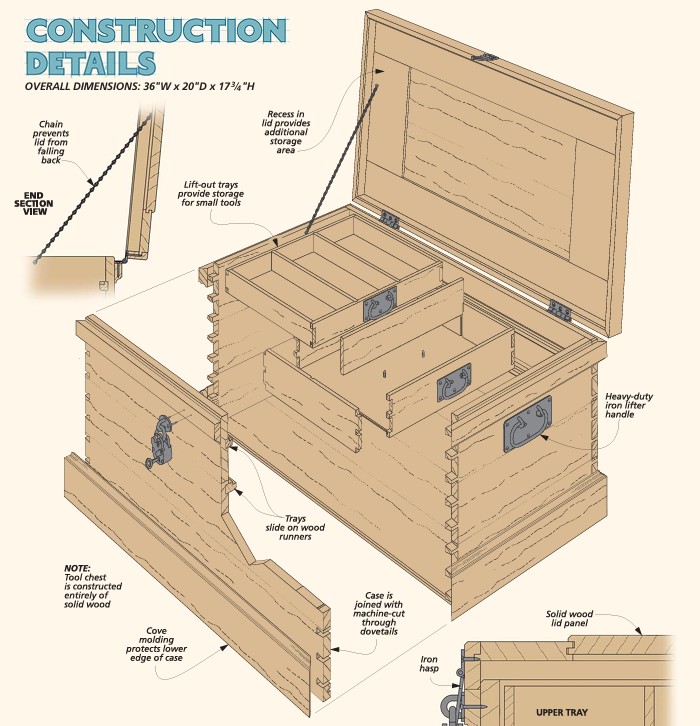
The Traditional Tool Chest from Woodsmith 161 takes an old-school approach with just a few sliding trays and some storage in the top.
I'd love to hear from you what kinds of storage solutions you have.
Transcript
Hear's what else we talked about in this episode.
Phil Huber (00:18.491) Hey everybody, it is the ShopNotes Podcast, episode number 289 already. I'm Phil Huber, along with Logan Wittmer and John Doyle, the threesome that makes up the Shop Notes Podcast, your weekly dose of inspiration, celebration, and perhaps some muppetation. on this episode, we're gonna do a little recap of woodworking in America. We're gonna share a couple of highlights from the Sweden and Denmark tour.
Also, a few updates of what's going on in the world of popular woodworking and woodsmith. We're also gonna maybe dive into some questions I have about a tool chest. All that and more are coming up, but we're gonna kick things off with some listener comments and viewer comments from the last episode. And
I'm not gonna lie, there's some shade here. So
Logan (01:19.682) Ha yes, let's go. Let's go.
John Doyle (01:20.217) Yes.
Phil Huber (01:22.641) All right. We'll just save that one towards the end because then it'll transition into our first segment. Rick Delmer says, nice restoration job on the plane, John. Solid work.
John Doyle (01:38.743) Raise the roof. Is that are the kids still raising the roof? No. I think they're literally six sevening.
Phil Huber (01:47.826) Driver says, responding to last episode's discussion about the weight of Japanese wood planes versus Western metal ones, I think the reason why they don't need the mass is because they operate under tension while you pull, which keeps the iron in the cut, as opposed to a metal body's reliance on mass and rigidity of the frog to keep the iron engaged while pushing through the cut. Also, I'm not a physicist.
John Doyle (01:48.088) No?
Phil Huber (02:16.091) But I think for pull planes, your own body mass becomes part of the plane's mass.
Which feels like a very Tony Stark sort of don't know what to say about that. Right. Yeah. Two, I also do not like the Veritas Mark II honing guide, the top bottom clamping all results and the blade shifting to the left or right slightly out of square. It was maddening, so I switched to the side clamping Veritas and it's been great.
John Doyle (02:25.881) I'm I'm a bit of a scientist myself, so I get what he's saying.
Phil Huber (02:50.577) Boney Board Wood Shop says Logan is gonna need a new LLC Chunk a Trunk Resellers.
Logan (02:59.126) Keeping that under the table for right now.
Phil Huber (03:00.985) Yeah. Also quick tip gun blueing has been used if you need to do a little touch up on Japanning.
Logan (03:06.892) Yeah. Yeah, the the problem I have with gun blowing is it's a chemical it's like a chemical process so you don't gain any of that thickness back. So at yeah, so at that point you're almost like you could just color it with a sharpie and it would kind of be the same thing. I mean y yeah, gun blowing adds a little chemic corrosion or corrosion resistance. I think you could if you had like little areas to touch up, I think like a oil pen.
Phil Huber (03:15.417) Right, that's what I was gonna ask.
Logan (03:36.334) Might do it a black oil pen.
You might be able to p dab it in there. I think the kids are still dabbing John in case you're wondering. Yeah, yep. Yep.
John Doyle (03:45.879) Yeah, I think
Phil Huber (03:47.184) Yeah, right. Yeah. John Nasta says it definitely was swallow tails. I asked if they were African or European. Another great part of the trip was trying to think of inane questions to email John all day.
John Doyle (04:02.989) Yeah. And I was getting them too. I was getting them.
Phil Huber (04:05.061) Yeah. Yeah.
Logan (04:07.446) was great.
John Doyle (04:07.818) All ours, all hours.
Phil Huber (07:31.825) really me, Dag Nabbit writes after all the crap talking about Shopsmith, are you going to give them a fair shake at the show?
Logan (07:41.839) we shook Alright. They were shook. Yeah.
John Doyle (07:41.923) No. Yeah. Yeah, I shook my fist at him from a distance.
Phil Huber (07:44.463) Yeah. Yeah.
John Doyle (07:49.219) Mm.
Phil Huber (07:51.76) Which we're gonna add our normal disclaimer about ShopSmith and that step one, go back to the previous podcasts about him and actually listen. Two, we don't hate ShopSmith. We're not trying to put him out of business. It's just all good natured teasing. Yeah.
Logan (07:58.063) It's the people we hate, not the tool.
Logan (08:13.934) I mean we did once though, like we did once, so been there done that. We need to find something else new. Yeah. Yeah.
John Doyle (08:17.254) But then we brought him back. We killed them and then we revived him.
Phil Huber (08:19.279) Yeah, and then we brought back, yeah.
I think all three of us actually had conversations with the shopsmith folk while they were out there. And most of the time I would say it we were involved in laughing about this whole thing. It was they're not scared.
Logan (08:27.949) Yeah.
John Doyle (08:34.295) Yeah. Yeah. Let's just say they have heard of us.
Logan (08:40.735) And if there is if there's a video floating around of me turning on a shopsmith, it is 100% AI. You cannot believe it. Do not believe it.
John Doyle (08:40.825) Mm-hmm.
John Doyle (08:48.823) Yeah. Can't can't be real. You would never.
Phil Huber (08:49.701) Ha ha
Phil Huber (08:53.861) Yeah. right. we also did bring a shopsmith back to the shop w with us from the show. Right. Yeah. So that'll be kind of kind of fun to play with.
Logan (08:54.719) Audacity.
John Doyle (09:01.315) Mm-hmm.
Logan (09:02.85) Spoiler alert, Phil, geez.
John Doyle (09:04.045) Yeah.
Have you ever have you ever felt like you just been so busy that you're like drowning in the ocean and then somebody throws you a shopsmith?
Logan (09:15.278) There's an attachment for that.
Phil Huber (09:15.813) Ha ha ha.
John Doyle (09:18.893) Yeah.
Hmm. Yeah.
Phil Huber (09:22.565) No, lots of fun talking to the Shopsmith guys. really cool to see what they're up to. All right. This is the one that I've been waiting for. And so has John. Steve Krogan, hopefully writing the last doing the last name correctly here says, So I've been listening to your podcast for quite some time.
Logan (09:32.461) Go.
Got
Phil Huber (09:48.748) I will I've been wanting to go to woodworking in America for a couple of years now and finally made it there this year. I also went to handworks in Amana earlier this year as well. I was looking forward to woodworking in America as I am more of a power tool woodworker than a hand tool guy. I was very impressed at handworks by the number of vendors and different items available. Walking into woodworking in America at the 4-H building on Friday morning was a major letdown. I came
Just for the vendor exhibits as the full two day pass was not in my budget. Maybe my expectations were just too high after attending Handworks only a month prior, but only 15 vendors about? The place was basically empty. I just expected more based on all the publications under your umbrella and the years of experience coming from them. I enjoy your podcast and will continue to listen, and I hope this was just an off year for vendor attendance.
Sincerely disappointed in Iowa.
Logan (10:49.272) Wow. Okay, so I'm gonna take this as a personal challenge that he said he's gonna listen to the podcast from here on out. We're gonna make him quit. Let's go. Let's go. Let's roast this guy, disappointed Iowa.
John Doyle (10:58.433) No
If if he hasn't quit after 289, he's not going anywhere. You could say there was only 15-ish vendors, but like shop shopsmith like 15 vendors in one. Like all in one, all the tools in one. You can spend all day with ShopSmith. So yeah.
Logan (11:18.712) Yeah.
Phil Huber (11:20.017) I mean you're not wrong.
Logan (11:23.158) No, definitely not. so here can I give my take or my opinion on this, okay? Yes. Yes. No. Question and opinion. Okay. You have a question, we tell you how you're wrong.
John Doyle (11:29.613) Thank you.
Phil Huber (11:29.743) Right. That's why I read this stuff is so that it's I mean, it's not really question and answer, it's more like question and response.
Yeah. Mm-hmm.
Logan (11:44.257) Yes, we intentionally keep the vendor size small. If you look at the exhibitor list when you buy the tickets, you will see the exhibitors that are exhibiting. So kind of feel like we need to do our research before we buy the ticket, right? also. Feels like shop Logan. also we we put woodworking in America on
In particular for those demonstrations, I understand that it is an expensive ticket. 100%, not everybody can afford that. And we get that and we understand that. now that we have somebody in place to kind of manage our events like this, we may look at selling like maybe seminar only tickets like two singular seminars, which would allow somebody to at least get some of the seminar experience without buying the the full the full ticket.
With that said, we are a magazine. We are a publication company, a media company, obviously in the woodworking field. So our our direction, at least from an editorial standpoint, is always going to be education. So to us, woodworking in America is an education opportunity for people. People are coming there to see those demonstrators. it is not meant to be a trade show. if you are
Looking for a big vendor trade show where you can walk around and you can visit a bunch of different tool makers, large tool makers. I think you're better off probably looking at something like the Klingspore event. there's there's a few others. the Texas Woodworking Festival was one recently. I don't know that that's gonna happen again. Those are more your style.
the reason we bring vendors in to this event is that it allows our partners that we've worked with, our vendors, the opportunity to have really good discussions with a hyper focused group of people, people that are extremely invested in the hobby. So you know, is are these vendors making tool
Logan (14:07.426) Deals and selling tools out of these out of the exhibit space. They are, yes, but they're not doing it to sell tools. They're doing it to collect feedback. They're doing it to talk to the audience. you know, Grizzly came this year because they were showing off a couple of new tools. They wanted feedback from people. This was the first time that those tools have ever been out in the public. And it's a big deal to Grizzly because these are the first tools that Grizzly has put patents in place on.
So instead of going to a a manufacturer and saying, What do you have for drill presses? This is what we are gonna order from you, they're saying, This is what we want, make it for us. so it was an opportunity for for vendors to talk to customers like that. I get what you're saying. If you're if you're expecting a big trade show like Handworks, that's not that's not what this is. there aren't actually any of those left really.
Like the Kling Spore show is maybe the only one that I know of off the top of my head. Like the Woodcraft show, that is just for Woodcraft franchise owners.
Phil Huber (15:14.553) There's the the one in Minnes or in Minnesota, the that's a bigger one that usually is kind of like around the same time as woodworking in America.
Logan (15:24.514) Well, but that's like the North Guild, the Northwoods Guild, right? and I don't even think that like I don't know if they have I mean I'm assuming they have exhibitors there, but I don't know how many and what volume. but again, our focus is the is the education. So I think I think over the next couple of years that we do WIA, you'll see it evolve. I think. I think you'll see the education portion of
Phil Huber (15:26.969) Right. Yeah.
Phil Huber (15:32.537) Yeah, they do, but right.
Phil Huber (15:51.875) It's evolved already.
Logan (15:53.51) it has, absolutely. And we heard I mean, it's funny because, you know, this is this is one comment from Disappointed in Iowa. It wasn't his name. What was his name?
Phil Huber (16:02.924) I closed out of it.
Logan (16:04.082) we're gonna call him Josh. Okay. This is this is one comment from Josh. Chad, Chad, right? That's the that's the male version of a Karen, right? So we're gonna call him Chad. so Steve, all right, Steve. so I
John Doyle (16:08.661) No. I think it was Steve.
Phil Huber (16:18.321) Steve.
Logan (16:24.938) Think Steve that you're gonna see this evolve. And for for Steve's comment on, like, you know, hey, I was disappointed in the exhibitor area. We had dozens of people say, I've been here every single year you guys have done this, and it is better and better and better every year. so like I get what you're saying. I think our expectations were probably your expectations are probably different than what our goal is. So
Also, with everything I just said, I would like to have twice as many vendors next year. not to make Steve happy. In fact, I would rather have half the vendors to make Steve more disappointed. No, no. In reality, what I would really like, and we and we said this long, long, long before this event was finalized.
I'd love to have some bespoke makers there. You know, I would love to have some of these small makers that were at hand works. the just the fact of the matter is that it was like a month after handworks, and you know, somebody like Iron Burke Tools can't fly in from Australia to Iowa twice in a month, or you know, Hillview Tools out of New York can't drive to Ohio or to Iowa.
twice in a month. Like it's just not feasible for a lot of these small makers. Next year we we're not fighting against hand works. we're not gonna be fighting against the Texas woodworking shows. So I expect next year we will have more vendors in place.
John Doyle (18:01.133) Yeah, and I'd say the the date we picked was intentional not to try to compete with handworks and kind of doing them a favor and doing us a favor of of not trying to step on toes or or whatever, but
Logan (18:17.346) Yeah, I mean yeah, in reality, if we wanted a lot of their vendors to come to this event, we would have scheduled it the weekend after and people could have just made a long week in the Midwest, right? but yeah, it I get I get why Steve is disappointed. However, our our focus was not on the Steves, it was on the attendees that were that were
going to the seminars that we put a lot of our effort and our cost into. So
John Doyle (18:49.047) And usually yeah, usually disappointment comes from expectations and he was expecting hand works and it was not that. So I mean it's true, it's true. I mean right. Just have lower expectations. You know, set the bar really low. We'll step right over that.
Logan (18:53.454) I'm gonna use that one on my wife later. Usually disappointments come from your expectations.
No, no, I I like I I get I I do I I understand exactly what Steve's saying. and like honestly, I just I wish there was I wish there was a feasibility in hosting a show just like that. but the current marketplace for the woodworking industry does not support a show like that.
As we have seen, the Texas Woodworking Festival is done. It wasn't profitable. You know, even charging vendors, you know, a a small amount and having a lot of vendors still does not offset the cost. It doesn't even cover the costs of it. the woodworking show that was traveling up and down kind of the east coast and kind of the eastern Midwest, they pulled the plug, what, last year or two years ago, because they weren't profitable and and traffic was just low. And, you know, if
Phil Huber (19:56.187) Two years ago, yeah.
Logan (20:02.228) If I wanted to promote a charity, it wouldn't be in the woodworking space. Sorry.
John Doyle (20:13.815) Yeah, I think going forward, we're definitely gonna continue with the focus on the classes and education. But there are discussions of how to enhance the vendor space as far as vendors or do we just bring in local like swap meat type like tools or like local kind of a local flavor or you know, that kind of thing to fill up that space, bring more people through there and and kind of
give a better experience on top of the demonstrations that
Logan (20:45.016) Yeah.
Yeah. I mean the the kind of the the fact of the matter is like for one of those vendors to get there, depending on where they're coming from, it is several thousands of dollars, right? Like if you're shipping in pallets of tools, you're flying in two people, it's very expensive for them to get there. we have purposefully kept the attendance limited because we if you were here two years ago
You knew I walked into one of Shay's classrooms and had to stop him ten minutes into his presentation and make everybody move to other classroom 'cause there's too many people in the class. like we want it to be that kind of up close and personal educational experience. And to do that, we can't have thousands of people come in, you know, otherwise we'd just be putting in a giant auditorium and then you kind of lose a lot of what we're trying to do.
So yeah, that's kind of yeah. I mean, we we've talked about I would love to get something in line with like the Midwest Tool Collectors Association, to say, hey, you know, we'd love for you guys to to run your run a swap meet while we're doing this or, you know, do set up your tool displays. you know, it was Steve, while you came through, if it appeared empty in there, it was probably because there was classes going on at the time.
and that is that's an that's a struggle we have because there are times where the the exhibitor hall is completely empty because everybody's in classes. But then all the classes will release, then it will be flooded with people and they'll be out there for half an hour, forty five minutes chatting with vendors and stuff, and then they'll go back into the another another class. so yeah. We hear you.
John Doyle (22:32.589) Yeah. And kinda like you what you were saying, keeping the numbers down, people are paying the premium price for access to the presenters and to us. And if we've got, you know, thousands of people, you're really not having that personal interaction, I guess. So that's something that we're trying to balance, I guess, there as well. So
Phil Huber (22:58.683) Yeah, definitely two different events, handworks and woodworking in America with different goals and a different focus. So it it's almost is a it's unfair to both of those events to call them woodworking events because there's just not a name for what the other you know, it's easy to conflate one or the other.
John Doyle (23:00.675) Mm.
Logan (23:21.612) Yeah. I it's interesting because it's exactly I spent the last so I got home last night from a trip up to Canada. I visited Ottawa and Lee Valley Tools and Veriktas at their headquarters. And it very much what we do with what what what Handworks does and what we do with WIA is kind of came up in the discussions with Lee Valley. Lee Valley
Robin Lee, the owner, had said a few times during our our two days together that we, Lee Valley, is a what how did he word it? High mix low volume. So they have a bunch of skews. They have, you know, Veritas makes thousands of skews, but they're low volume. So they only sell like fifty or sixty a year of a certain skew, but it's worth them doing it.
Whereas other manufacturers are high volume, low SKUs. it that I mean, I would relate that to our our two shows that you're talking about, right? Handworks is free to attend. It costs the vendors, like they the Abrams brothers take that event and keep the cost for the vendors very low. Like they don't make money on that. It's kind of their own little give back to the community doing that.
So it's very economical for the vendors to get there. All they have is the cost of getting their product and themselves there. so that is a high volume. it's not a money making event. hopefully it is for the the tool manufacturers, where we are a much lower volume event purposefully.
John Doyle (25:13.217) Are you saying we were only doing it for the profit? Because I don't think it's working out. I don't know if it's working out for us. By the time we pay all of our scientists and our researchers, I think we're losing money. What we gain though is friendship, memories, and cheese. So
Logan (25:16.49) I'm saying that I'm saying I haven't seen a **** penny out of that. I know. I know. Yeah.
Logan (25:33.272) Yes. And a shops like mark seven.
John Doyle (25:36.745) Right. And we're in we're in the black, baby.
Logan (25:40.15) Yeah. man.
Phil Huber (25:40.517) Yeah. It's priceless, frankly.
Phil Huber (25:45.532) All right. In spite of that, I got a lot of great comments from people who were at Woodworking in America. We had a good event. had beautiful weather for it. And as always, we kick it off with an open house here at the mothership, and that was well attended with a lot of people and the presenters hanging out. Kind of a low-key way to ease into the event, get to see behind the scenes of what's going on. where we film the TV show, how Woodsmith is put together, talking to staff.
Logan and Colin were here to talk about popular woodworking stuff. Owen from Fine Woodworking was here. So he got to talk to some people. Like I said, a bunch of the presenters were here. so it was a great a great time. There's a definite social value to it because I saw a lot of those same people chit chatting during the event too. So get to know some of the people that you're gonna be sitting next to in the in the presentations. So
looks like we're we've got the fairgrounds reserved for October eighth and ninth next year, twenty twenty seven. So circle that date on your calendar for woodworking in America, especially if you came this year and were excited about it, or you missed out and you're ready for giving it a try. So you want to do that too.
Logan (27:10.399) B'stiv.
John Doyle (27:12.471) No, Steve, come back. Don't listen to don't listen to Logan. You c you come back, I'll show you a good time. I don't know what that means, but
Phil Huber (27:14.405) Ha ha.
Logan (27:16.052) I'm kidding.
John Doyle (27:24.281) putting it in my calendar for next October. Sh show Steve a good time.
Logan (27:24.823) Phil Huber (27:26.233) All right.
Phil Huber (27:29.733) There we go.
John Doyle (27:32.589) He can come to our open house and try out the shopsmith.
Logan (27:37.73) Well if we still have it. I think they're gonna come pick it up, yeah. Well we have the Trojan horse it back to them. I don't know what that means, but
John Doyle (27:40.19) we're gonna s no, we're gonna still have it. Yeah. True.
Cause if anybody sees Yeah. They're on the inside. They've infiltrated. You're saying we have to charge and horse it because it'd be embarrassing if we saw if anybody saw it leaving. Yeah. Doing the walk of shame with the shopsmith out the back door. Jeez. I'm you know what? I'm honestly I'm afraid I'm gonna fall in love with it. You know?
Logan (27:49.346) Or do we accept the Trojan horse? ****. Like we might have the we might have the Trojan horse. Yeah. no.
Logan (28:00.001) Yes, yeah. Yep.
Logan (28:09.558) Mm.
Logan (28:14.542) John Doyle (28:14.625) I'm afraid I'm afraid I'm gonna catch feelings. And that's why I was afraid to go talk to them.
Logan (28:17.144) So all jokes aside, we do have a Mark Seven to to mess around with. I definitely did not turn on it at the event at all. they built a little table over the weekend, all on the shopsmith. it was Andrew and Jim, I believe.
At Shopsmith and they it was cool. It was fun to talk to them. because it was I walked up there and Andrew's like, Hey, I hear we hate each other. I was like, that's what I've heard. Like clearly nobody has ever listened to this. So we we stood there, we we chatted about the machines because honestly, I like honestly, I've never seen one, never, never touched one. And if you if if
You people, you people would go back and listen. You would have heard me heard me say that. I have the Smithians, yeah. Yeah. I I've never touched one, so I I stood there for for quite a while and we we chatted and one of the coolest things I saw, they had some
John Doyle (29:24.185) You're talking about the the Smithies? Is Yeah. They have their their group.
Logan (29:42.829) really nice tool pouches that they're gonna be making and selling. I'm looking forward to those. So but yeah, it's it's interesting. in talking to Andrew, they they manufacture and sell the Mark 7, obviously. they also and I did not know this, I mean I knew they kind of supported old machines, but they will take old machines back and refurb them. If somebody buys one, they'll take it and refurb it for people.
I think he said that there's a year of like blackout dates. So like this time frame they can't touch stuff too. And I I I don't remember why that was. I think maybe something with design or I I don't exactly recall. There was a lot going on that weekend. and you know, I was trying to sneak behind the trees and talk to them and not let anybody see me talk to them. So so yeah, it was it was interesting. But I do one thing I do really like their caster system is pretty nice.
On that Mark 7. It's a well, it's like a three-prong cog underneath the base. And when you step on it, it it rat it ratchets for lack of better term and kicks the wheels down. And then you step on it again and it ratchets it further. So it's up a little bit higher. So then you like have clearance. which if you've ever rolled stuff around in the Woodsmith parking lot, you want all the clearance you can get. And then one more kick.
Phil Huber (30:44.358) That's for sure.
Logan (31:09.536) and step and ratchet, drops it back down to the base. So it's a pretty it's a pretty slick system. So
Phil Huber (31:14.204) Yeah. It's kind of like a three way light switch on a lamp, except for casters.
Logan (31:19.796) That's exactly what it is. Dim, bright, off. Yeah. Yep. So Yeah.
Phil Huber (31:23.76) Yeah. Yep. Yep. Speaking of dim bright off, one of the things that we're finally learning about getting ready for woodworking in America is that moving four or more workbenches from the Woodsmith Mothership out to an event site is not as easy as you would think it should be, even when all four of those workbenches have casters on them.
John Doyle (31:35.096) Okay.
Logan (31:52.45) Yeah. Well, let's yeah.
Phil Huber (31:54.523) we have and the reason is is that we like to build thick workbenches. And then they end up being super heavy.
John Doyle (32:03.021) Two C's.
Logan (32:07.628) Yeah they are. Big legs.
Phil Huber (32:09.33) All right. Yep. Yep. Anyway, they're just large. So we were thinking about like what it would take to as a design group. I was talking with John and Dylan about creating some kind of a knockdownslash portable bench that would still do do the job for what we need them to do. So that maybe we only need one or two of the big workbenches at the event.
Logan (32:16.27) This one's off the hinges. well the other yeah.
Phil Huber (32:45.53) And then have some smaller ones that are easier to transport.
Logan (32:49.068) Yeah, well, you it's funny because for a while Alex has our technically he's our publisher of the wood group. he has wanted us to use the minimalist woodworker. Bill had his knockdown workbench there. And he has wanted us to to use that as like the show workbench design for a while. and that I think would be a good one. I think your little traveling workbench, Phil, would be a good one.
Phil Huber (33:19.139) yeah. I kinda like Vic's setup that he had too.
Logan (33:19.982) Logan (33:24.084) Yeah, that's from a Canadian company. I'm just saying that because he's br I mean yeah, British Columbia. Like there's some yeah, some form of tie there, I think. yeah, that is nice. it's almost like an MFT style thing about. I think the biggest issue that I had with our benches, and we've moved them what, th four years now. We moved these things all over.
Phil Huber (33:28.956) British it U J K.
Phil Huber (33:34.002) There you go.
Phil Huber (33:42.469) Little bit, yeah.
Logan (33:54.083) First of all, the the workbench caster wheels work great for a sh garage floor with a polished with a garage shop with polished floor. Not meant for off-roading. We need pneumatic tires on that bad boy. also, it does not help that previous woodsmith generations did not think that these bench tops really needed
Phil Huber (34:02.95) Yeah. Yeah, relatively smooth concrete or some other kind of flooring. Not meant for rot roading.
John Doyle (34:08.793) Yeah.
Logan (34:23.222) Leg screwed down. They were sitting on dowels or threaded inserts or you know, whatever. Like, no, give me some six inch GRK leg screws and attach those things down. So those I think were the two biggest issues. I do appreciate having the full size benches while we're in there doing demos, especially if you're doing like some form of hand tool work. so yeah, but yeah.
Phil Huber (34:41.99) Yeah. Right.
Phil Huber (34:51.11) Yeah. anyway, it was just kind of something that you think about. And then I had my portable bench or knockdown bench, like you said, here in the video studio and had quite a few people asking about it and talking about it. So that was kind of what made me think about it as well, is just what can we do that provides a solid foundation. But I think there's a lot of people out there that either want like a temporary workbench or something that works in a in a smaller space.
that would that could fill both needs. That we could do it as a plan for the magazine and then also have it as a as an easily transportable event site. So
Logan (35:25.112) Mm-hmm.
Logan (35:32.483) Yeah. Yeah. One of the you know, some of the feedback I got at the show, from a few people that were first time attendees, that they really liked the idea of doing longer demonstrations and doing like maybe full builds. I had a few people had mentioned that to me. like, you know, actually,
one of our presenters said, I would absolutely love to do like a half day build, like doing a a a chair or a stool or something, you know. And I think we had Katie and I kind of talked about that a little bit. You know, maybe next year we'll do like a a pre-show event if people want to come in for a half day and or a full day build and it's like, you know, watch watch Shay Alexander do a a post and rung chair full day in the walnut center. You know, it'll just kind of be a, you know, sit there
watch we'll bring coffee donuts, shout out questions as he's working, you know.
So it'd be kinda cool. Yeah.
Phil Huber (36:36.018) Yeah, that'd be cool.
Phil Huber (36:40.964) And like you said earlier, we have a event director now. So we're looking to increase the number and scope of the events that we have. Like not all of them are going to be woodworking in America style things, but just having somebody that can wrangle all the behind the scenes stuff for having shorter events or low key events, things like that that'll help us to be able to make those connections.
Phil Huber (37:12.686) All right. One of the things that I've been working on, especially as I get ready for doing events like Woodworking in America, is corralling all the tools and props that I need. So I had done a class not that long ago. It's I think out in the car right now. It was called Grandpa's Tool Chest that we did on the TV show and in Woodsmith. It was actually based on the toolbox that our founder Don Peschke's grandfather had.
John Doyle (37:27.843) Okay.
Phil Huber (37:43.943) And then we had it on the set of the TV show for many years and did an episode about it. And I built one when I was teaching a class for the Des Moines Woodworkers. We walked through that project. It was pretty fun to make, and it's kind of a nice size. However, right now, as I built it, it's just an empty box. And I was thinking about what it what I would want to do to organize it. And
How much do you spend time trying to fit it out for a specific kit of tools versus leaving it flexible for a variety of things, that it's more of like a tote rather than holding a specific kit of tools? So I would love to hear anybody's thoughts on how they would do that.
what kinds of tools they would want to include in something like that or specific types of organizers. Love to hear it. Love to see anybody's feedback on that. I was also inspired, Mike Pekovic just had his book come out through Lost Art Press called Benchwork, and he built a couple of small toolboxes and had plans for that in the bench or in the book.
And then had some organizers as well. So I'm thinking about some of those. Of course, the anarchist tool chest is floating in the distance as well. I'm also thinking, Logan, you have that little tool chest that you made a few years ago just kind of over your shoulder there. Right there, that's the one. so looking at all those as well. Would love to hear people's take on.
Logan (39:26.476) Yep. Yep.
Logan (39:36.442) I I messed around with a a couple of tool chests when I was at Lee Valley. this was interesting because I only I'm not Canadian, clearly. Wouldn't have been razzing the steep up as much as I did if I was Canadian 'cause I'd be nice.
John Doyle (39:39.617) Yeah.
Logan (39:59.053) I've never been into a Lee Valley store. Okay. So my only my only interactions with Lee Valley as a consumer have been through the catalogs, but mainly their website, right? Like we get their website, we get their emails, we get their catalogs, we know the tools they produce. I don't think you understand the depth of tools that they produce. Like there are so many tools.
Phil Huber (40:02.544) Okay.
Logan (40:27.608) But what you don't see is you don't see the nuttiness behind the scenes and in a good way. Like, like we were doing kind of a tour through their their headquarters and stuff. And Robin was like, you guys want to see the tool collection? It's like, don't tempt me with a good time, Robin. So he took us upstairs in the mezzanine, and like I have a feeling that I have Robin and I have bit each other up on tools at some point.
Logan (40:59.126) Like but it makes sense, right? Because Robin is a tool nut. He loves tools. So like going into his office or into his late father's office and just seeing all the like the most high-end like Stanley prototype hand planes and like just all this crazy stuff that people would die to get their hands on.
But he he being Robin has kind of curated this I'm gonna call it a tool exhibit. but it's more like a tool archive where it's like it's there for the Veritas and Lee Valley designers, like, hey, we wanna build a a plow plane. Well, you can go up and there's there's nine pallet racks full of plow planes. You know, everything from you know XYZ patent to mom and
Pops, you know, made it in his garage plow plane, like all these weird things. and Robin was telling me, he's Yeah, he's like, you know, sometimes he's like, sometimes I get weird stuff. Like we were I we were standing next to something. He's I see, like, I got all these. Like they were it was something off the wall, like door knockers or something. And he's like, Sometimes I just buy an entire lot of something because there's one tool that I want to add to like the library.
He's like, so I but he's like, I also end up going to these auctions and then I'll buy a tool chest just so I can pack all the crap into it and bring it home. So there's tool chests all over, circling back to what we were talking about. there's tool chests all over, and I've seen a few like modern tool chests. like you know, let I'm gonna throw Chris Schwarz's anarchist tool chest out there just because it's the most popular one. But like
John Doyle (42:40.297) Okay.
Logan (42:55.626) Brian DeYoung down in Atlanta, he has a giant traveling tool chest that he uses. but to actually stand in Lee Valley and look at some of these and kind of slide the drawers around and stuff, like it makes me appreciate a tool chest so much more as like a working item. I don't like it doesn't work for everybody in their shop. I'll be the first one to say that. Like, I do not want a tool chest. I have this.
Phil Huber (43:14.353) Okay.
Logan (43:23.49) This little one behind me because sometimes when I travel to do demonstrations, that's where all my planes go. And that one is fitted to fit certain tools in certain spots. So it fits my my smoother, my router plane, jack plane, sharpening stones, and a scrub plane in the bottom. then the top is kind of for small tools and my chisels, and then in the the lid is my
pull saw, my fret saw, and a couple other things square. but I think I like the idea of I like the idea of leaving a tool chest open. You can put whatever the project requires into it because not every project requires the same tools. So say you're going to install a door for somebody or help somebody install a door. You have a certain set of tools you're gonna bring. Whereas if you're doing
shrim carpenter, you're doing, you know, furniture repair for somebody, though that requires a di different set of tools. Sorry, we got dogs barking.
And so I like the idea of that, but in my experience, like bringing tools on the road, whether it's to the office or to Woodworking America event, stuff gets broke if it doesn't have a spot. And that's my my bigger issue. So and it's funny that you bring this up because I just saw this morning Megan Fitzpatrick, former editor of Pop Wood, posted on Facebook her her kind of
thing that she's been on lately has been the Dutch tool chest, lately being the last several years. and she has done several classes on this Dutch tool chest. and she posted this morning saying, Hey, I would like to see everybody's different interiors and tool storage in the Dutch tool chest because I think she's doing a class overseas somewhere and she wanted some examples to show people like, here's how you could organize it and here's how you could build tool holders into it.
Logan (45:30.872) But I guess it ultimately I think it just depends on what you are. What's your goal with that chest? Is it in your shop? Is it a travel chest? Is it a catch all and carry stuff around? Which I think maybe a tote may be better for that. I don't know.
Phil Huber (45:49.021) Yeah, and that's what I'm trying to decide is what because I was thinking of your tool chest, but then also I think yours is at least inspired by David Barron's.
Logan (46:03.682) Yep, absolutely one hundred percent. It's it's much larger than his, but yes, it is.
Phil Huber (46:07.206) Yeah. but that, you know, so it's like, are you gonna go to a c so it's really easy because I think in the woodworking space, especially where we are, it's interesting to see how, you know, there's people like Mike Pekovich designed one for taking to classes. Same thing with like Megan Fitzpatrick and a few other people where it's like, I teach and these are the kinds of tools that I require for
XYZ classes that I teach. So then you design a project around it. And is there some utility in that for other people? Most likely yes. But yeah, that's a good set of questions. Is you know, I'm gonna be like for example, I'm gonna be in Indianapolis next week doing a demonstration for a woodworking club in Indianapolis and then teaching a class, a a real quick workshop that we're gonna do. So
I want to bring some tools along. I teach classes for the Des Moines woodworkers. And to me, as a woodworker, it's fun to be able to make something out of wood that's a home for that stuff. But you're right. A lot of times it does have to be basically a utility grade tote that needs to hold a few items. But that being said, a few of those items are common on practically every one of those trips. And how is it worthwhile to
Logan (47:27.138) Yeah. Yeah.
Phil Huber (47:31.362) have some dedicated homes for things without having to feel like I have to like unpack it when I get somewhere back to my shop and put all the like specialized holders in if it's just going to be a tote the next time.
Logan (47:48.876) Yeah. Or
Do you make holders that can quickly be removed?
Phil Huber (47:57.361) Right, that's what I mean. Like, and then what do I do with those in between? You know, those they have to live somewhere too. So Right, there we go. A tote to hold all the organizers for the original tote. It's getting meta.
Logan (47:58.605) Yeah. Yeah. You make a second tote.
Logan (48:09.996) Yeah. No, I we all and we always talk about this like with hand tools, but like what if you're what if you're a router person? What if you're a trim router person? Like do you make a space in your in your toolbox for a trim router? Why not?
Phil Huber (48:25.136) Right, which is part of part of the workshop that I'm gonna be doing is with a trim router. So I feel like that has to have a home too. And you're right, there's a lot of them where it's this little portable shrine to hand tools that for some reason, you know, there are people that use power tools just as much, and I feel like they deserve
Logan (48:29.357) Yeah.
Phil Huber (48:52.474) And are worthy of a special way to carry them as hand tools are. You know? Like you I think the three of us are big fans of little trim routers. Like, why doesn't that have a a place to go? So
Logan (49:03.214) Mm-hmm.
Logan (49:08.504) Well they do, they're plastic cases that get thrown away immediately when you purchase it. Womp womp.
Phil Huber (49:12.218) Right, right. All right. That's it. That's my question for the group is would love either in some inspiration. If you want to send me photos or drawings, you can. Woodsmith at woodsmith dot com is the email address or post a comment on the Shop Notes Podcast YouTube channel. We're gonna wrap things up here.
with today's episode. Logan, any updates on the outfeed table?
Here we go. Yes.
Logan (49:50.123) Whoop. There it is. So there's a you can kind of see it over there. There's a torsion box. So last last week was it was WIA just last week? God, I feel like it was weeks ago. so Colin came in early on Monday, and we spent a couple days in here. we did a torsion box for the top. So took a giant four-byte sheet of plywood, a bunch of off cuts from the kitchen island build.
John Doyle (49:54.925) Okay.
Phil Huber (50:13.009) Okay.
Logan (50:18.612) And we did torsion box top. It is approximately 46 by 48 inches and five inches thick. was looking for a plastic laminate to go over top, but we discovered plastic laminate is extremely expensive. Did not know that, and it's very hard to find. I found a company in Des Moines that distributes it and I could pick it up the same day. But a four by eight sheet of plastic laminate, black plastic laminate was two hundred and eighty dollars.
Phil Huber (50:46.642) Whoa.
Logan (50:46.872) For a four by eight sheet. That seems insane. So instead, we went to good old Menards. and at Menards, we found a quarter-inch thick sheet of HDPE. high density poly high density polyethylene. it is black, it is kind of textured on one side, super slick and smooth on the other side. And we decided that was the perfect top for this outfeed table. So
we routed that to size. I painted the base a couple of weeks ago. I was just doing some touch up this morning before I permanently attached the top. so top will get attached, cherry trim around the torsion box to trim that up. and then at that point, I can actually slide that out feed into place as I work on the drawers and door for it.
there's only there's three drawers and one door with two pull-out drawers. so we're making some progress. I gotta get it finished though, because that's going in the next issue. So but I think I think this weekend I'm gonna make some really good progress on it. I'm I'm hoping. I have nothing, no travel on the schedule, nothing. So, yes.
Phil Huber (52:09.264) Awesome. That'll be fun to see. I can't wait to see that top on there because that'll be interesting to how did you end up attaching it? 'Cause like nothing sticks to it. So it's not like you glue it down, right? Yeah.
Logan (52:20.29) The HDPE. so it is just gonna float. there's cherry trim that creates a lip all the way around. Yeah, so and it's and it's quarter inch, so I have the cherry trim an eighth inch higher than the base of the top. So there's an eighth inch holding it, and then I chamfered the edge of the HDPE. So if there is a little discrepancy on height on the in feed, it should pop over. But
Phil Huber (52:28.146) just enough of a lip and you just drop it in.
Logan (52:50.208) I did buy six leveling feet and I don't have them here. They screw on, they have a bracket and they screw on, and then there's a like a s a screw head that lowers the foot so you can level everything. So I'm going to try to spend some time, get that in place, and then put a good straight edge across everything and try to get it leveled in all axes so it is a good continuous plane.
We'll see if I just get frustrated or not. I might just get frustrated. We'll see. Yeah.
Phil Huber (53:22.834) All right. Might just get frustrated, especially with six 'cause that's gonna be a weird
Logan (53:27.404) Well, I'm gonna do the f four corners and then just do the two center feet down till they touch. You know what mean? So we'll do what is it? Pitch and yawl. Is that what it pitch and yaw? Yeah. So yaw. Yeah.
Phil Huber (53:33.88) right. Yeah, that's fair. Yeah. Okay.
Yaw. Yeah. There you go. Yep. Y'all. That's what it is in the south.
John Doyle (53:41.112) Y'all
John Doyle (53:45.047) Yeah.
Phil Huber (53:47.918) Airplane pilots, we apologize in advance.
Logan (53:49.773) Yep.
I know. Nope.
Phil Huber (53:54.502) All right, there you are. That's another episode of the ShopNotes podcast. John, you got any last words here?
John Doyle (54:02.765) Nope. Keep it to myself.
Logan (54:04.226) Yeah.
Phil Huber (54:04.294) Yep. As my college roommate said when he ended any of his papers that He had to write, well, what more can be said? That's it for the Shop Notes Podcast. It's a production of Active Interest Media, a weekly woodworking podcast. It's edited by Nate Gruca and John Doyle is the digital editor. We'll see you next time, everybody. Bye.


