



Sharpen a Card Scraper with This Handy Shop-Made Block
A sharp card scraper is one of the most useful hand tools in a woodworking shop. It's great for smoothing surfaces, refining curves, and removing stubborn grain without the dust created by sanding.
But as you use a card scraper, the tiny cutting burr along its edge eventually wears down. When that happens, the scraper stops producing fine shavings and becomes less effective.
Fortunately, restoring the cutting edge doesn't have to be difficult.
This simple card scraper sharpening block makes it easier to hold the scraper while preparing its edge. With a diamond sharpening plate and a burnisher, you can create a fresh burr and get your scraper cutting again.
How a Card Scraper Cuts Wood
Unlike a hand plane or chisel, a card scraper relies on a small hooked burr along its edge to remove material.
When properly sharpened, that burr acts as a cutting edge, producing thin shavings as you push or pull the scraper across the wood.
As the burr wears, the scraper becomes less effective.
Rather than cutting cleanly, it may begin producing dust or require more pressure to remove material.
The solution is to prepare the edge and turn a fresh burr using a burnisher.
Make a Simple Card Scraper Sharpening Block
One of the challenges of sharpening a card scraper is holding the thin steel blade securely while keeping its edge square.
This shop-made sharpening block solves that problem.
The block has a narrow kerf cut into it at the band saw.
The kerf accepts the card scraper and holds it in position while you work on the cutting edge.
This simple arrangement makes it easier to maintain control as you flatten the edge with a diamond sharpening plate.
The block doesn't require complicated hardware or adjustments. Its purpose is simply to support the scraper during sharpening.
How to Sharpen a Card Scraper
The sharpening process consists of two main operations: preparing the steel edge and burnishing a new burr.
Step 1: Remove the Old Burr
Before creating a new cutting edge, you need to remove the worn burr.
Insert the card scraper into the kerf in the sharpening block.

With the scraper supported, use a diamond sharpening plate to flatten the cutting edge.
Work carefully to remove the old burr and establish a clean, straight edge.
The sharpening block helps keep the scraper steady throughout this process.
Step 2: Prepare the Faces of the Scraper
After flattening the edge, make a few passes with the diamond plate across both faces of the scraper near the cutting edge.
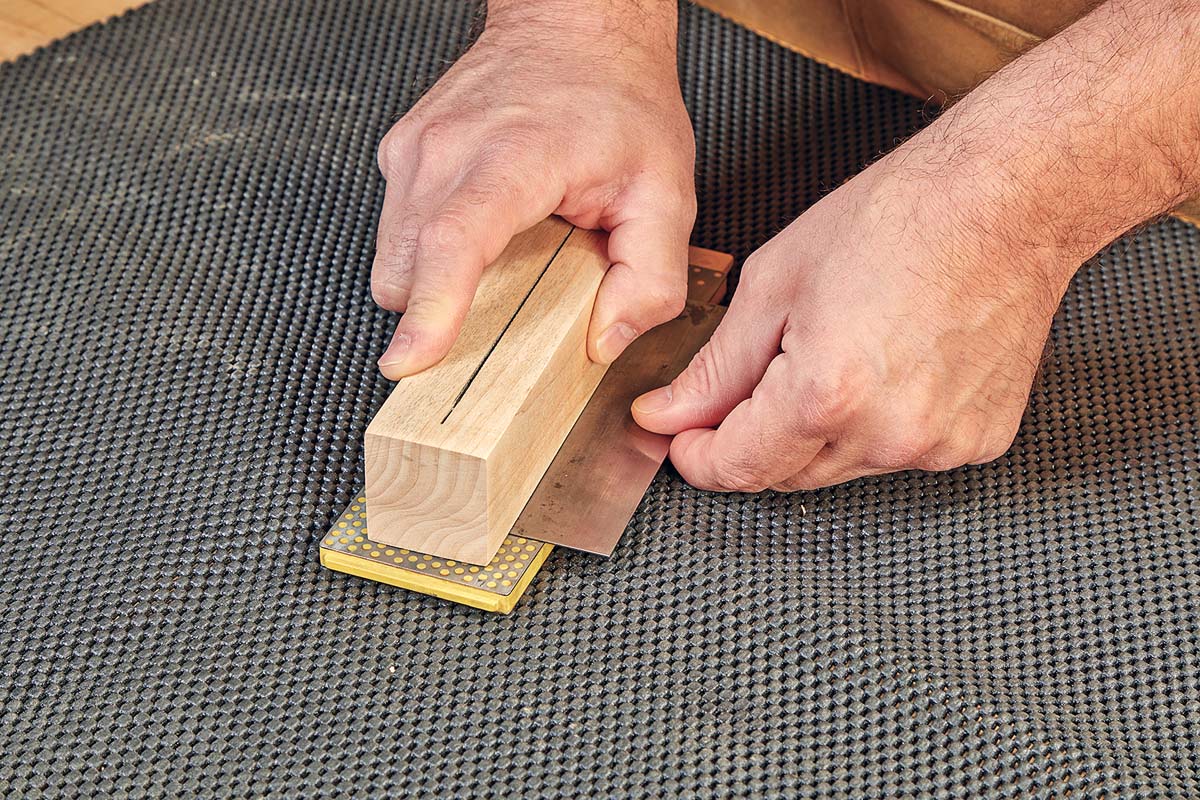
This removes any remaining burr and helps establish a square, clean edge.
The goal is to create a properly prepared edge before burnishing.
A consistent edge makes it easier to form a sharp burr in the next step.
Burnishing a New Cutting Burr
Once the edge is prepared, it's time to use a burnisher.
A burnisher is a hardened steel tool used to shape the edge of a card scraper.
The burnishing process creates the small burr that allows the scraper to cut wood.
Step 3: Form the Initial Burr
Begin by making a few controlled passes with the burnisher along the prepared edge.
These passes shape the fresh steel into a new cutting burr.

At this point, the burr is sharp, but it may not be positioned at the most comfortable angle for using the scraper.
That's where the final burnishing pass comes in.
Step 4: Turn the Burr to a Comfortable Angle
For the final step, hold the burnisher at an angle to the scraper and make another pass along the edge.
This rolls the burr slightly, positioning the cutting edge for a more comfortable grip and cutting action.

The result is a fresh cutting edge that's ready to produce fine shavings.
Test the Scraper Before Returning to Work
Once you've finished burnishing, test the scraper on a scrap piece of wood.
A properly sharpened card scraper should produce thin shavings rather than simply rubbing across the surface.
If the scraper isn't cutting well, check that the edge was properly prepared and that the burr was turned consistently.
With a little practice, the process becomes quick and repeatable.
A Handy Sharpening Jig for Your Shop
Card scrapers are simple tools, but getting a consistently sharp edge can take some practice.
This small sharpening block makes the process easier by holding the scraper securely while you remove the old burr and prepare the edge.
A few passes with a diamond sharpening plate, followed by careful burnishing, are all it takes to restore the cutting edge.
It's a straightforward shop-made solution that helps keep one of woodworking's most versatile hand tools ready for use.
Submitted by Dave Fowler, Bedford, Nova Scotia
Mastering a Card Scraper

A sharp card scraper is one of the most versatile hand tools in your shop. But knowing how to use it is just as important as keeping it sharp. Learn the techniques for controlling a scraper, removing fine shavings, and smoothing difficult grain for a clean, professional finish.
MASTER YOUR SCRAPER → Get More from Your Card Scraper


