

Hold-Down vs. Straight-Line Toggle Clamps: Uses & Adjustments
Toggle clamps are some of the handiest accessories you can add to a woodworking jig or fixture. They hold workpieces securely with a quick movement of a lever, making repetitive cutting, drilling, and assembly tasks easier and more consistent.
Two of the most useful styles for woodworking are hold-down toggle clamps and straight-line toggle clamps. Both provide adjustable clamping pressure, but they apply that pressure in different directions.
Hold-down clamps press vertically against a workpiece, while straight-line clamps push horizontally against an edge or surface. Understanding how each style works will help you choose the right clamp for your table saw jigs, drill press fixtures, and assembly setups.
Here's a closer look at their uses, adjustments, and advantages in the workshop.
What Are Toggle Clamps?
A toggle clamp is a quick-action clamping device that uses a lever and linkage mechanism to hold a workpiece in position.
Unlike a traditional screw clamp, which requires several turns to tighten or release, a toggle clamp can be engaged or disengaged with a single movement of its handle.
This makes toggle clamps particularly useful for woodworking operations that require repeatedly positioning and securing parts.
They're commonly installed on shop-made jigs and fixtures for table saws, drill presses, router tables, and assembly workstations.
Most toggle clamps also feature adjustable threaded spindles, allowing you to fine-tune the pressure applied to the workpiece.
The two styles we'll focus on here differ primarily in the direction they apply that pressure.
Hold-Down Toggle Clamps: Vertical Clamping Pressure

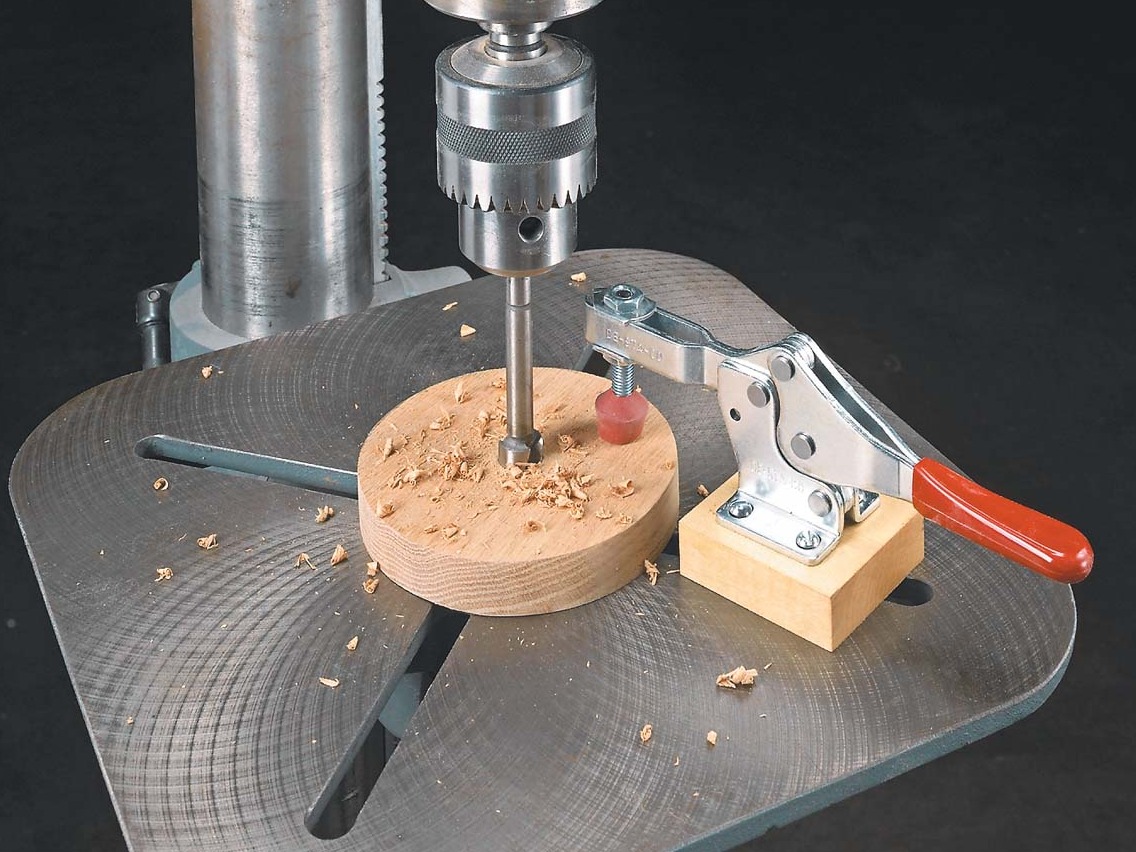
Hold-down toggle clamps apply downward pressure to secure a workpiece against a table, jig, or fixture.
When you move the lever into its locked position, the clamping arm presses a threaded spindle against the workpiece.
This keeps the material from lifting or shifting during an operation.
Best Uses for Hold-Down Toggle Clamps
Hold-down clamps are particularly useful on woodworking jigs that need to secure material from above.
For example, they work well on table saw ripping jigs and miter sleds, where they can hold a workpiece firmly against the jig's surface.
They're also valuable at the drill press.
When drilling small parts, a hold-down clamp can secure the workpiece to a fixture, reducing the need to position your fingers close to a spinning drill bit.
This makes drilling operations safer and helps keep the workpiece from moving as the bit enters the wood.
How to Adjust a Hold-Down Toggle Clamp
One of the biggest advantages of hold-down toggle clamps is their adjustability.
Most designs allow you to adjust the spindle both vertically and horizontally.
Vertical adjustment: The threaded spindle is held in position by nuts above and below the clamping arm. Loosen the nuts and turn the spindle to raise or lower the contact point.
This allows you to accommodate different workpiece thicknesses and adjust the pressure applied when the lever is locked.
Horizontal adjustment: The clamping arm typically features an elongated slot that allows the spindle to slide forward or backward.
Moving the spindle along this slot changes where the pressure is applied to the workpiece.
This is especially helpful when working with parts of different sizes or when you need to position the clamping point closer to a particular area.
Together, these adjustments make hold-down toggle clamps versatile additions to many shop-made fixtures.
Straight-Line Toggle Clamps: Horizontal Clamping Pressure

While hold-down clamps press vertically, straight-line toggle clamps apply pressure horizontally.
Instead of using a swinging clamping arm, a straight-line clamp features a plunger that moves forward and backward as the lever is operated.
The motion is similar to a piston.
When the lever is engaged, the plunger pushes against the workpiece to hold it in position.
Best Uses for Straight-Line Toggle Clamps
Straight-line toggle clamps are ideal for woodworking jigs and fixtures where a workpiece needs to be pushed against a fence, stop, or another component.
They're especially useful for assembly and glueup jigs.
For example, a straight-line clamp can apply pressure to hold frame components together while the glue dries.
They also work well at the drill press, where a clamp can hold a workpiece firmly against a fence.
This helps maintain consistent positioning when drilling multiple identical parts.
How to Adjust a Straight-Line Toggle Clamp
Straight-line toggle clamps typically offer one main adjustment: the position of the threaded spindle.
To change the clamping pressure, loosen the jam nut and turn the spindle in or out.
Extending the spindle increases its reach, while retracting it provides additional clearance for thicker workpieces or different fixture arrangements.
Once the desired position is set, tighten the jam nut to secure the adjustment.
Although straight-line clamps don't offer the same vertical and horizontal spindle positioning as hold-down clamps, their direct pushing action makes them particularly effective for edge clamping and assembly work.
Use Multiple Straight-Line Clamps for Even Pressure

One of the most useful features of straight-line toggle clamps is that several can be used together.
For example, two or more clamps can be mounted along a jig to apply pressure across a wide workpiece or assembly.
This arrangement is particularly helpful for frame glueups and other tasks where pressure needs to be distributed across a larger area.
Each clamp can be adjusted individually to provide the appropriate amount of pressure.
Using multiple clamps also helps prevent a workpiece from shifting or rotating as pressure is applied.
For repetitive assembly work, this can be much faster than repositioning traditional clamps for every part.
Customize Toggle Clamp Pressure with Different Tips

Both hold-down and straight-line toggle clamps allow you to customize how pressure is applied to a workpiece.
Most clamps come equipped with rubber-tipped spindles.
These soft contact pads provide a little cushioning and help protect wood surfaces from dents or marks.
They're a good choice for finished surfaces, softer woods, and other materials that could be damaged by direct metal contact.
Change the Contact Point
Depending on the clamp, you may be able to replace the rubber tip with another style of contact pad.
Different tips can change how pressure is distributed across the workpiece.
A wider pad spreads the load over a larger surface, while a smaller contact point concentrates pressure in a specific area.
Replace the Spindle with a Hex Bolt
For some applications, you can replace the standard threaded spindle with a hex bolt of the appropriate size.
This creates a smaller, more concentrated contact point than a typical rubber cap.
It can be useful when you need to apply pressure to a specific location on a workpiece.
However, a metal bolt can easily leave marks or dents in wood, so it's best reserved for applications where surface damage isn't a concern.
Choosing the Right Toggle Clamps for Woodworking
When selecting toggle clamps for your shop, start by considering how you'll use them.
If you need to hold a workpiece down against a jig or table, a hold-down toggle clamp is usually the better choice.
If you need to push a workpiece horizontally against a fence or another component, a straight-line clamp is often more practical.
Other factors to consider include the clamp's holding capacity, spindle adjustment range, mounting arrangement, and overall construction quality.
Quality Makes a Difference
Toggle clamps are available from a variety of manufacturers, with prices and quality varying considerably.
One well-established manufacturer is De-Sta-Co, short for Detroit Stamping Company.
The company offers a wide range of toggle clamp styles and sizes suitable for woodworking jigs and fixtures.
Less expensive alternatives are also widely available, but construction quality, adjustment mechanisms, and clamping performance can vary.
For jigs that see frequent use, a well-made clamp with smooth operation and dependable locking action is worth considering.
Make Your Woodworking Jigs More Useful with Toggle Clamps
Whether you're building a table saw sled, setting up a drill press fixture, or creating a dedicated assembly jig, toggle clamps can make your woodworking more efficient.
Hold-down clamps provide convenient vertical pressure for securing workpieces against a surface, while straight-line clamps offer controlled horizontal pressure for positioning parts against fences and stops.
Both styles are easy to adjust and can be customized with different contact tips to suit the job.
Once you start incorporating toggle clamps into your shop-made jigs, you'll find plenty of opportunities to make repetitive woodworking tasks faster, more accurate, and safer.
More Woodworking Jigs & Fixtures

Make your time in the workshop more productive with our collection of woodworking jigs and fixtures. From table saw sleds and cutting guides to clamping fixtures and precision layout aids, these practical shop-made accessories help you work more accurately, efficiently, and safely. Explore clever designs and useful projects that make everyday woodworking tasks easier.
SEE MORE → Explore More Woodworking Jigs & Fixtures