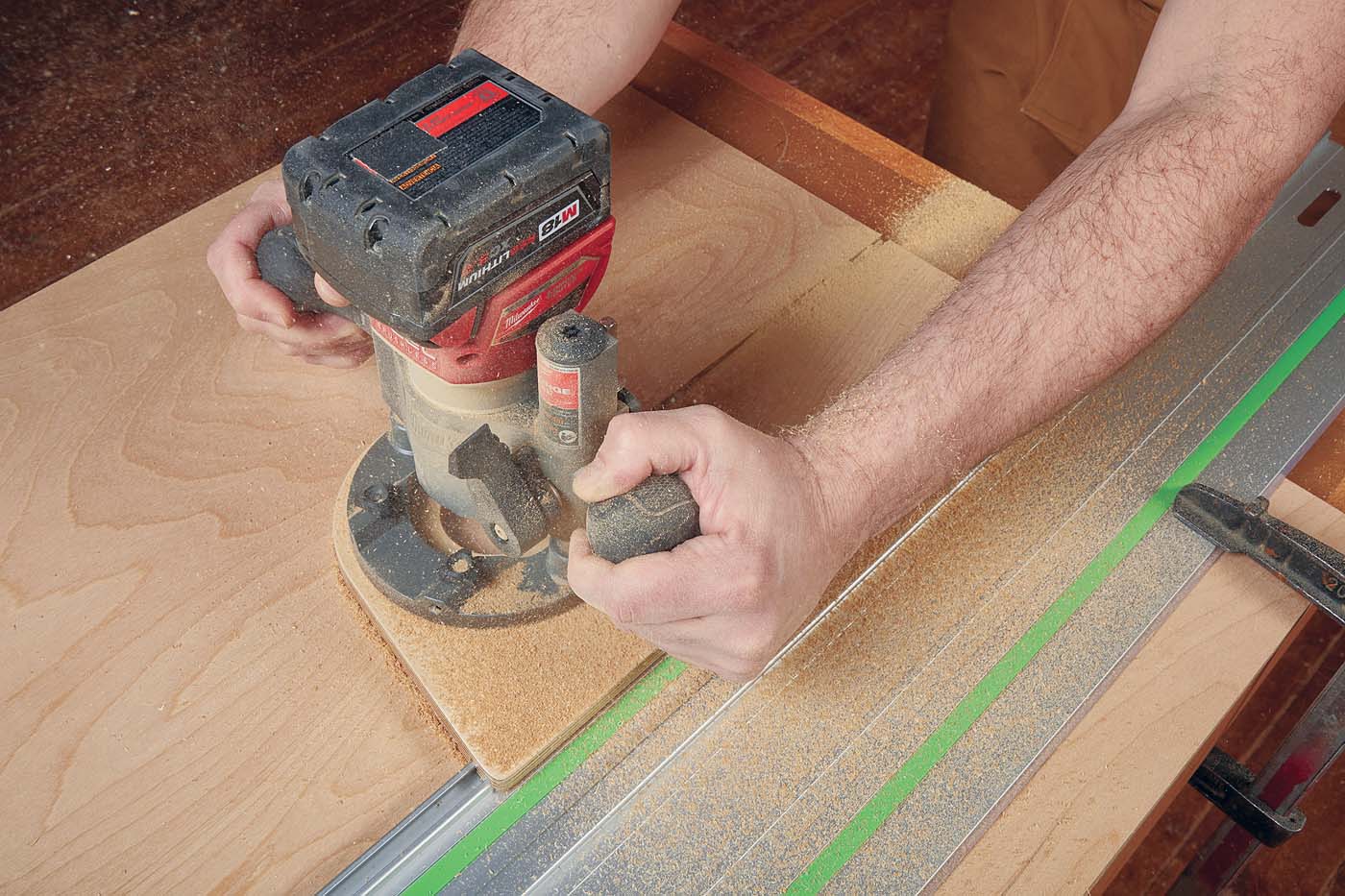


When someone just getting into woodworking asks if I have any recommendations, one of my first suggestions is to get a router and learn to use it. There’s a lot you can do with a router. For a beginner, investing the money in bits and accessories and time in building the skills will pay dividends that few other tools can match. Additionally, a smaller palm router is an easy-to-handle tool for those new to working with power tools.
Recently, at the Woodworking in America event we held here in Des Moines, I got to meet a woodworker by the name of Toyohisa Sugita. This turned out to be quite serendipitous: one of Sugita’s books had recently been translated into English and crossed my desk only a few months back. This book was Routing.
 |
| Routing by Toyohisa Sugita, GMC Publications, RRP $35, available online and from all good bookshops. |
A BIT ABOUT ROUTING.
Routing is a book that covers the use of palm routers, or trim routers. Sugita begins from the ground up, with the first chapter covering the fundamentals of using a router: how it functions, what bits you’ll need, avoiding back-routing, etc. The following two chapters build on those basics, and Sugita’s method quickly becomes evident.
 |
 |
| box joint inro box | desktop chest |
At the event, Sugita gave a demonstration, not of routing, but rather of hand sawing. However, his approach remains the same for both methods. He showed a few of his jigs, which used spacers to locate his cuts on a few joints. In Routing, his style is the same, and much of the book focuses on the use of guides and jigs to eliminate any “eyeballing” or guesswork.
A PRACTICAL APPROACH.
In talking with Sugita, it came up that his style of woodworking stemmed from a rule he set for himself early in his career: he’d figure out a way to ensure his joints were perfectly fit after the initial cut, without need for fitting with planes or chisels. That’s an admirable goal for any woodworker, I’d say, if a lofty one. Sugita’s answer to that riddle was to make sure that every joint he made was cut with a jig that he could dial in to his exact measurements.
WHAT’S IN THE BOOK?
I found Sugita’s approach in this book to be an excellent starting point for beginners. As I mentioned previously, his first chapter is dedicated to the fundamentals of router use. The second chapter of Routing covers handheld use. He provides his designs for several handheld accessories, such as an auxiliary baseplate and an edge guide. The chapter culminates in a simple mitered box to make use of the techniques learned earlier.
The third chapter moves on to working with a benchtop router table (or a trimmer table, as Sugita calls it). Like the previous chapter, this one starts with the basics. The parts of the router table are explained, as are common operations (rabbets, dadoes, grooves) and safety protocols (which way to push the piece, which side of the bit it should be on). The last section of this chapter provides instructions on building a benchtop router table and a fence to go with it.
The final chapter of Routing is devoted to projects. You can see two of these above. These projects either aim to give some instruction on fundamental joinery, or be used as more accessories for your shop. For instance, the left box illustrates how to create both a box joint and a half-blind rabbet.
While Routing is quite beginner-friendly, there’s still plenty more experienced woodworkers can pick up. In the following pages, I’ll dive into one of the projects to show Sugita’s style and a jig I particularly enjoyed.
WALL-MOUNTED BOXES
 |
 |
| These wall-mounted boxes offer some practice in splined miter joints. Sugita includes plans for several jigs to rout this joinery. | Sugita’s splined miter edge guide is the key to these boxes, and one of my favorite accessories from his book. |
To show you what you can expect from Routing, I’ll break down one of the projects included in the final chapter of the book. The “Wall-Mounted Box” is shown at right, and utilizes several techniques taught throughout the course of the book, including cutting splined miter joints and creating a French cleat. In addition, Sugita shows how to construct a flush trimmed door panel to close them up.
PROJECT BREAKDOWN.
Each project begins by breaking down the construction, either into the basic operations or by pointing out the key features of a particular project. For the wall-mounted boxes, there are ten basic operations to be performed. From there, each operation is walked through step-by-step with photos of Sugita to help guide the reader. The photos on this page come from his book.
DIMENSIONING BY HAND.
 |
| Sugita eschews the table saw when sizing material, instead using hand saws to reach a rough shape. The router is then used to cut the piece to final size and give it a clean, finished edge. |
In the photo at left below, you can see Sugita sizing his material with a hand saw. The only power tools used in Routing are the router and occassionally a drill. Sugita does his planing and dimensioning by hand, using a guide in this case to rough out the mitered ends of the workpieces.
While he doesn’t go indepth on precisely how to dimension by hand, he offers some useful tips, such as how to construct the 45° guide shown at left below.
BUILDING ON SKILLS.
 |
| The book builds on its techniques as it progresses. The method shown to finish the miter joints on these boxes utilizes skills and jigs addressed in previous chapters. |
Sugita finishes that mitered edge by routing it to the final size and angle. For this task, he provides both a handheld and tabletop method. The handheld method is learned in the second chapter, utilizing a set of pins to ensure workpieces are precisely positioned. By the time the reader gets to the projects, they will have gone through his chapter on using a router table, so Sugita uses this project to show a method of mitering at the table instead.
MITERED SPLINE JIG.
 |
 |
| Sugita’s spline joint jig uses cutoffs from the splines to ensure that the width of the dado will match the thickness of the spline exactly. | After the initial cut, removing the spline correctly positions the jig to finish the groove with a second cut. |
Sugita continues the project by showing how to cut dadoes for the back panels along the newly mitered workpieces. However, what I’d like to discuss is the operation after that, which involves the mitered spline jig you see above.
As I mentioned before, althougth this book is geared toward giving beginners the tools they need to use a router effectively, there are still plenty of techniques and designs that seasoned woodworkers can make use of, and one of those things is the mitered spline jig you can see on the previous page and the photos at right. This is another jig that Sugita introduces early, in his second chapter, but which he demonstrates the practical use for in this project.
Put simply, Sugita’s jig uses the spline that will join the miter to size the dadoes for them. He provides the designs for it in the second chapter (along with the angled table the workpiece sits on), and it is a jig that I find to be emblematic of Sugita’s style. It eliminates guesswork and opts to use a physical spacer (the spline in this case) to accurately size the joint. I’ve made the jig myself, and even begun to use it in my own shop.
ART & PHOTOS.
 |
 |
| Drawings and step-by-step photos guide the reader through each operation, such as with these French cleats that hold the boxes. |
After showing the reader how to create the mitered splines, Sugita takes them through gluing up and painting the project. This is followed by an introduction to the French cleat and a series of photos on its construction. In addition to the step-by-step photos, Sugita often includes his own art to expand on the design of a guide or jig, or to illustrate a structural component, such as the French cleat shown below.
PRACTICAL APPLICATION.
Learning by doing is the key theme with many of these projects. The wall-mounted boxes are completed with a pair of simple, flushtrimmed panel doors. Flush trimming is shown here for the first time, however a reader doesn’t need to be working on this particular project to find the information useful.
 |
| Common operations, such as flush trimming, are demonstrated in the projects, and indicated in the table of contents for easy reference. |
Common operations like this are indicated as “Tips” in the table of contents. Additionally, this book is well indexed, and the location of a certain technique can easily be found simply by looking it up in the back of the book.
WHAT YOU’LL LEARN.
As I’ve indicated earlier, Routing is a great book for beginners. It contains everything someone starting out would need to know about their router, and it offers ways to make a variety of projects with only a router, drill, and a few hand saws, so not having a dream shop yet isn’t an excuse to put off woodworking. In terms of structure and presentation, Sugita does an excellent job at laying down the groundwork, then “testing” the reader’s knowledge by providing them projects that utilize their skills.
For the more experienced router-wielder, there is still plenty you can pick up. The jig I showed here is just one example. Sugita offers his take on a number of common jigs and guides that emphasize his focus on both precision and approachability. If you’ve an urge to expand your routing horizons, whether you’re a beginner or a woodshop veteran, then I recommend checking out Routing.
ABOUT THE AUTHOR
Toyohisa Sugita. Toyohisa Sugita is a Japanese author and woodworker based out of Tokyo. His woodworking career began at the age of 28 when he started constructing his own cruising yacht. He completed the vessel at the age of 33, and his work over those years illustrated to him the importance of jigs in woodworking.
In the four decades since, he has worked on the development, manufacturing, and sale of woodworking products, along with authoring several books and producing a number of educational videos. Today, Sugita developes his own woodworking products and continues to write, in addition to performing demonstrations across the world, including Japan and the U.S. Routing has been translated into English and published in western markets by GMC Publishing. If you’re interested in purchasing a copy of Routing, refer to sources on page 66.
 |
 |
| Photographed above is the 27 1/2 cruising yacht that kicked off Sugita’s woodworking career. |