

Router pattern bits are some of the most versatile bits you can keep in your router bit collection. They're commonly used to follow templates and duplicate shapes, but their usefulness extends well beyond pattern routing.
With the right bit, you can cut dadoes, grooves, mortises, and other joinery, often using the same bit you'd normally reach for when following a template.
The trick is understanding the differences between the various styles of pattern bits and choosing one that matches the job.

What Is a Router Pattern Bit?
A pattern bit is a router bit with a guide bearing located near the shank, above the cutting flutes.
The bearing rides against a template or other reference surface while the cutting edges remove material from the workpiece.
This allows you to create matching shapes, clean up edges, and rout details that follow a predetermined pattern.
Pattern bits are closely related to flush-trim bits, but there's an important difference in bearing location.
Pattern Bit vs. Flush-Trim Bit
Both types of bits use a bearing to guide the cut.
The distinction is where that bearing is located.
- Pattern bit: The bearing is near the shank, above the cutting edges.
- Flush-trim bit: The bearing is at the tip, below the cutting edges.
With a pattern bit, the template is typically positioned above the workpiece when using a handheld router. With a flush-trim bit, the template is positioned below the cutting edges.
Both can produce accurately matched parts. Choosing between them often comes down to where you want to position the template and how you're supporting the workpiece.
Woodsmith Tip: Check the Bearing Location. When selecting a bit for template routing, make sure the bearing will contact the template throughout the cut. A pattern bit and a flush-trim bit may look similar, but their different bearing positions affect how the template and workpiece must be arranged.
What Is a Dado Cleanout Bit?
Dado cleanout bits belong to the broader family of pattern bits.
Like other pattern bits, they have a bearing near the shank. But their shorter cutting lengths make them especially useful for cleaning up or routing relatively shallow recesses.
That includes dadoes, grooves, and other flat-bottomed details.
Because the cutting edges extend to the bottom of many pattern bits, they can also serve some of the same functions as ordinary straight bits.
However, not every pattern bit is designed for plunging directly into the wood. If you plan to start a cut away from an edge, choose a bit specifically designed for plunge cutting.
Choose the Right Cutting Length
One of the first things to consider when selecting a pattern bit is the length of its cutting flutes.
Longer cutting lengths allow you to work with thicker stock or rout deeper details.
For example, a long pattern bit can be useful when trimming a thick workpiece to match a template or routing a deeper mortise. But there's a tradeoff.
Longer bits can be more susceptible to vibration and deflection, especially when they're extended farther from the router collet.
Shorter bits generally provide a more stable setup. That's why a short cutting length is often a good choice for shallow dadoes and grooves.
Choose a bit with enough cutting length for the job without using more length than necessary.
Router Bit Diameter Makes a Difference
Pattern bits are available in a range of diameters, and diameter affects more than the width of the cut.
Larger-Diameter Pattern Bits
Larger-diameter bits generally have a more substantial cutting body.
In a suitable setup, they can provide a stable cut and work well when removing material from broad edges or trimming thicker parts.
However, a larger bit also removes more material and requires more clearance.
Smaller-Diameter Pattern Bits
Smaller bits can reach into tighter spaces and produce narrower cuts.
They're especially useful for details such as hinge mortises, where a smaller diameter leaves less material to square up in the corners.
A smaller bit may also be necessary when you're working with narrow grooves or compact templates.
Woodsmith Tip: Think About the Corners. When routing a rectangular recess, the bit leaves rounded inside corners. A smaller-diameter bit produces a smaller radius, which means less cleanup with a chisel if the recess needs square corners. This is especially handy when routing hinge mortises.
Choose a Plunge-Cutting Pattern Bit for Stopped Cuts
Not all pattern bits can plunge directly into a workpiece. Some are intended primarily for trimming along an existing edge, while others have cutting edges designed to remove material from the bottom of a cut.
For versatility, I prefer plunge-cutting pattern bits. They're particularly useful for stopped grooves, mortises, and other cuts that begin or end within the workpiece rather than running completely across it.
Before using a bit for plunge cutting, verify that its design and manufacturer's instructions allow it.
Spiral Pattern Bits for Smoother Cuts
Pattern bits are also available with spiral cutting flutes. Rather than using straight cutting edges, these bits shear the wood as they rotate.
This cutting action can produce a cleaner surface, especially when trimming edges or working with difficult grain.
Some spiral pattern bits use a compression cutting geometry, with opposing flute directions that help reduce tearout on both faces of sheet goods when the bit is engaged at the appropriate depth.
Spiral bits can be a good choice when the quality of the routed edge is especially important.
Match the Bit to the Project
You don't need every size and style of pattern bit to get started. A couple of well-chosen bits can handle a surprising range of tasks.
A short pattern bit is useful for shallow joinery, while a longer version provides more capacity for trimming thicker workpieces or routing deeper details.
From there, let your projects determine what else belongs in your collection.
For example, a router finger-joint jig may require specific bit diameters or cutting lengths to accommodate different stock thicknesses.
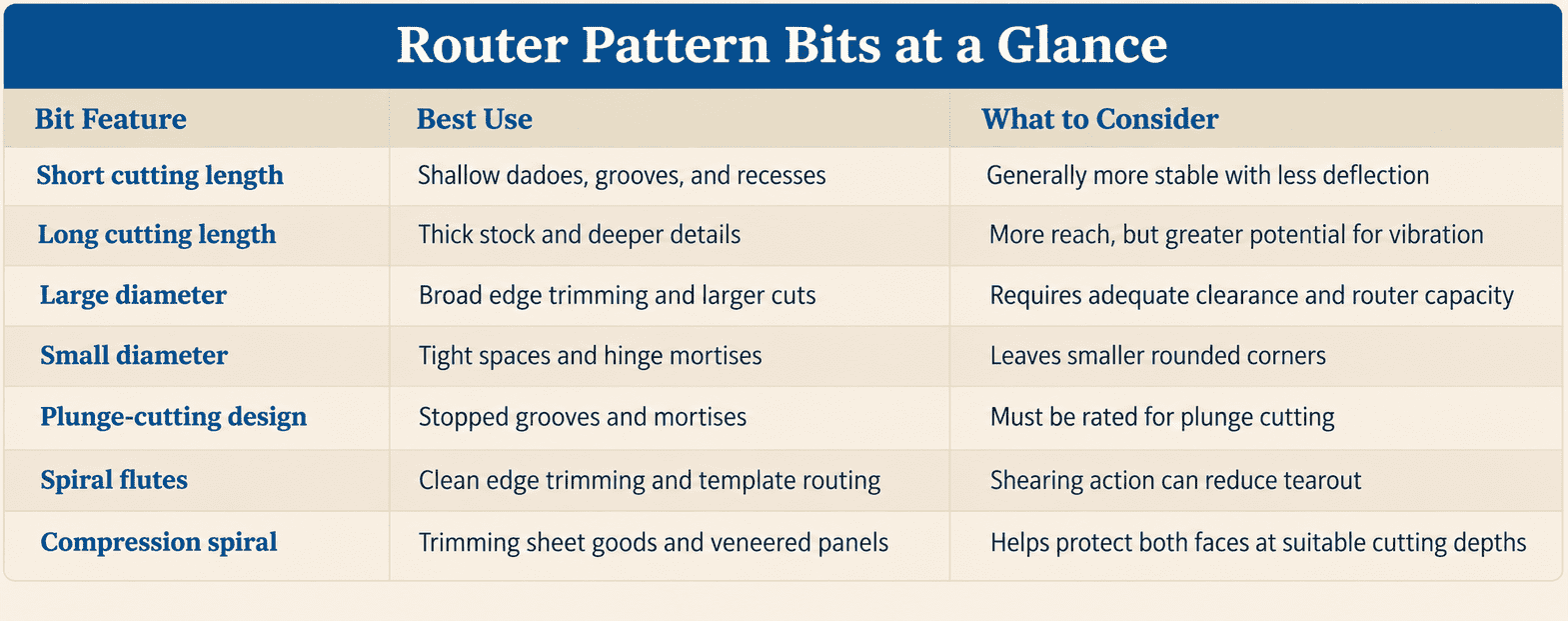
Router Pattern Bits at a Glance
Get More from Your Router Bits
Pattern bits are worth having around because they aren't limited to one task.
The same bit you use to follow a template may also be useful for cutting a groove, cleaning up a dado, or routing a mortise.
Start with a couple of sizes that suit the work you do most often. Then expand your collection as specific projects call for different cutting lengths, diameters, or flute designs.
Understanding these differences makes it easier to choose the right bit and get cleaner, more accurate results.
Make Identical Parts with Your Router
Pattern bits really shine when you need to duplicate curved or irregular parts. Learn how to make accurate templates, rough-cut your workpieces, and use bearing-guided router bits to produce matching components.
LEARN TEMPLATE ROUTING → How to Use Templates for Accurate Router Cuts
Discover More Handy Woodworking Tips
We've collected some of the best woodworking tips and techniques from our readers, covering everything from joinery and shop-made jigs to sharpening, finishing, and more. Find practical solutions that save time and help you get better results in the shop.
EXPLORE TIPS & TECHNIQUES → Tips & Techniques for Better Woodworking