


A sharp router bit can make all the difference between a clean, precise cut and a rough edge that needs extra sanding. While traditional straight router bits have their place in the workshop, spiral router bits offer some distinct advantages when it comes to cut quality, chip removal, and versatility.
Unlike straight bits, spiral flute router bits feature cutting edges that wrap around the bit in a helix. This design creates a shearing cut that can reduce tearout and leave a smoother surface. Depending on the direction of the spiral, the bit can also pull chips out of a groove or push wood fibers downward to protect a delicate veneer.

But not all spiral bits work the same way. An upcut bit, downcut bit, and compression bit each have advantages for different woodworking operations.
Whether you're routing mortises in hardwood, cutting dadoes in plywood, or trimming a veneered panel, understanding these differences will help you choose the right router bit for the job.
What Is a Spiral Flute Router Bit?
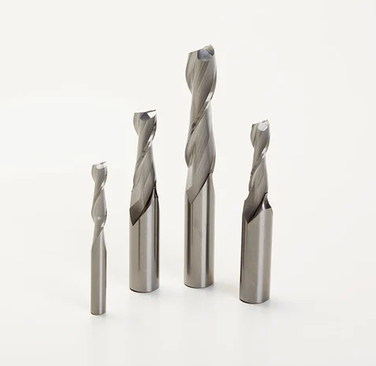
A spiral router bit looks similar to a twist drill bit, but it's designed to cut along its sides as well as, in the case of plunge-capable bits, at its end.
Instead of having straight cutting edges that run parallel to the shank, a spiral bit has one or more flutes that wrap around its body. These flutes create a continuous cutting action as the bit rotates.
Most modern spiral router bits are made from solid carbide, which provides excellent edge retention and durability. They're available in a range of diameters and cutting lengths to suit everything from narrow grooves to deep mortises.
The primary advantage, however, comes from the way the cutting edges engage the wood.
Why Do Spiral Router Bits Make Cleaner Cuts?
There are two important reasons spiral router bits often produce smoother results than traditional straight bits: their shearing action and their ability to move chips away from the cutting edge.
1. A shearing cut reduces tearout
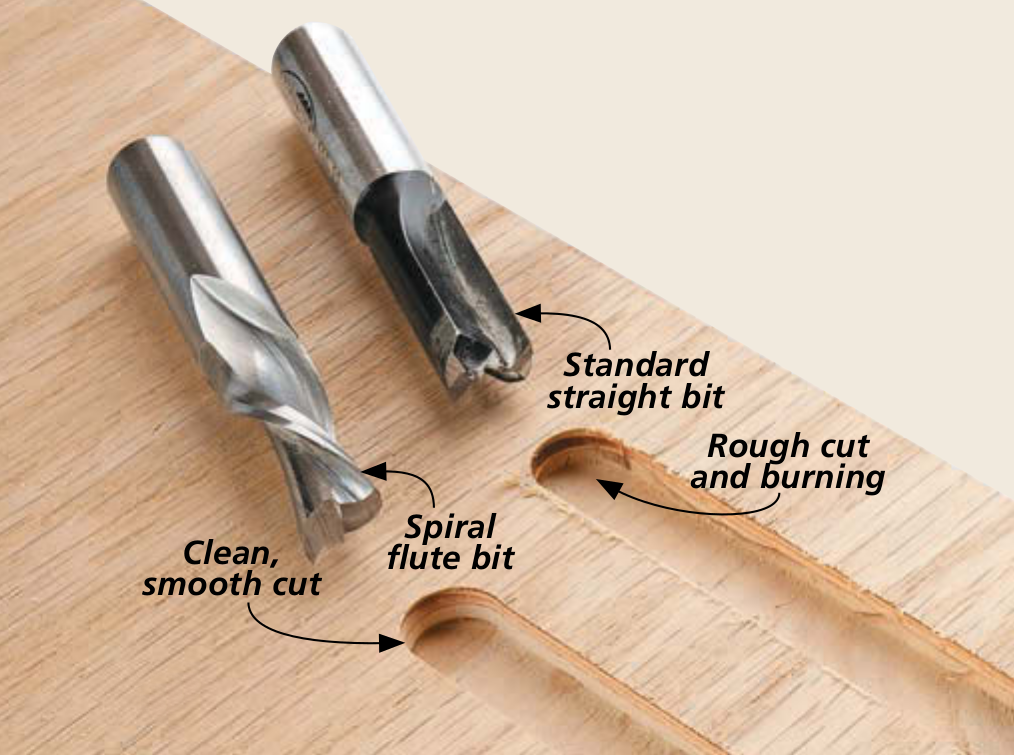
A traditional straight router bit cuts into the wood with a relatively direct chipping action. Depending on the grain direction and the material, this can produce tearout, a rough surface, or the scalloped appearance sometimes called chatter.
A spiral bit approaches the wood fibers at an angle. Its cutting edges shear through the material progressively rather than engaging the full cutting length at once.
This slicing action can produce a smoother surface, especially when routing hardwood, plywood, or materials with difficult grain.
2. Better chip removal keeps the cut clear
A spiral router bit also moves chips along its flutes as it cuts.
Depending on the design, those chips are directed either upward or downward. Keeping waste away from the cutting edge helps reduce recutting, friction, and heat buildup.
Efficient chip removal is especially important when cutting deep grooves or mortises, where chips can otherwise accumulate inside the cut.
However, the direction of chip movement also affects which face of the workpiece receives the cleanest cut. That's where choosing between an upcut and a downcut bit becomes important.
Upcut vs. Downcut Spiral Router Bits: What's the Difference?
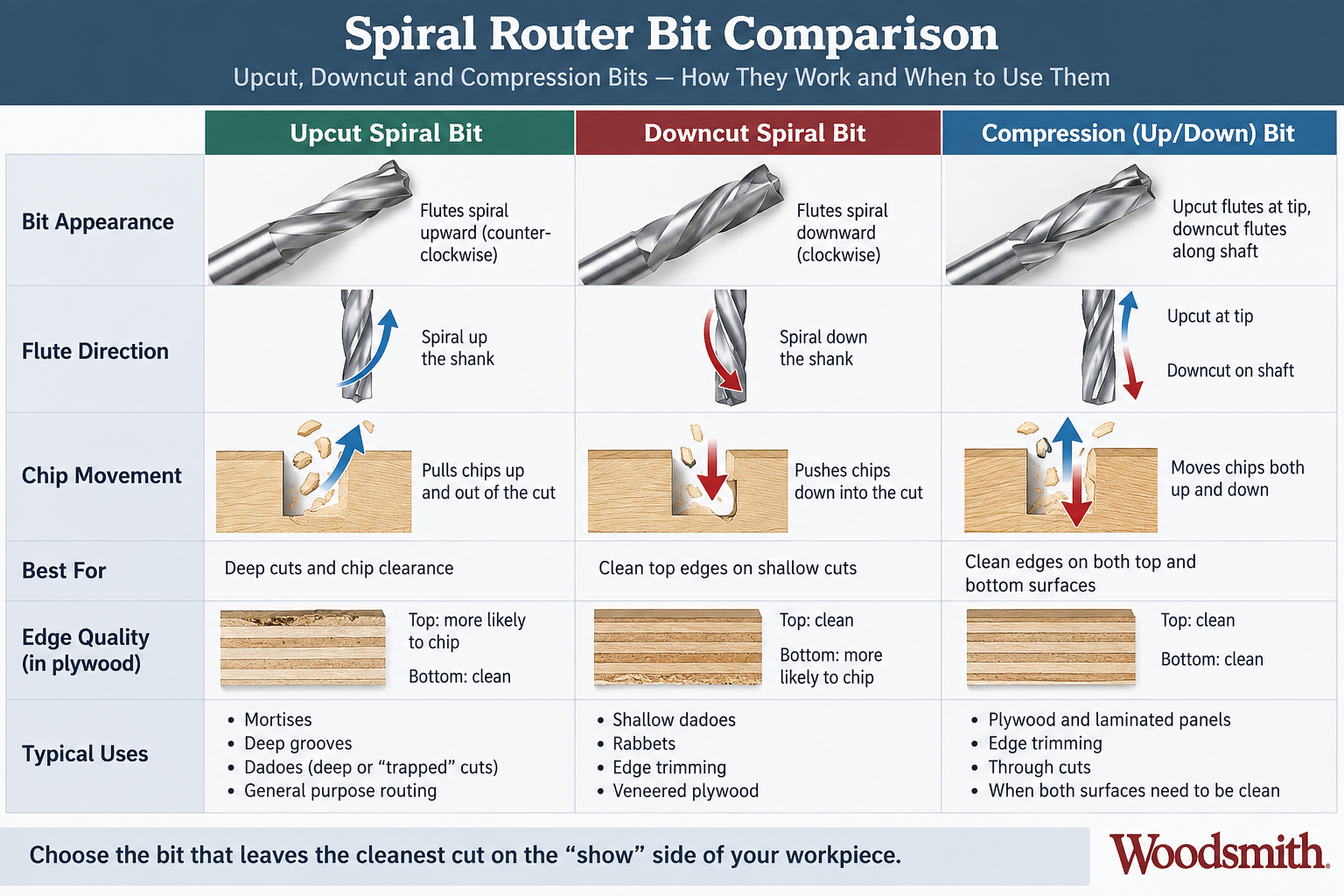
The main difference between an upcut and a downcut spiral router bit is the direction in which the flutes move chips and shear the wood fibers.
An upcut bit lifts chips toward the router, while a downcut bit pushes them toward the bottom of the cut.
Both types are designed for the normal rotation of a woodworking router, but their cutting action makes them suited to different applications.
Upcut Spiral Router Bits: Best for Mortises and Deep Grooves
When cutting a deep mortise or groove, chip removal is especially important. An upcut spiral bit works much like a twist drill, lifting waste out of the opening as it cuts.
This helps prevent chips from accumulating around the cutting edges, reducing heat buildup and allowing the bit to work more efficiently.
The trade-off is that the upward shearing action can lift wood fibers along the top surface. This may result in fuzzing or tearout, particularly when routing veneered plywood.
For this reason, I generally reach for an upcut spiral bit when routing mortises in solid wood or making deep, enclosed cuts where efficient chip removal is the priority.
Downcut Spiral Router Bits: Cleaner Edges on Plywood
A downcut spiral bit works in the opposite direction, pushing wood fibers downward as it cuts. This helps produce a crisp, clean edge along the top surface of the workpiece.
That's a significant advantage when cutting shallow dadoes or rabbets in veneered plywood, where chipping along the visible surface can be difficult to repair.
However, because a downcut bit pushes chips into the cut, it isn't always the best choice for deep grooves or mortises. Taking multiple shallow passes and clearing accumulated waste helps prevent overheating and produces better results.
When the appearance of the top surface matters most, a downcut bit is often the better choice.
Compression Router Bits: Clean Cuts on Both Sides of Plywood
What if you need a clean edge on both the top and bottom faces of a plywood panel?
That's where a compression spiral router bit comes in.
A compression bit combines two cutting directions in a single tool. The lower portion of the bit has upcut flutes, while the upper portion has downcut flutes.
As the bit moves through the material, these opposing cutting directions shear the outer fibers toward the center of the panel.
The result is a clean edge on both faces, making compression bits particularly useful for cutting plywood, melamine, and other laminated sheet goods.
Compression spiral router bit
When should you use a compression bit?
Compression bits are commonly used for cutting through plywood panels, particularly with a CNC router.
They can also be useful for edge trimming and other operations where both faces of the workpiece must remain clean.
There's one important detail: The cut must engage both the upcut and downcut portions of the bit to achieve the full compression effect.
If your cut engages only the lower upcut section, the bit will behave like an upcut bit. Check the length of the upcut portion and plan your cutting depth accordingly.
For CNC operations, the first pass may need to extend beyond the upcut portion to prevent chipping along the top surface.
When working with veneered plywood, a properly selected compression bit can save considerable cleanup time.
Why Spiral Upcut Bits Work So Well for Routing Mortises
One of my favorite uses for a spiral router bit is cutting mortises.
A traditional straight bit can cut a mortise, but plunging into solid wood presents some challenges. Chips accumulate in the opening, and the bit can generate excess heat if the waste isn't cleared frequently.
A plunge-capable spiral upcut bit addresses both issues.
As the bit enters the wood, its end-cutting edges remove material from the bottom of the mortise while the spiral flutes lift chips out of the opening. This helps the bit cut smoothly and makes it easier to produce a clean, accurately sized mortise.

For the most consistent results, use a plunge router with an edge guide or a dedicated router mortising jig.
Tips for cutting clean mortises with a spiral bit
A spiral upcut router bit makes cutting mortises easier by lifting chips out of the opening as you work. But a clean, accurate mortise also depends on proper layout, a secure workpiece, and controlled cutting depth.
Follow these six steps to get smooth mortise walls and a precise fit for your mortise-and-tenon joints.
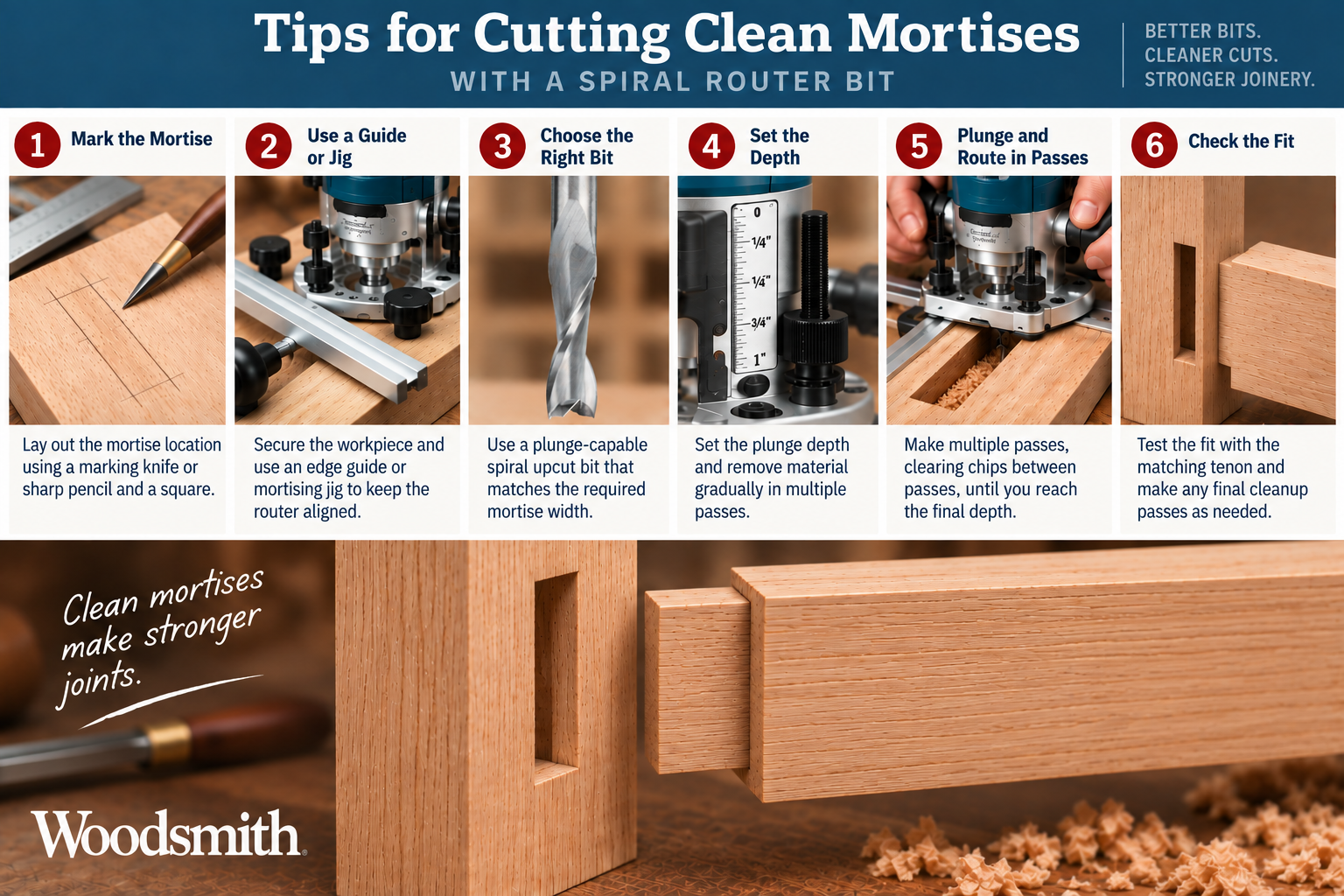
1. Mark the mortise. Lay out the mortise location and dimensions using a marking knife or sharp pencil and a square. Accurate layout helps ensure the mortise is positioned correctly.
2. Use a guide or jig. Secure the workpiece firmly and use an edge guide or shop-made router mortising jig to keep the router aligned. A jig makes it easier to cut straight, consistent mortises.
3. Choose the right bit. Select a plunge-capable spiral upcut bit that matches the required mortise width. Its upward-cutting flutes help remove chips and reduce buildup inside the mortise.
4. Set the cutting depth. Adjust the router's plunge-depth stop for the first shallow pass. Plan to remove material gradually rather than cutting the full mortise depth at once.
5. Plunge and route in passes. Move the router smoothly along the guide, allowing the bit to do the work. Raise the bit and clear accumulated chips between passes, then increase the depth until you reach the final mortise depth.
6. Check the fit. Test the mortise with its matching tenon. Make any necessary cleanup passes to achieve a snug fit without forcing the joint together.
Avoid pushing the router too aggressively. Even with a spiral upcut bit, removing too much material in a single pass can cause chatter, overheating, or excessive stress on the bit.
Want more accurate, repeatable mortises? A shop-made router mortising jig helps keep the router aligned and provides better control over mortise width and length. Check out the Woodsmith Precision Router Mortising Jig woodworking plan for a versatile way to improve your mortise-and-tenon joinery.
Related Woodsmith project: Build a Precision Router Mortising Jig
How to Choose the Right Spiral Router Bit
Spiral router bits are available in a variety of diameters, cutting lengths, flute configurations, and materials. Selecting the right combination depends on the type of cut you're making and the material you're working with.
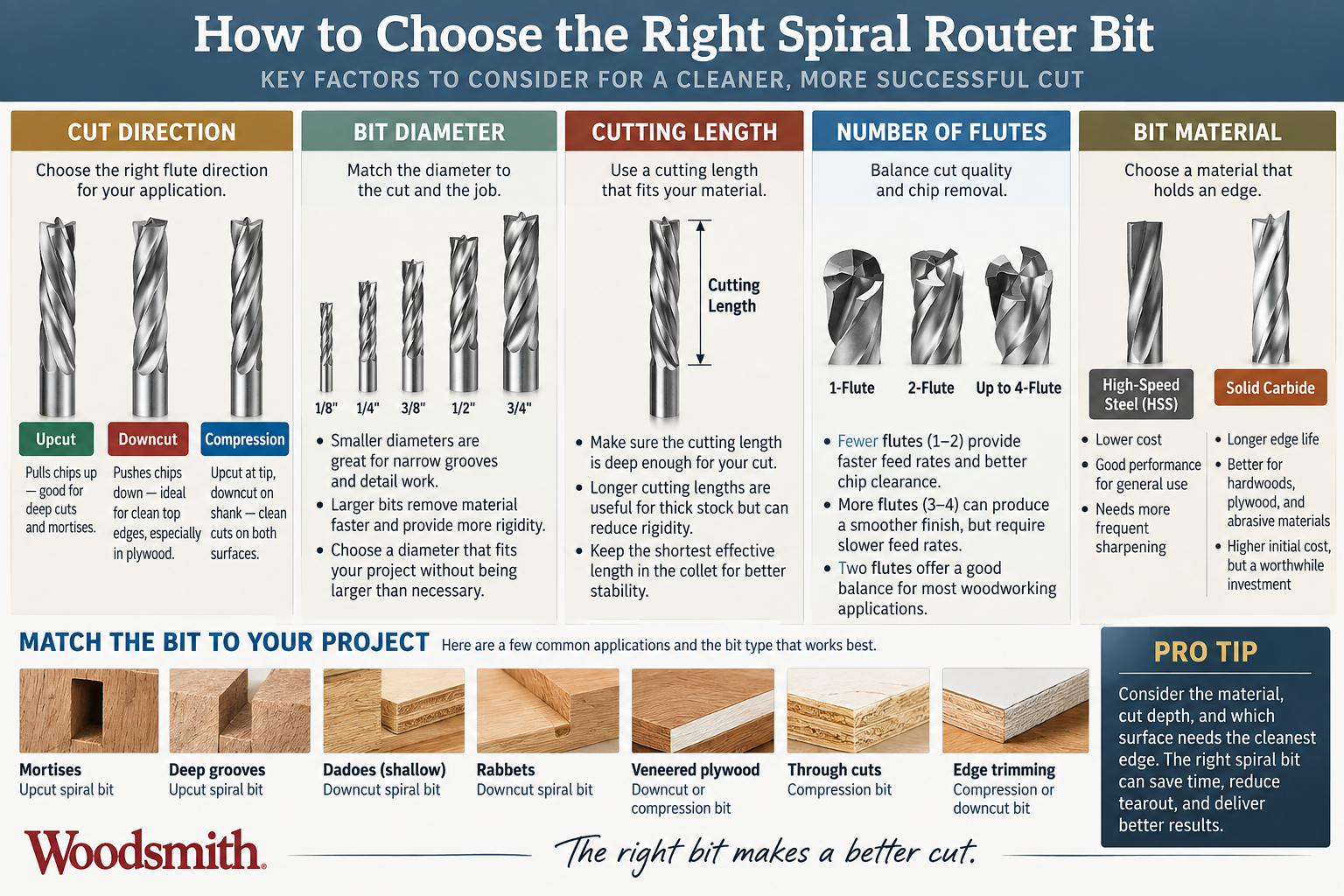
Solid carbide vs. high-speed steel
Most quality spiral router bits are manufactured from solid carbide, although high-speed steel (HSS) versions are also available.
Solid carbide holds a sharp cutting edge longer than HSS, making it particularly useful when routing abrasive materials such as plywood, MDF, and particleboard.
Carbide bits generally cost more, and their cutting edges can be brittle if mishandled. However, their edge retention makes them a worthwhile investment for many woodworking operations.
For a router bit that you'll use regularly, I prefer solid carbide.
Choosing the right diameter and cutting length
Spiral router bits are available in diameters ranging from small 1/8" bits to larger 3/4" models and beyond. Cutting lengths vary depending on the bit.
A smaller diameter is useful for narrow grooves and mortises, while a larger bit removes material more quickly and can provide greater rigidity.
When selecting a bit, consider both the width and depth of the cut. Use a cutting length appropriate for the operation without choosing an unnecessarily long bit.
Also, make sure the bit's shank is compatible with your router's collet. A 1/2" shank is generally preferable for larger bits when the router supports it.
How many flutes do you need?
Spiral router bits may have one, two, three, or four cutting flutes.
The number of flutes affects cutting performance, chip clearance, and the feed rate required to produce a clean surface.
Bits with more flutes have more cutting edges, which can improve surface finish under appropriate cutting conditions. However, the additional flutes leave less room for chip evacuation.
Two-flute spiral bits offer a useful balance between cutting performance and chip clearance for many general woodworking operations.
The ideal flute count also depends on the material, router speed, and feed rate. Follow the bit manufacturer's recommendations rather than assuming that more flutes will always produce a better result.
Specialty Spiral Router Bits: Chipbreaker and Flush-Trim Designs
In addition to standard upcut, downcut, and compression bits, there are specialized spiral router bits designed for particular operations.
Two useful examples are chipbreaker bits and spiral flush-trim bits.
Specialty spiral router bits
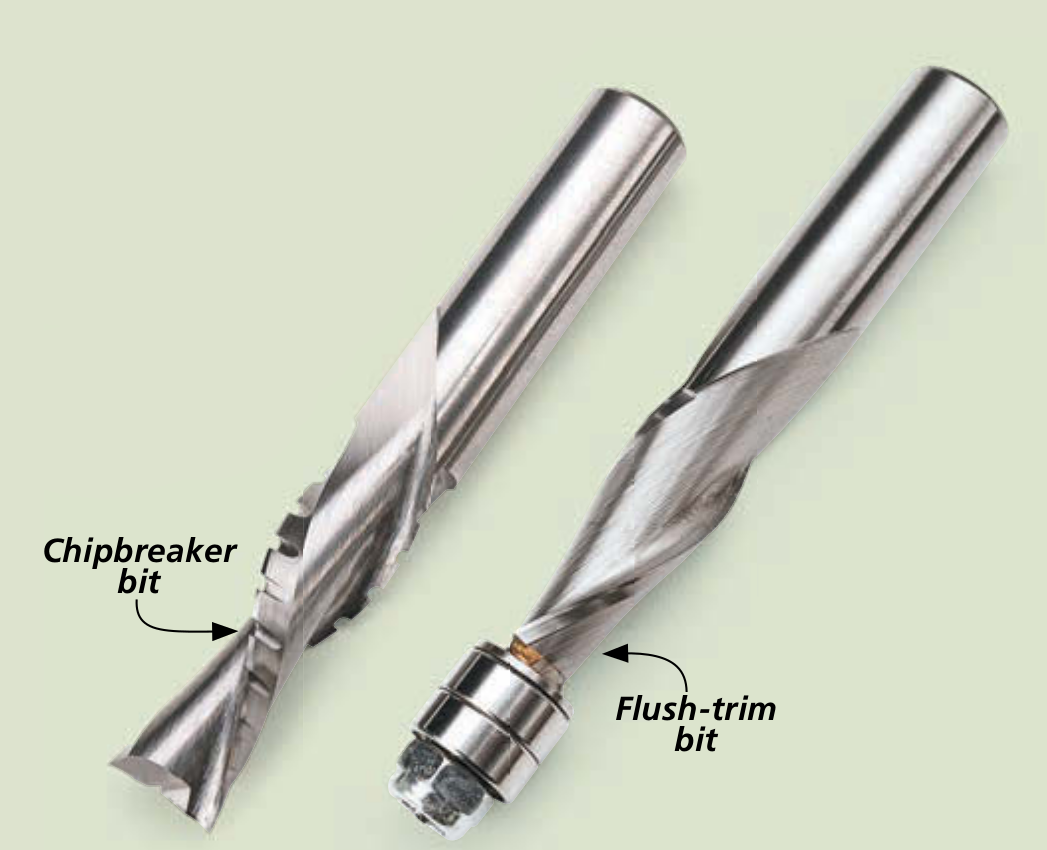
Chipbreaker spiral router bits. A chipbreaker bit features small interruptions along its cutting edges.
These interruptions divide the chips into smaller pieces, helping the bit remove material efficiently during demanding cuts.
The chipbreaker grooves are staggered between flutes so the cutting edges can still produce a relatively smooth surface.
These bits are useful when removing material quickly from hard or dense stock, although the exact application depends on the bit's design.
Spiral flush-trim router bits. Flush trimming can be challenging when the grain direction changes along a curved workpiece.
A traditional straight flush-trim bit may lift or tear wood fibers as it encounters difficult grain. A spiral flush-trim bit uses a shearing action that can reduce this problem.
Like a conventional flush-trim bit, a spiral version uses a bearing to follow a template or reference edge.
Some models also feature compression-style cutting geometry, which can help protect both faces of plywood or other laminated materials.
For pattern routing, trimming curved furniture parts, or working with figured hardwood, a spiral flush-trim bit can be a useful addition to your router bit collection.
Frequently Asked Questions About Spiral Router Bits
Are spiral router bits better than straight bits? Spiral router bits often produce smoother cuts and provide better chip evacuation than traditional straight bits. They're particularly useful for mortising, cutting deep grooves, and working with materials prone to tearout.
However, straight bits remain useful for many routing operations. The best choice depends on the material, cut depth, and desired surface finish.
Should I use an upcut or downcut bit for plywood? Use a downcut spiral bit when you need a clean top edge on a shallow dado or groove. For through-cuts where both faces need to remain clean, a compression bit is often a better option.
An upcut bit can be useful when chip evacuation is the priority, but it may cause chipping along the top veneer.
Which spiral router bit is best for mortising? A plunge-capable spiral upcut bit is an excellent choice for cutting mortises. Its flutes lift chips out of the opening, reducing chip buildup during deep cuts.
Use a router guide or mortising jig for better accuracy and repeatability.
Can you plunge with a spiral router bit? Yes, provided the bit is designed for plunge cutting. Many spiral bits have cutting edges on the end that allow them to enter the material vertically.
Not every spiral bit is plunge-capable, so check the manufacturer's specifications before making a plunge cut.
Can spiral router bits be used in a router table? Yes. Many spiral router bits can be used in a router table, provided they're suitable for the router, material, and operation.
Remember that the workpiece's orientation changes which face receives the cleanest cut. An upcut bit that lifts chips toward a handheld router will still move chips in the same direction relative to its shank when mounted in a router table.
Always follow the manufacturer's recommendations for bit speed, cutting depth, and feed direction.
Final Thoughts: Are Spiral Router Bits Worth Adding to Your Shop?
If you've been using traditional straight router bits for all your routing operations, a spiral bit is worth trying.
The shearing cutting action can produce noticeably cleaner results, while improved chip evacuation makes operations such as mortising and deep grooving easier to manage.
For general woodworking, I'd start with a quality solid-carbide upcut bit for mortises and grooves. Add a downcut bit when you're working with veneered plywood, and consider a compression bit if you frequently cut through plywood or laminated panels.
Once you understand how each style works, choosing the right spiral router bit becomes much easier — and you'll spend less time cleaning up rough edges after routing.


