


A roll of tape probably isn't the first thing that comes to mind when you think about woodworking tools. But look around the Woodsmith shop and you'll find several types within easy reach.
The trick is choosing the right tape for the job. Some provide a temporary bond for templates and jigs. Others protect a surface during a glue-up or finishing operation. And a few specialized tapes can permanently attach materials or even make parts slide more smoothly.
Here are five types of tape that earn their keep in a woodworking shop.
1. Double-Sided Tape for Templates & Jigs
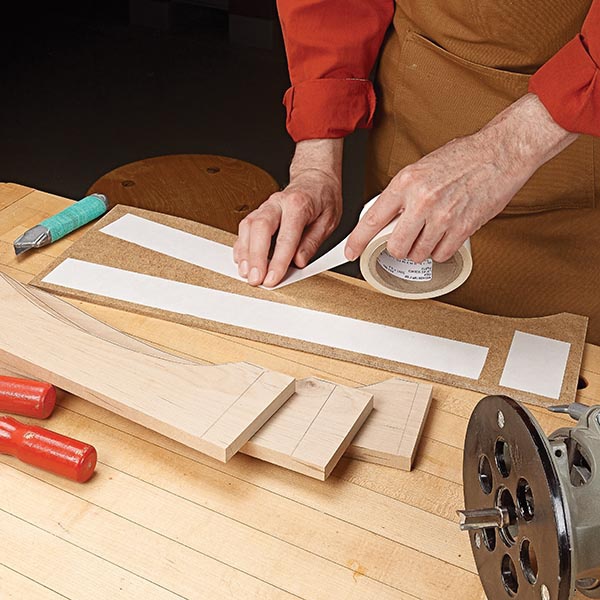
Double-sided tape is one of the most versatile choices for jig and template work. It temporarily joins two pieces without clamps getting in the way.
That's especially handy when routing with a template. Apply a few strips between the template and workpiece, press the pieces together, and the tape prevents the template from shifting while you work.
The woodworking tape shown here uses different adhesives on its two faces. One side provides a stronger bond to the template while the other is designed to release more easily from the workpiece. It also tears by hand and is intended to remove without leaving adhesive residue.
That's a significant improvement over the carpet tape traditionally used for this job.
Woodsmith Tip: Don't Overdo It. More tape isn't necessarily better. For temporary workholding, use only enough to prevent the parts from shifting. Too much high-strength double-sided tape can make the pieces unnecessarily difficult to separate.
2. Painter's Tape for Masking, Glue-Ups & Clean Cuts

Painter's tape may be the most versatile tape in the shop. Its relatively low tack makes it useful anywhere you need temporary protection without a permanent bond.
It can mask areas during finishing, protect nearby surfaces from glue squeeze-out, hold small parts together during assembly, and provide a convenient surface for layout marks.
The example shown here uses delicate-surface painter's tape over a cut line in cabinet-grade plywood. The low-tack tape helps support the surface fibers during the cut and then peels away.
Painter's tape is also useful for marking parts during complicated assemblies. Write directly on the tape and remove the label when the project is complete.
WOODSMITH TIP: Painter’s Tape and CA Glue Trick for Temporary Workholding
3. High-Strength Double-Sided Tape for Laminate & Veneer

Not all double-sided tape is meant to be temporary. High-strength acrylic tapes provide a much more aggressive bond and can be used for applications such as laminate, veneer, edge banding, and cabinet refacing.
The SpeedTape shown here provides an alternative to liquid contact cement or spray adhesive for suitable applications. Apply the tape to one surface, remove the release paper, carefully position the mating material, and press it firmly into place.
A J-roller helps apply consistent pressure across the entire surface.
Because products differ in their bonding strength, surface compatibility, and application requirements, follow the tape manufacturer's recommendations for the material you're attaching.
Woodsmith Tip: Position Before You Press. Treat high-strength adhesive tape much like contact cement. Once the two surfaces are pressed firmly together, repositioning them may be difficult. Get the alignment right before applying pressure.
4. UHMW Tape for Jigs, Drawers & Fixtures

UHMW tape solves a completely different shop problem. Rather than sticking two parts together, its slick polyethylene face reduces friction between moving surfaces.
That makes it particularly useful on woodworking jigs and fixtures. Apply it to areas where two parts need to slide against each other, such as jig runners, fences, or other bearing surfaces.
It's also useful on traditional wood drawer runners. The slick surface helps the drawer move more easily while providing a wear surface between the wooden parts.
Another clever application is on pipe clamps. UHMW tape allows heavy workpieces to slide more easily when positioning a glue-up. Dried glue is also less likely to stick tenaciously to the slick surface, simplifying cleanup.
5. High-Friction Guard Tape for Carving & Hand Tools

The last item is different from the other four. High-friction guard tape isn't an adhesive tape in the conventional sense. The cotton gauze material is coated so that it sticks to itself rather than adhering to your skin or tools.
For carving and other hand-tool work, it can be wrapped around your fingers to provide an added layer of protection from abrasion. Because the tape holds its shape, a finger wrap can also be slipped off and reused during a work session.
The same high-friction surface makes the tape useful for wrapping tool handles when you want a more secure grip.
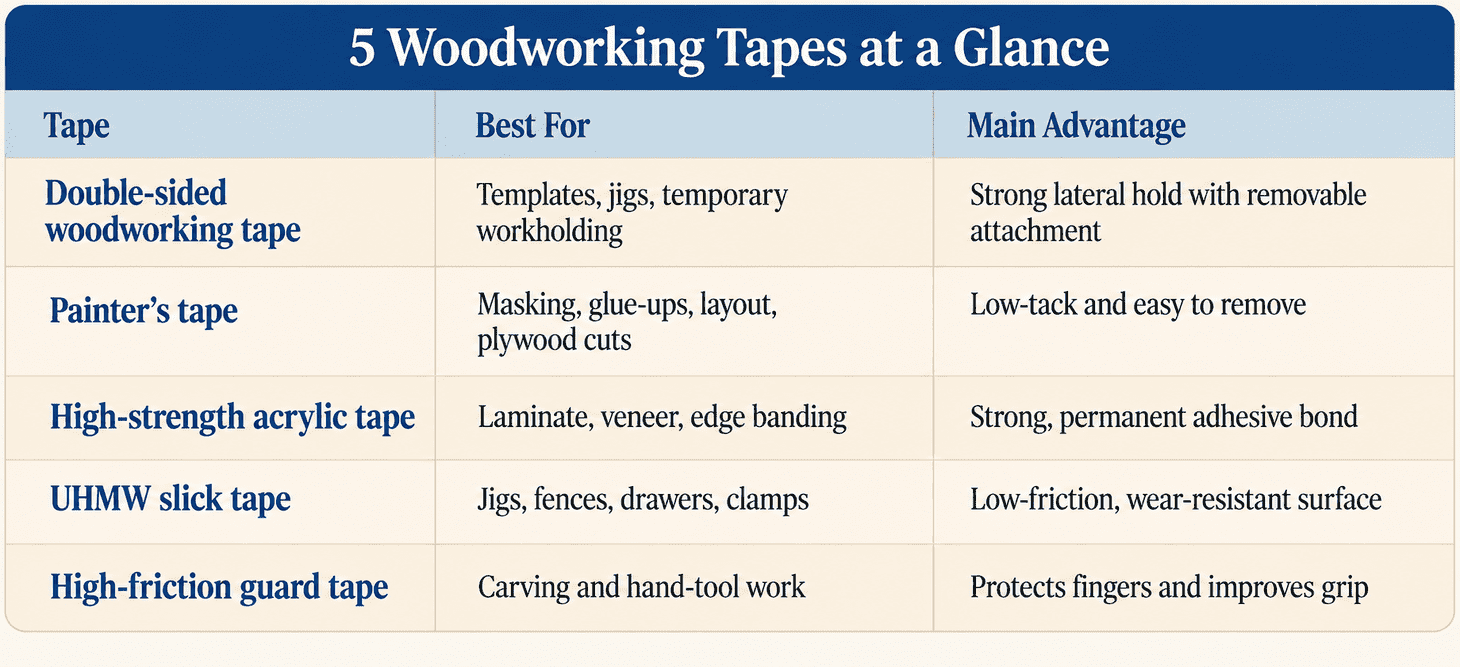
5 Woodworking Tapes at a Glance
Build a Small Tape Arsenal
You don't need a drawer overflowing with different tapes. A few carefully chosen rolls cover an impressive number of woodworking situations.
Keep painter's tape around for everyday masking and layout work, double-sided tape for templates and jigs, and UHMW tape anywhere parts need to slide. Add high-strength adhesive tape and guard tape when your projects call for them.
They're simple supplies, but when the right situation comes along, you'll be glad they're sitting in the shop.


