


Getting to review tools offers a nice opportunity to try new things, even when I might not normally be inclined to. A benchtop jointer sounded like an odd idea — then I got to try out the one you see here.
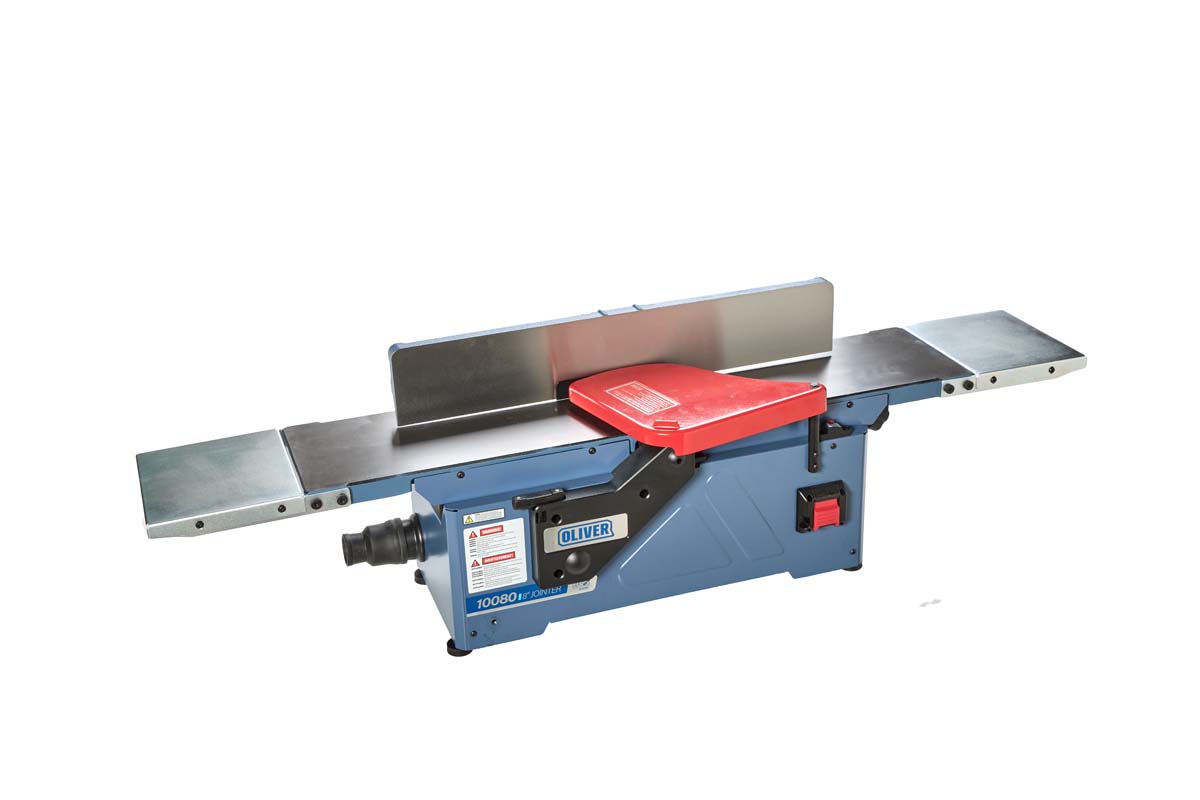
OLIVER BENCHTOP JOINTER
The jointer we’re looking at comes from Oliver Machinery Company, a brand with a long history in woodworking machinery. Founded by Joseph Oliver in 1890, the company made a name for itself in the early 1900s with innovations in cutterhead design. In 1908, Oliver introduced its cylindrical cutterhead, which offered advantages in both cut quality and safety compared to the square cutterheads commonly used at the time.
Today, Oliver still produces large-scale tools and machines, but they’ve expanded into making products for home woodshops as well. This brings us to the subject of this page and the next: their “benchtop” jointer.
FUNCTION & PERFORMANCE.
 Aluminum extension wings can be flipped out to support longer workpieces. With the wings out, the jointer offers 56 inches of table length.
 The helical cutterhead of this jointer contains four-edged blades, which can be rotated as they dull. The dots in the corner indicate which sides have been used.
The jointer you see here offers 8" of table width and 56" of length (with the extension wings) to support longer workpieces. A two-horsepower motor runs a helical cutterhead. Each of the carbide cutters has four edges, and can be rotated as they dull.
In practice, I find this machine covers a good deal of my workpieces. The length is sufficient for most boards, and 8" covers most material until you start getting into glued-up panels. Helical cutterheads seem to have become the standard option for jointers, as well, and it’s a welcome feature. It’s nice to simply rotate cutters as they dull, and I find the helical heads are less prone to snipe and tearing out. Of course, the real selling point of this jointer is its size.
A BENCHTOP OPTION.
 The benchtop jointer offers up to 8" of width, which allows me to face-joint most pieces I work with. The 2HP motor can limit your depth of cut on workpieces that approach the max width.
What precisely constitutes a benchtop tool? To me, it’s one that can be used while sitting on top of your bench. Seems simple enough, right? You may already see where an issue arises. On a standing jointer, the table tends to be around 32" off the floor — which is also where most workbenches stand.
On this jointer, the table is about 12" tall, which means that on a workbench the table will end up being about chest height. Instead, an ideal stand for this tool would be around two feet tall, and Oliver offers a rolling companion stand at that height for $250.
ASSESSMENT.
Now, none of this is meant to detract from the tool itself. The “benchtop” discussion here is largely semantic. Admittedly, “benchtop jointer” sounds better than just “short jointer,” even if it is a bit of a misnomer.
The important sizes to consider on this machine are the table and the motor. I’ve discussed the table, but you should consider the motor as well. You aren’t likely to notice much difference between this model and a 3HP jointer when you’re edge-jointing, but you may when face-jointing. If you’re taking off 1⁄16" of material on a 7" or more board, the motor may start to bog.
However, I never had any issues when the depth stayed at 1⁄32". The small model has its advantages. It can be mounted on a rolling cart and plugged into a 120V outlet. The big one, though, is the price, at half that of a full-size option. And that might just make the smaller model worth it.


