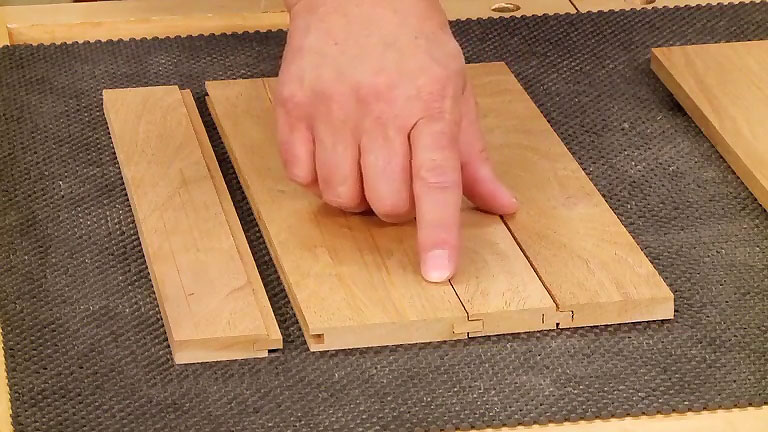


Cutting a groove that's the same width as your router bit is straightforward. Set the fence to position the bit on your layout line, then guide the workpiece along the fence to make the cut.
But what happens when the groove needs to be wider than your router bit? Or when you need a groove perfectly centered on the thickness of a workpiece?
Both jobs are easy to handle at the router table with a couple of simple techniques.

How to Rout a Wider Groove
If the required groove is wider than the router bit, you can create it with multiple passes.
Make the first pass normally. Then adjust the fence slightly and make another pass to remove the remaining material.
But there's an important detail: Move the fence in the right direction.
Move the Fence Away from the Bit
When widening the groove, move the router table fence away from the bit.

This keeps the material you're removing on the outside of the bit and fence and allows you to feed the workpiece into the rotation of the router bit.
Moving the fence toward the bit would trap the waste between the cutter and fence and result in a backrouting operation. The rotating bit can then try to pull the workpiece rather than allowing you to maintain normal control over the feed.
Woodsmith Tip: Remember "Fence Away". When widening a router-table groove, think fence away from the bit. Make small adjustments and sneak up on the finished width rather than trying to hit the exact dimension with one large adjustment.
How to Rout a Perfectly Centered Groove
A centered groove presents a different challenge.
You could carefully measure the workpiece and try to position the router bit exactly on its centerline. But there's an easier approach that requires no precise centering measurement.
The trick is to make the groove in two passes.
Start with a router bit that's narrower than the finished groove. Set the fence so the bit is positioned slightly off center on the workpiece.

Make the first pass with one face of the workpiece against the fence.
Flip the Workpiece for the Second Pass
Instead of moving the fence for the second cut, flip the workpiece end for end while keeping the same reference face against the fence.
Then make another pass.

Because both cuts reference the same fence setting, the resulting groove is centered automatically.
If the groove is still too narrow, make a small fence adjustment and repeat the two-pass process. By making small adjustments, you can sneak up on the exact groove width you need.
Woodsmith Tip: Fit the Groove to the Workpiece. When you're routing a groove to accept another part, such as a plywood panel, don't rely solely on its stated thickness. Use a scrap of the actual material as your gauge and gradually widen the groove until you get the fit you want.
Two Router Table Techniques Worth Remembering
These techniques eliminate the need to own a router bit for every possible groove width.
For a custom-width groove, start with a narrower bit and move the fence away from the cutter for the additional pass.
For a centered groove, position a narrower bit slightly off center and make matching passes with the workpiece flipped end for end.
They're simple techniques, but they're worth remembering whenever your router bit and the groove you need aren't exactly the same size.
Get More from Your Router Table → Learn More Essential Router Table Techniques