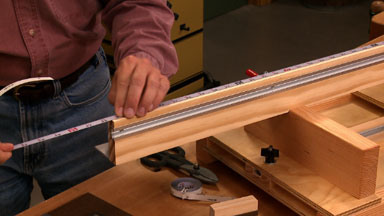



Build a Sliding Tall Fence Jig for Your Table Saw
A table saw is one of the most versatile tools for cutting woodworking joinery. But some operations, especially those that require holding a workpiece vertically, can be difficult with a standard rip fence.
Cutting tenons, spline slots, and other joinery often calls for additional support to keep the workpiece square to the table and securely positioned during the cut.
That's where this shop-made sliding tall fence jig comes in handy.
The jig fits over the existing table saw rip fence like a saddle. A tall vertical face provides support for the workpiece, while a pair of T-tracks and adjustable hold-downs keep it securely clamped in position.
The entire assembly slides along the rip fence, making it a useful accessory for a variety of joinery operations.
A Rip Fence Saddle for Better Workpiece Support
The key to this jig is its saddle-style design.
Rather than replacing the table saw's rip fence, the jig slips over it and uses the existing fence as a guide.
The saddle needs to fit snugly enough to prevent side-to-side movement while still sliding smoothly along the fence.
A tall vertical face supports the workpiece, allowing you to hold it upright for operations such as cutting tenons and spline slots.
Two T-tracks installed in the face accept adjustable hold-downs. These clamps keep the workpiece firmly against the jig during the cut.
The result is a simple accessory that provides both vertical support and positive workholding.
Build the Sliding Tall Fence Jig

The jig consists of a horizontal saddle that fits over the rip fence, a tall vertical face, and reinforcing braces.
Start by measuring the width and height of your table saw's rip fence.
Use those measurements to size the saddle so it fits your particular saw. The fit is important: Too loose, and the jig can shift during a cut. Too tight, and it won't slide smoothly.
Next, cut the vertical face to size.
Add T-Tracks and Hold-Downs

Cut a pair of dadoes in the face to accept the T-tracks.
Position the tracks so the hold-downs can accommodate a range of workpiece sizes and shapes.
Install the T-tracks according to the hardware manufacturer's recommendations, making sure all fasteners are recessed and clear of the blade path.
The adjustable hold-downs allow you to clamp a workpiece securely to the jig before making a cut.
This is particularly useful when working with narrow or short pieces that would otherwise be difficult to support.
Keep the Fence Square with Reinforcing Braces
One important detail is keeping the vertical face square to the table saw surface.
To accomplish this, the jig includes braces attached between the saddle and vertical face.
These braces stiffen the assembly and help prevent the face from flexing or tilting under pressure.
Before fastening everything permanently, check the face with a reliable square.
A rigid, square face is essential for cutting accurate joinery.
Use the Jig for Table Saw Joinery
Once the jig is assembled, slip it over the rip fence and check that it slides smoothly without rocking or binding.
Clamp the workpiece to the vertical face using the T-track hold-downs.
Then adjust the table saw setup for the cut you need to make.
This sliding tall fence can be useful for several common joinery operations.
Cutting tenons. The tall face supports a workpiece vertically while making cheek cuts or other tenon-related cuts.
Cutting spline slots. Secure a workpiece in the appropriate orientation to cut slots for reinforcing mitered joints.
Other vertical cuts. The jig can help with operations that require a workpiece to remain square to the table while moving past the blade.
Before cutting, verify that the workpiece is clamped securely, the jig is stable, and the blade has adequate clearance from all clamps, tracks, and fasteners.
Use the saw's appropriate guarding and safety equipment for the operation, and never attempt a setup that allows the blade to contact the jig's hardware.
Make a test cut in scrap stock to confirm the setup before machining your project parts.
A Versatile Upgrade for Your Table Saw
A sliding tall fence is one of those shop-made accessories that can make a table saw much more useful.
It provides support for workpieces that need to be held vertically, while the adjustable T-track clamps help keep everything securely positioned.
And because the saddle fits over your existing rip fence, there's no need to permanently modify the saw.
With a little careful fitting and a few pieces of hardware, you can build a practical jig that makes cutting tenons, spline slots, and other joinery more accurate and repeatable.
More Ways to Cut Accurate Table Saw Joinery
A sliding tall fence is just one way to improve the accuracy and versatility of your table saw.
Learn more about cutting tenons, rabbets, dadoes, grooves, and other essential woodworking joints using straightforward table saw techniques.
EXPLORE TABLE SAW JOINERY TECHNIQUES → Get Better Results from Your Table Saw
Adjustable Tenoning Jig
If you frequently cut mortise-and-tenon joints, a dedicated tenoning jig can make setup faster and help you produce consistent results.
Our Adjustable Tenoning Jig woodworking plans show you how to build a versatile table saw accessory for cutting accurate tenons on furniture and cabinet projects.
GET THE TENONING JIG PLANS → Take Your Table Saw Joinery to the Next Level