


Woodworking involves a surprising amount of metal. Beyond the steel in our hand tools and machines, nearly every project seems to require screws, bolts, washers, hinges, knobs, drawer hardware, or some other small part.
And all of it needs a home.
Some woodworkers keep only a small selection of frequently used fasteners. Others seem to have a miniature hardware store tucked into the corner of the shop. Most of us fall somewhere in between.
The best workshop hardware storage system isn't necessarily the one that holds the most stuff. It's the one that matches the amount and types of hardware you actually use — and lets you find what you need without digging through a coffee can full of mystery fasteners.

Start With a Hardware Storage Strategy
Before building another cabinet or buying another stack of bins, take stock of how you use hardware.
If you routinely use the same handful of screw sizes and hinges, you may only need a compact organizer near the bench. Buying unusual hardware as needed keeps clutter under control and minimizes the amount of storage space devoted to small parts.
There's another advantage to standardizing hardware. Using the same hinges, screws, and other fittings from project to project means you're already familiar with their installation.
On the other hand, keeping a larger hardware inventory makes sense if you're frequently building projects or don't have convenient access to a well-stocked hardware store.
The goal isn't necessarily to own less or more. It's to create a system that fits the way you work.
Benchtop Hardware Organizers
For a modest collection of screws and small hardware, a benchtop organizer is one of the simplest solutions.
The key is taking advantage of vertical space rather than spreading containers across the workbench.
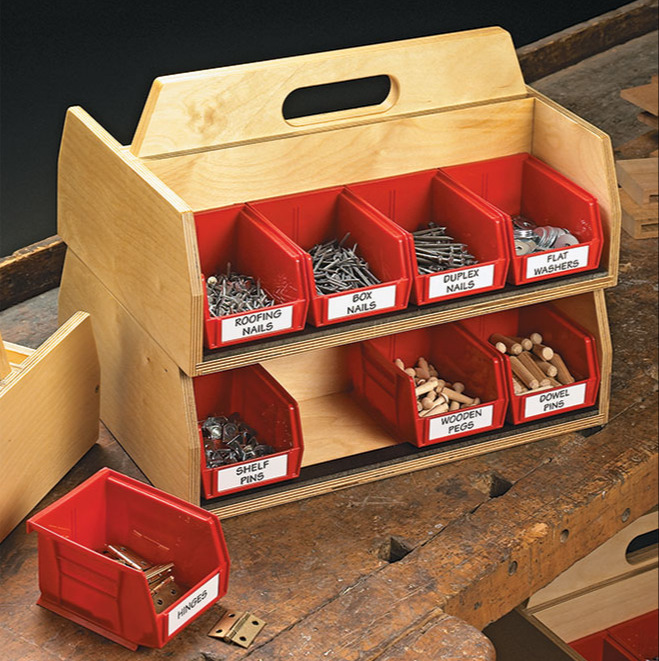
A stacked organizer like the one shown above keeps several sizes of bins organized and within easy reach. The stackable totes can be added as your storage needs grow, and each one is easy to carry around the shop or take with you on the go.
RELATED PROJECT PLANS: Free Stackable Hardware Tote Plans
Rotating Hardware Organizers
A revolving organizer packs even more storage into a small footprint.

The shop-made version above borrows its design from old hardware-store nail displays. Multiple compartments surround the rotating body, allowing a surprising amount of hardware to fit into a relatively small space.

A simpler version combines a shop-made rotating rack with removable plastic bins. A lazy Susan bearing lets the entire organizer spin, making it practical to tuck into a corner of the bench.
Woodsmith Tip: Put your most frequently used screws and fasteners in the easiest-to-reach bins. Specialty hardware can occupy the less convenient locations.
Move Hardware Storage to the Wall
Workbench space is valuable. Once a hardware collection outgrows a compact organizer, moving it onto the wall makes a lot of sense.
A wall-mounted hardware cabinet offers high-capacity storage without consuming floor or bench space. Mounting it around eye level also makes labels and bin contents easier to scan.

There's no rule that says a hardware cabinet has to use a single type of storage. The cabinet above combines open bins for frequently used fasteners, removable lidded trays for portable storage, and a larger drawer for bulky items.
That flexibility is useful because not every piece of hardware fits neatly into the same container.
RELATED PROJECT PLANS: Build a Hardware Cabinet
Build a Wall of Removable Parts Bins
If you have a lot of different fasteners, removable bins make an efficient system.

The cabinet shown above holds 40 bins. Custom hangers allow the bins to be rearranged or removed and carried to the workbench.
That's one of the biggest advantages of this type of system: the container comes to the project instead of the hardware being transferred to another container.
Rolling Hardware Storage Carts
Eventually, a collection of hardware may become too large for a benchtop or wall-mounted system. That's when a rolling cart starts to make sense.

Think of this style of cart as a mobile hardware store. Different areas can be dedicated to different types of supplies:
- Small bins for screws, nuts, and washers
- Shallow trays for assorted small hardware
- Deep drawers for larger components
- Cubbies for dowels, threaded rod, T-track, and other long items
Mobility also means the hardware collection can move closer to the project when needed.
RELATED PROJECT PLANS: Build a Mobile Hardware Cart
Use Deep Drawers for Bulky Hardware

Deep drawers provide space for hardware and supplies that don't fit comfortably into small-parts bins. They can also share space with related tools, such as wrenches and sockets.
Use Shallow Trays for Small Parts

Shallow pullout trays keep small parts visible instead of allowing them to disappear at the bottom of a deep drawer.
A modular arrangement also allows the individual containers to be rearranged as your hardware collection changes.
Drawer Cabinets Keep Hardware Clean
Open bins are convenient, but they have one unavoidable drawback: everything in a woodworking shop eventually collects dust.
Enclosed drawers solve that problem.

Custom dividers let you tailor each drawer to the hardware stored inside. Small compartments can hold individual fastener sizes, while deeper drawers near the bottom accommodate larger items.

A cabinet with full-extension drawers offers another advantage: you can see and reach the contents at the very back without digging through everything in front.
This approach is particularly useful for specialty hardware that needs to stay organized but isn't used often enough to justify prime wall or benchtop space.
Plastic Parts Bins: Simple, Flexible Storage
There's a reason plastic parts bins show up in so many woodworking shops: they're inexpensive, modular, and available in a wide range of sizes.

Bins don't have to hang on a wall. They can also organize drawers, trays, and shop-made cabinets.

Look for bins that can both stack and hang from a rear lip. That gives you more options as your storage system evolves.
It's also worth choosing a system before buying dozens of containers. Bins from different manufacturers — and sometimes different product lines — aren't necessarily compatible.
RELATED PROJECT PLANS: Build a DIY Workbench
Use Bin Size to Match the Hardware
Don't waste a large container on six screws.
Small bins work well for specialty fasteners and low quantities. Larger bins make sense for screws, bolts, and other hardware you buy in bulk.
Color can provide another level of organization. For example, different colors could identify screws, bolts, cabinet hardware, or miscellaneous parts.
The exact system matters less than being consistent.
Open Bins vs. Drawers
Neither system is automatically better.
Open bins make frequently used hardware easy to see, grab, refill, and carry to the workbench. They're especially convenient for screws and fasteners you use every day.
Drawers and covered containers provide better protection from woodworking dust and make it easier to store less frequently used or unusual hardware.
For many shops, the best solution is a combination of both.
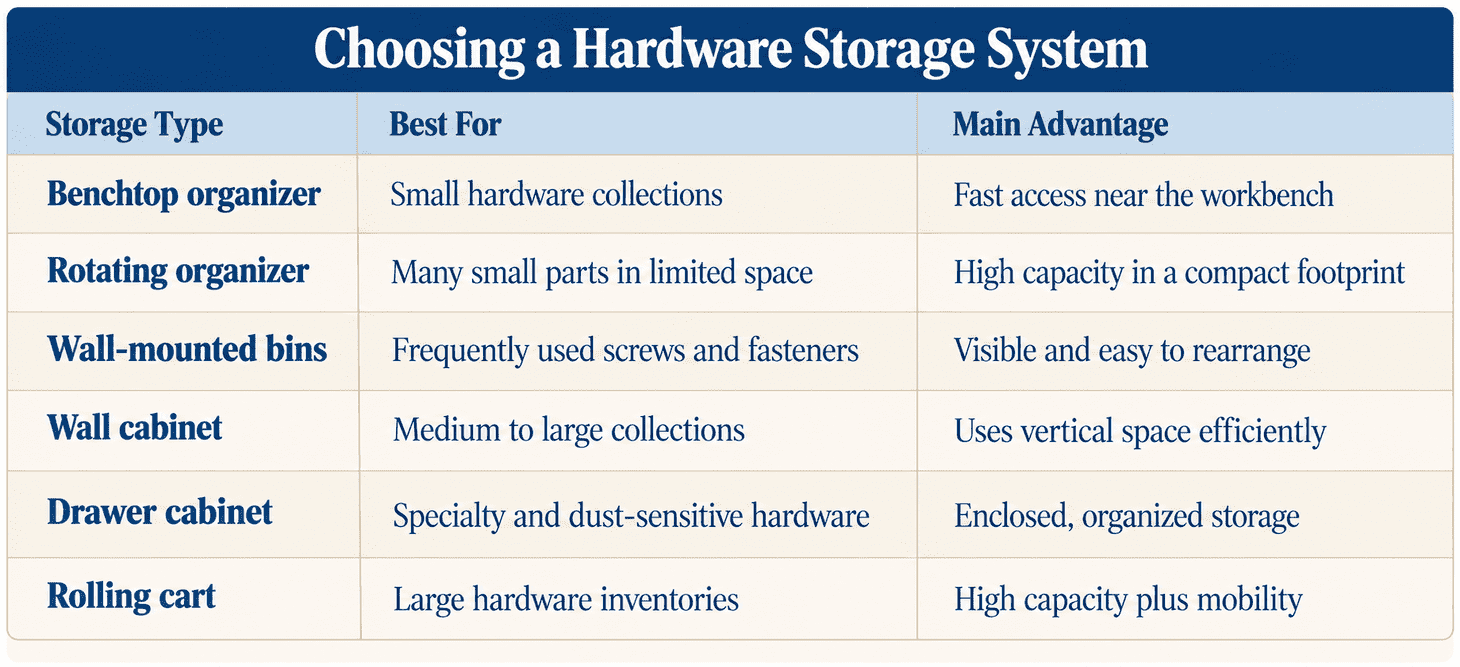
Label Hardware Before You Forget What It Is
No storage system works particularly well if you can't remember what's in it.
Labels are especially valuable for fasteners because similar screws can be difficult to distinguish at a glance. Useful information might include:
8 × 1¼" Flat-Head Wood Screw
rather than simply: Wood Screws
For specialty hardware, you can also retain the manufacturer or project information. Months or years later, that information can make it much easier to find a matching replacement.
Woodsmith Tip: When you have leftover specialty hardware from a project, store its label, package information, or part number with it. The mystery hinge in the bottom drawer isn't nearly as useful when you don't know where to get another one.
Don't Forget the Odd Stuff
Every hardware collection eventually develops a category that doesn't fit anywhere else.
It might contain an unusual hinge, specialty knob, threaded insert, odd bracket, or leftover piece of hardware that seems too useful to throw away.
Giving those items a dedicated miscellaneous or specialty-hardware drawer prevents them from infiltrating every other container in the shop.
You might even call it the "curiosity shop."
Just revisit it occasionally. If you can't identify an item or imagine using it anymore, it probably doesn't deserve permanent shop space.
Build a Hardware System That Can Change
Hardware storage isn't something you solve once and forget.
Your inventory changes as you build different projects. A screw you once bought by the handful may eventually deserve its own large bin. A specialty hinge you stocked for several projects may stop getting used altogether.
That's why some of the most useful storage systems are modular. Removable bins, adjustable dividers, pullout trays, and movable shelves allow the storage to change along with the hardware.
Start with what you actually use, leave a little room for expansion, and make it easy to reorganize.
When every screw, hinge, knob, and odd bit of hardware has a logical home, you'll spend less time searching through drawers — and more time building.


