

KREG RIP-CUT GUIDE
The last item featured in this issue of Great Gear is another from Kreg, but it’s a far cry from pocket holes. The tool you see here is their Rip-Cut guide. While its primary intent is circular saws, it’s made to work with jig saws and trim routers too.
 | |
| ---------- |
|
| |
| ---------- |
| |
|The Rip-Cut guide holds the attached saw parallel to the edge guide to achieve a consistent rip cut on large panels. |
|
|The Rip-Cut guide holds the attached saw parallel to the edge guide to achieve a consistent rip cut on large panels. |
AN ADAPTABLE EDGE GUIDE.
The idea behind this tool is simple. An adjustable mounting sled is attached to an edge guide via a registration bar. The edge guide keeps your saw or router parallel to the edge of the board throughout the cut, while the registration bar has increments to help you to set the width of your rip cut.
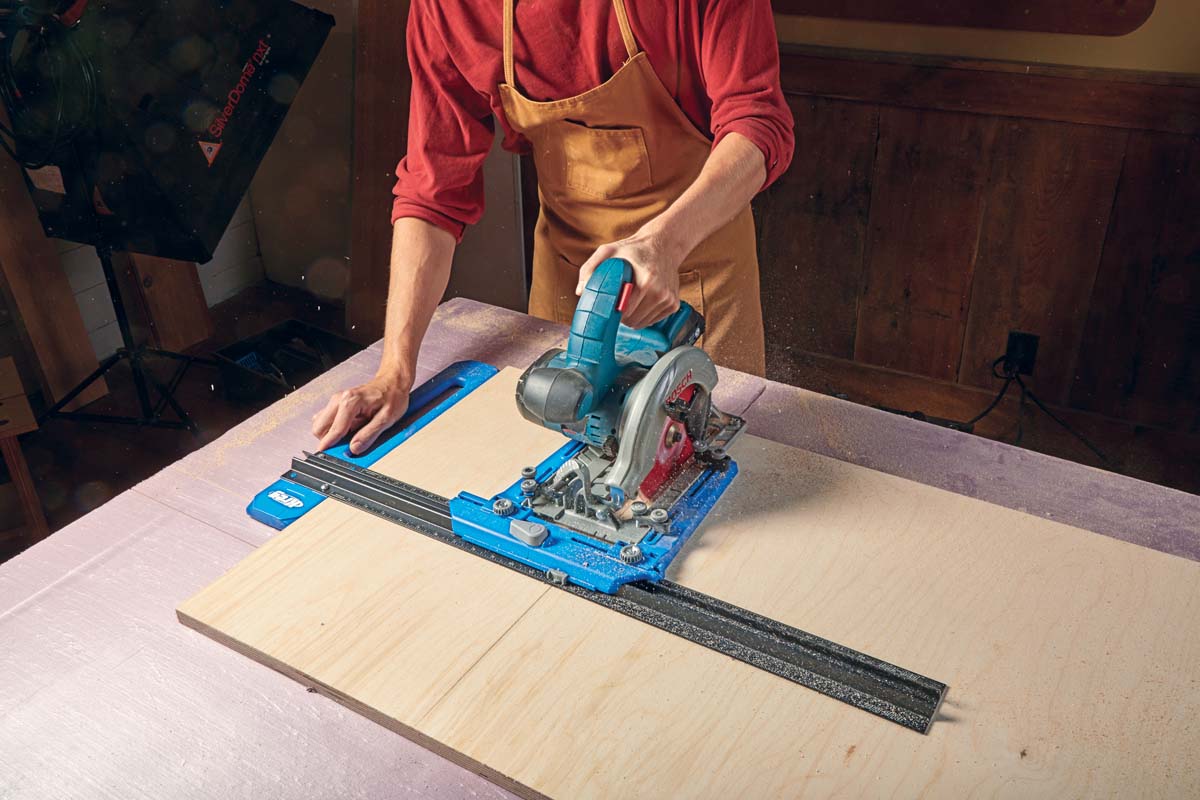 |
| The edge guide can be attached to either side of the registration bar for right- or left-handed woodworkers. |
MOUNTING SLED.
To use the Rip-Cut guide, you’ll first need to mount a tool. You can see the mounting sled above. Two adjustable arms slide in to cradle the base of your saw, with the baseplate resting on the rubber.
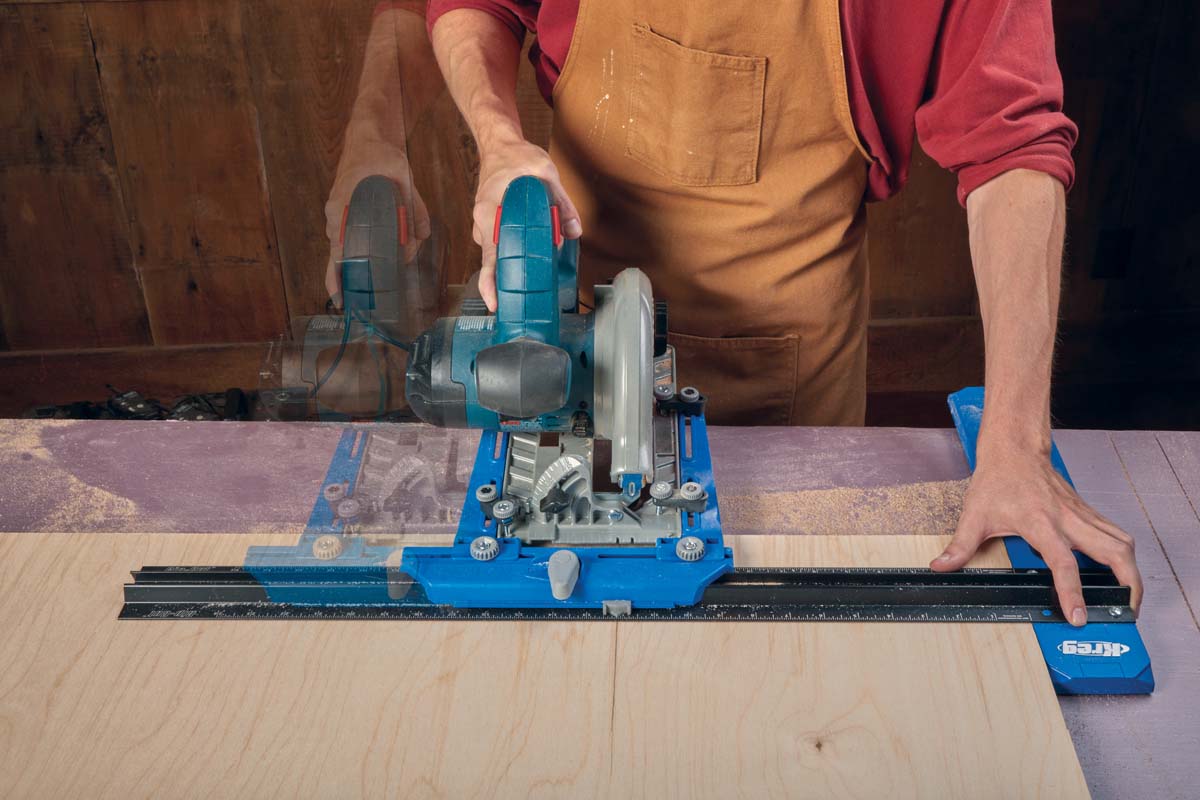 |
| The mounting sled slides along the registration bar, and is locked in place by flipping down the cam lever. |
Once the saw sits snug within, the swivel clamps swing in over-top and tighten down to hold the base. These are hex-head screws set in plastic, knurled nuts and joined by small arms.
The mounting sled can then be slid into position. A cam lever on the sled flips down to lock it. A cursor on the sled shows what the width of the cut will be. This is meant to be adjusted to the tool being used, which can be done by making a test cut on a scrap piece and aligning the cursor with the edge of the the kerf.
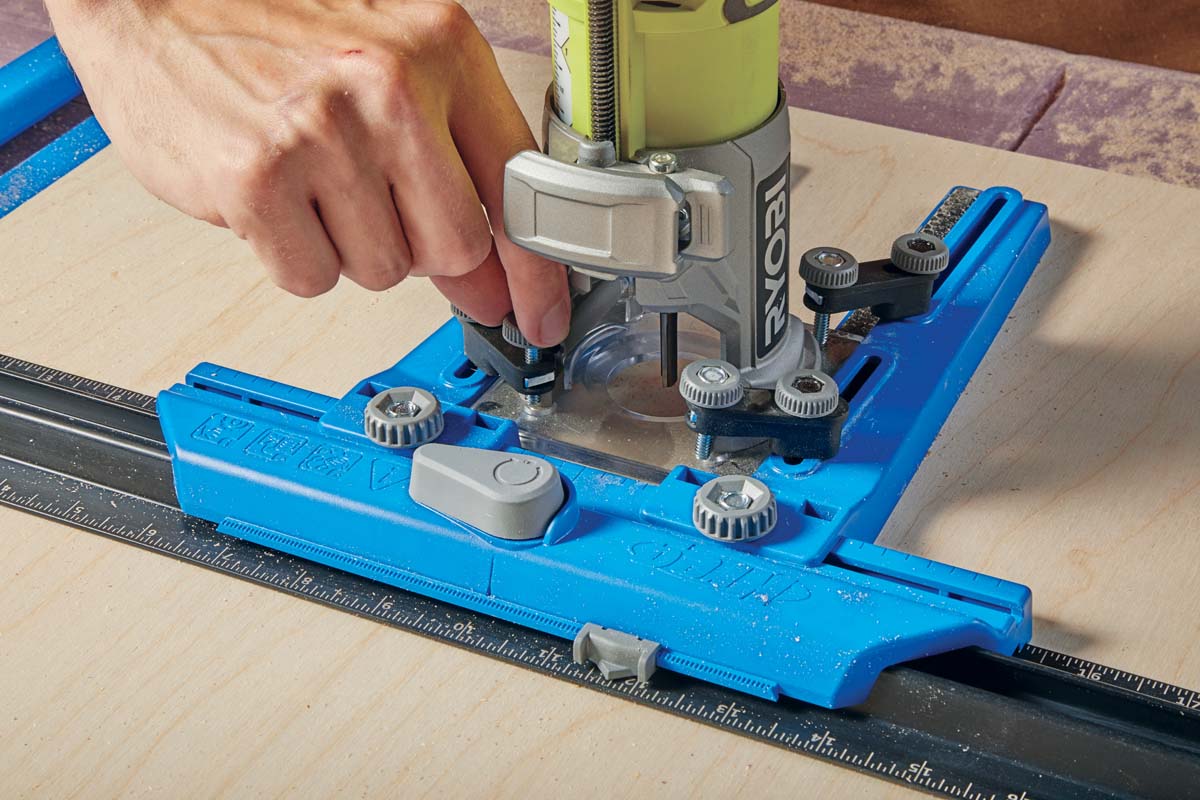 |
| The adjustable arms of the mounting sled and the clamps attached to them can fit the bases on a number of tools. |
IN PRACTICE.
The best use of this edge guide is breaking down sheet goods. A circular saw works great to size panels (when you don’t have a track saw), but it can be difficult for newer woodworkers to get straight cuts, or even seasoned ones if they’re using a new saw. Here, the Rip-Cut guide will help significantly in getting a clean edge.
However, it’s not quite what I’d call a precision tool, and I think this is largely due to the materials. The registration bar is aluminum, and it’s stable and accurate. The rest of the parts, save for the screws, are plastic. They have a sort of “flex” to them, and while it won’t ruin a cut, the results don’t hold a candle to a cut on a table saw.
Similarly, I didn’t feel any more confident using a router with this guide. It proved reliable when the distance between the router and edge guide was short, such as when routing grooves for a back panel, but at that point I could use a router edge guide instead.
Despite that, the Rip-Cut guide still has its place. It’s not perfect, but it’ll aid in getting straight rip cuts with a circular saw if you could use the help. And, considering its rather inexpensive price, it’s not a bad deal, especially for beginning woodworkers.