


Grizzly G0999 15" Benchtop Planer Review
One of the biggest challenges when outfitting a woodworking shop is finding machines that offer the performance you need without taking up too much space. A thickness planer is a good example. Full-size stationary planers offer plenty of power and capacity, but they also require a dedicated spot in the shop.
Benchtop planers are often a more practical choice. They're smaller, easier to store, and generally less expensive. The tradeoff is usually a reduction in power or capacity.
The Grizzly G0999 15" Benchtop Planer takes a different approach. It combines the compact footprint of a benchtop machine with features typically associated with larger stationary planers, including a 2HP motor, a 15"-wide bed, and a spiral cutterhead with carbide inserts.
We put the G0999 to work in the Woodsmith shop to see how well this combination performs.
A Benchtop Planer with Stationary Planer Capacity
The first thing that stands out about the Grizzly G0999 is its size.
Most woodworkers choose a benchtop planer because they want to save space. But the G0999 offers a full 15" of planing width, putting it in the same capacity range as many larger stationary machines.
That extra width is useful when you're milling wide boards or preparing panels for furniture and cabinet projects.
And with a 2HP motor, the planer has the power to remove a substantial amount of material without requiring the floor space of a traditional stationary planer.
Compact Doesn't Mean Lightweight
Although the G0999 is classified as a benchtop planer, it's not a machine I'd want to carry around regularly.
At a little over 130 pounds, it's considerably heavier than many smaller portable thickness planers.
For that reason, I prefer keeping it on a rolling cart. This allows me to move the planer into position when needed and roll it out of the way when I'm finished.
For a smaller woodworking shop, that kind of mobility can be a major advantage.
Spiral Cutterhead with Carbide Inserts

One of the G0999's most appealing features is its spiral cutterhead.
Instead of using traditional straight planer knives, the cutterhead is equipped with individual carbide inserts arranged around its circumference.
These inserts provide several advantages for woodworking.
Clean, Smooth Cuts
The spiral cutterhead produced a clean surface during our testing.
This is especially valuable when working with hardwoods, where a poor cut can leave torn grain or machine marks that require additional sanding or scraping.
The G0999 handled our planing tasks well, producing smooth surfaces while removing a useful amount of material with each pass.
Rotatable Carbide Inserts
Another benefit is the ability to rotate or replace individual inserts as they become dull or damaged.
Rather than replacing an entire set of long planer knives, you can service the affected cutting edges.
This is especially convenient if a blade encounters a hard knot or other defect that damages one cutting edge.
The replaceable insert design makes cutterhead maintenance more manageable over the life of the machine.

Digital Readout and Precision Depth Controls
Another feature I appreciate about the G0999 is the collection of gauges and stops that help control the final thickness of a workpiece.
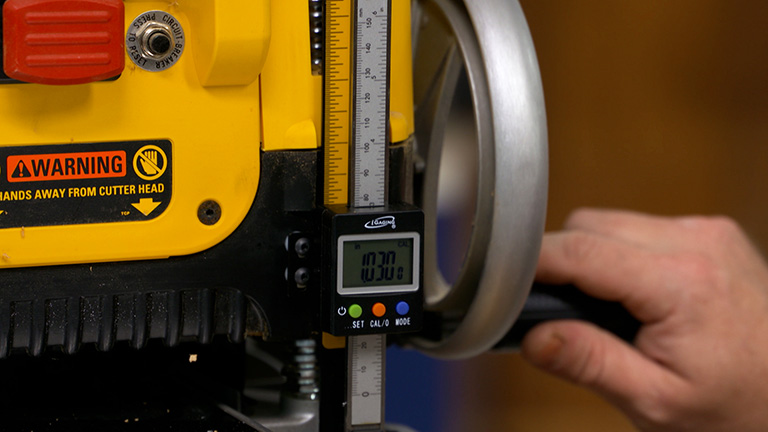
The planer includes both analog and digital thickness readouts, along with a rotating depth stop.
These features make it easier to dial in a specific thickness and produce multiple parts with consistent dimensions.

Digital Thickness Readout
The digital readout provides a convenient reference when adjusting the planer.
This is especially helpful when milling a collection of boards that all need to finish at the same thickness.
Rather than relying solely on a scale and pointer, you have an additional way to monitor the setting.

Rotating Depth Stop
The rotating depth stop provides another useful reference for repeatable planing operations.
When preparing multiple workpieces, a consistent thickness setting helps ensure that parts fit together properly during assembly.
This is particularly important for furniture and cabinetmaking, where even small differences in thickness can create problems during joinery and glueup.
Depth-of-Cut Gauge Helps Prevent Heavy Passes
In addition to the thickness readouts, the G0999 includes a depth-of-cut gauge located above the planer bed.
This gauge indicates how much material will be removed during a pass.

It's a useful feature because the amount of material a planer can remove depends on the width of the board, the wood species, and the condition of the cutting edges.
A wide hardwood board, for example, places more demand on the motor than a narrow piece of softwood.
Being able to check the depth of cut before feeding a board helps you avoid taking an unnecessarily heavy pass.
Woodsmith Tip: Take Lighter Passes on Wide Hardwood. When planing wide hardwood boards, use lighter cuts rather than trying to remove too much material at once. This reduces the load on the motor and cutterhead while helping produce a smoother surface.
How Does the Grizzly G0999 Perform?
In actual shop use, I found very little to complain about.
The spiral cutterhead left a clean surface, and the 2HP motor provided plenty of power for removing material from hardwoods.
The machine handled substantial cuts without making the process feel overly demanding.
The combination of cutting capacity, motor power, and precision adjustments gives the G0999 much of the functionality I'd expect from a larger stationary planer.
And because it can be mounted on a rolling cart, it doesn't have to occupy a permanent location in the shop.
For woodworkers who regularly mill hardwood lumber but have limited space, that's an appealing combination.
Benchtop vs. Stationary Planer: Where the G0999 Fits
The G0999 occupies an interesting position between smaller portable thickness planers and traditional stationary machines.
A typical benchtop planer is attractive because it's compact and relatively affordable. But smaller models may have less capacity or fewer precision features.
Stationary planers generally provide greater mass and a more permanent setup, but they require more shop space.
The G0999 bridges much of that gap.
Advantages of the G0999
The 15" cutting capacity allows you to work with wider boards than many smaller benchtop planers.
Its 2HP motor provides the power needed for serious stock preparation, while the spiral cutterhead and carbide inserts offer a convenient cutting system.
The digital readout, depth stop, and depth-of-cut gauge make it easier to produce accurately dimensioned lumber.
Considerations Before Buying
The biggest consideration is the combination of weight and cost.
Although the machine has a compact footprint, its weight makes it better suited to a sturdy mobile stand than frequent lifting or transport.
It's also priced more like some midrange stationary planers than an entry-level benchtop machine.
That means the decision comes down to how much you value the combination of wide capacity, precision features, and a smaller footprint.
Is the Grizzly G0999 Worth It?
After using the Grizzly G0999 in the Woodsmith shop, I came away impressed with its performance.
The planer delivered clean cuts, plenty of power, and useful precision features. Its 15" capacity is especially appealing for woodworkers who need to mill wider stock but don't have room for a full-size stationary planer.
The premium price and substantial weight are worth considering. But for a serious home woodshop where space is limited, the G0999 offers a compelling combination.
If you're looking for stationary-planer capabilities in a smaller, movable machine, the Grizzly G0999 deserves a close look.
Get More from Your Thickness Planer
A good thickness planer is only part of the equation. The right techniques and shop-made accessories can help you flatten difficult boards, reduce snipe, and get more accurate results from your machine.
Explore five practical planer tips that will help you handle challenging stock and get more out of every planing session.
DISCOVER 5 PLANER SECRETS → 5 Essential Planer Secrets for Better Woodworking