


How to Cut Spline Slots in Miter Joints
Miter joints are a great choice when you want clean, seamless corners on a woodworking project. By joining two pieces at 45°, you can create a continuous appearance without exposing the end grain of the boards.
However, a plain miter joint has a weakness. Most of the glue surface consists of end grain, which doesn't provide the strongest connection on its own.
One way to reinforce a miter joint is to add a wood spline. The spline fits into matching slots cut into the mitered faces, increasing the long-grain gluing surface and helping keep the joint aligned during assembly.
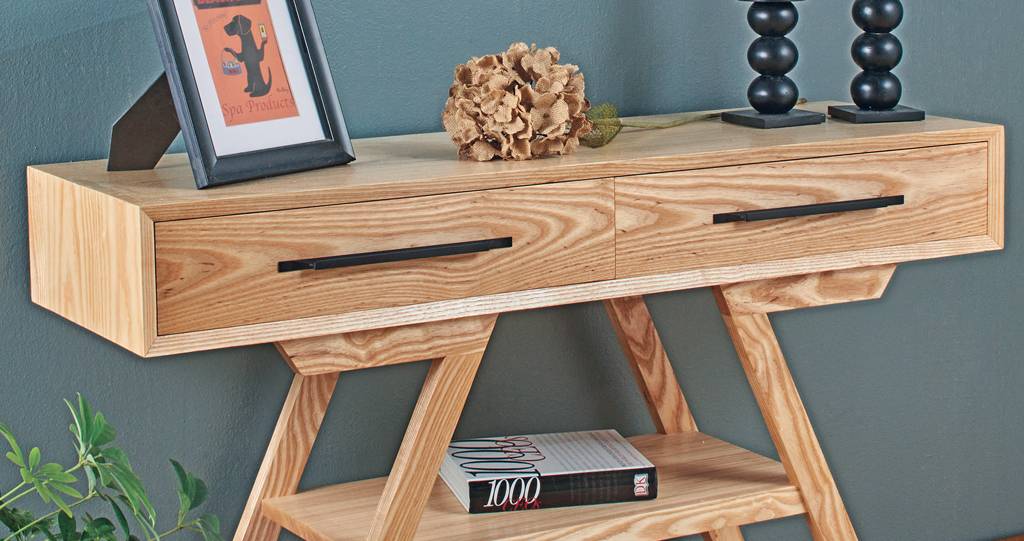
The mitered box on the sleek hall table from Woodsmith Issue 276 is a good example. Its clean corners provide a sleek appearance, while concealed splines strengthen the assembly.
There are two practical ways to cut the slots for this type of joinery. Shorter workpieces can be handled at the router table, while longer pieces are easier to manage with a simple shop-made router jig.
Why Use Splines in Miter Joints?
A spline is a thin strip of wood that fits into matching grooves or slots in two adjoining workpieces.
When used in a miter joint, the spline provides additional gluing surface and reinforces the connection between the parts.
Because the spline is concealed inside the joint, it doesn't change the appearance of the finished corner.
This makes splined miters especially useful for boxes, cabinets, frames, and other projects where you want the clean look of a miter without relying entirely on the glue bond between the mitered faces.
The key is cutting slots that align accurately when the two parts are assembled.
Method 1: Cut Spline Slots at the Router Table
For shorter workpieces, the router table provides a convenient way to cut spline slots directly into the mitered faces.
The setup uses a straight router bit and the router table fence to guide the workpiece.
Before making the cuts, however, there are a couple of details worth addressing.
Add a Protective Fence Facing
Start by attaching a piece of plastic laminate to the router table fence.
The laminate serves two purposes.
First, it provides a smooth surface that helps protect the edge of the workpiece as it moves past the fence.
Second, it helps prevent the edge of the workpiece from slipping beneath the fence.
Mark the router bit's position and cutting profile on the laminate so you can identify the cutter's location during setup.

Find the Correct Position for the Miter
With the router switched off and the bit lowered, position the workpiece on the router table.
Carefully rock the workpiece on its mitered face to locate the flat, stable position.
This establishes how the part needs to be supported as the slot is routed.
A support block can also be used to help hold the workpiece at the proper angle.
The goal is to keep the mitered face properly positioned so the slot remains consistent along its length.
Rout the Slot in Multiple Passes
Once the workpiece is positioned, adjust the router bit to begin cutting the slot.
Rather than attempting to remove all the material in one pass, make several progressively deeper cuts.
Taking lighter passes reduces the load on the router bit and provides better control.
Use the fence and any necessary support blocks to keep the workpiece stable throughout the operation.
Woodsmith Tip: Make a test cut in scrap stock with the same miter angle before routing the actual project parts. This gives you an opportunity to check the slot location and depth.
Method 2: Build a Router Jig for Longer Workpieces
The router table works well for shorter parts, but long panels can be difficult to support and control.
For the top and bottom pieces of the hall table's mitered box, a simple router jig provides a more practical solution.
The jig allows you to bring the router to the workpiece rather than trying to maneuver a long panel across the router table.
It's also easy to build from scrap material.

Make the Router Support
The jig consists of a top platform and two legs that guide it along the mitered workpiece.
Start by cutting the top platform to suit your router.
Drill a hole in the center to provide clearance for the router bit.
The dimensions of the platform may need to be adjusted depending on the size and shape of your router base.
Attach the Guide Legs
The two guide legs are fastened to the underside of the platform with four screws.
The legs establish the jig's position relative to the mitered workpiece and guide the router as it moves along the cut.
The legs can be made to whatever length works best for your setup.
However, shorter legs create less friction as the jig slides along the surface.
Make sure the legs are securely attached and positioned to keep the router stable during the cut.
How to Use the Miter Spline Router Jig
Before cutting slots in your project parts, make a practice cut in a piece of scrap.
The jig may feel a little different from a conventional router edge guide, so it's worth taking time to get comfortable with the setup.
Position the Jig on the Mitered Edge
Secure the workpiece so it can't move during routing.
Place the jig over the mitered edge, allowing the guide legs to register against the workpiece as shown in the drawing.
Check that the router is fully supported and that the bit is properly aligned with the intended slot.

Cut the Stopped Slot
With the jig positioned, rout the spline slot using several shallow passes.
The slots in this project are stopped, meaning they don't extend all the way to the ends of the workpiece.
This keeps the spline concealed when the mitered box is assembled.
Mark the starting and stopping points before routing, and make sure you can control the router as it enters and exits the cut.
Avoid trying to cut the slot to full depth in a single pass.
Reduce Friction with Beeswax
If the jig doesn't slide smoothly along the workpiece, apply a little beeswax to the inside faces of the guide legs.
The wax reduces friction and helps the jig move more easily.
This simple addition makes it easier to maintain a smooth, controlled feed while routing.
Woodsmith Tip: Test the jig with the router unplugged before making the first cut. Confirm that the guide legs register securely, the router remains stable, and the bit has adequate clearance.
Tips for Accurate Splined Miter Joints
Whether you're cutting spline slots at the router table or using a handheld router jig, accuracy is important.
A few simple practices will help produce better-fitting joints:
- Use matching setups. Cut corresponding slots with the same router bit and reference surfaces so they'll align during assembly.
- Make test cuts. Check the slot width, depth, and location before routing the project parts.
- Take shallow passes. Removing material gradually provides better control and cleaner results.
- Keep workpieces secure. Use clamps, support blocks, and suitable guides to prevent movement during routing.
- Check spline thickness. The spline should fit snugly in the slots without requiring excessive force.
For a strong glue bond, use straight-grained spline stock with the grain running across the joint rather than along its length.
The spline should fit comfortably into both slots while leaving enough room for glue.
Stronger Miters Without Changing Their Appearance
Splined miter joints combine the clean appearance of a miter with the added strength of concealed reinforcement.
For shorter workpieces, the router table offers a straightforward way to cut the slots.
When the parts become too long or awkward to handle, a simple shop-made router jig makes the same operation more manageable.
Both methods rely on careful setup, consistent positioning, and multiple light passes.
With a little practice, you can add concealed splines to mitered boxes, cabinets, and other woodworking projects while preserving the clean look of the finished corners.
Build a Hall Table with Splined Miters

This handsome hall table combines sleek mitered corners with concealed spline joinery for added strength. It's a great opportunity to put these router techniques to work while building a stylish, practical piece of furniture.
GET THE HALL TABLE PLANS → Clean Lines, Strong Joinery, and Practical Storage


