

Choosing the right finish is only part of a successful finishing schedule. How you apply that finish can have just as much impact on the final result.
Brushes and wiping cloths are great for many finishes, but spraying offers some distinct advantages. It's fast, makes it easier to cover large or complicated surfaces, and can produce a smooth, even film without leaving brush marks behind.
For the setup shown here, we're using a Fuji D6 turbine system with a T70 spray gun. Its adjustable turbine output and spray pattern make it a useful example of how an HVLP system can be matched to different types of finish.

What Is HVLP Spray Finishing?
HVLP stands for high volume, low pressure.
A turbine HVLP system supplies a large volume of air to the spray gun at relatively low pressure. At the gun, the air breaks the finishing material into a fine spray that can be distributed evenly over the project.
For a woodworker, the important part is what happens at the workpiece: You can apply a controlled, consistent coating without dragging a brush or wiping cloth across the wet finish.
Why Spray a Wood Finish?
Speed is one obvious advantage, particularly when you're finishing a cabinet or large piece of furniture.
But speed isn't the only reason we use spray-applied finishes in the Woodsmith shop.
Spraying can provide even coverage across large surfaces, and it's particularly handy on projects with corners, intersecting parts, and details that can be awkward to reach with a brush.
It also opens the door to applying a variety of finishing materials, including dyes, stains, lacquer, paint, and other compatible coatings.
Match the Sprayer to the Finish
Not every finishing material sprays the same way.
A thin dye or stain requires different spray conditions than a heavier coating. A capable spray system gives you some control over the air supplied to the gun so you can adjust the setup to the material you're applying.
The D6 shown here uses a six-stage turbine with selectable settings. Lower settings can be used with thin materials such as stains and dyes, while the upper stages provide more power for materials such as catalyzed lacquer or latex paint.

The broader lesson applies to any spray system: Match your equipment setup to the material you're spraying.
Follow the finish and spray-equipment manufacturers' recommendations for viscosity, air settings, needle/nozzle selection, and any required thinning.
Adjust the Spray Pattern to the Workpiece
The material isn't the only thing that changes from one spraying job to another. The workpiece changes, too.
A wide cabinet side and a narrow furniture component don't need the same spray pattern. The T70 gun shown here has a side-mounted fan control that lets you adjust the spray from a narrow pattern to a wider fan.

A wider pattern lets you efficiently cover broad surfaces. Narrowing the pattern gives you greater control on smaller parts and helps reduce the amount of finish sprayed past the workpiece.
Control the Amount of Finish
A good spray setup isn't about putting as much finish as possible on the project. You're looking for a controlled, consistent coat.
Too little material can leave the surface dry and uneven. Too much can lead to runs and sags. That's why it's worth spending a few minutes dialing in the sprayer before starting on the project.
Woodsmith Tip: Test the Spray Pattern First. Before pointing the gun at your project, make a few test passes on scrap or another suitable test surface. Check the width and shape of the spray pattern and the amount of material being applied. Make your adjustments there rather than experimenting on the project itself.
Match the Fan to Furniture & Cabinets
The ability to change spray patterns becomes especially useful when working on furniture.
A project might have a large top, narrow legs, aprons, doors, and interior surfaces — all requiring slightly different approaches.
Instead of trying to use one spray setting everywhere, adjust the fan as you move from broad surfaces to narrow components.
A one-quart spray gun such as the T70 also provides enough capacity for the larger furniture and cabinet projects we commonly build without constantly stopping to refill the cup.
Good Spray Technique Still Matters
Good equipment makes spraying easier, but it doesn't replace good technique.
Surface preparation still matters. So does the way the gun is set up and how consistently the finish is applied.
Before spraying the project, practice with the actual finish on scrap and adjust the system until you're getting the coverage you're after.
Then work methodically around the project, keeping the gun under control and applying consistent coats.
The more familiar you become with your equipment, the easier it is to recognize when the spray pattern needs adjustment.
What Can You Spray?
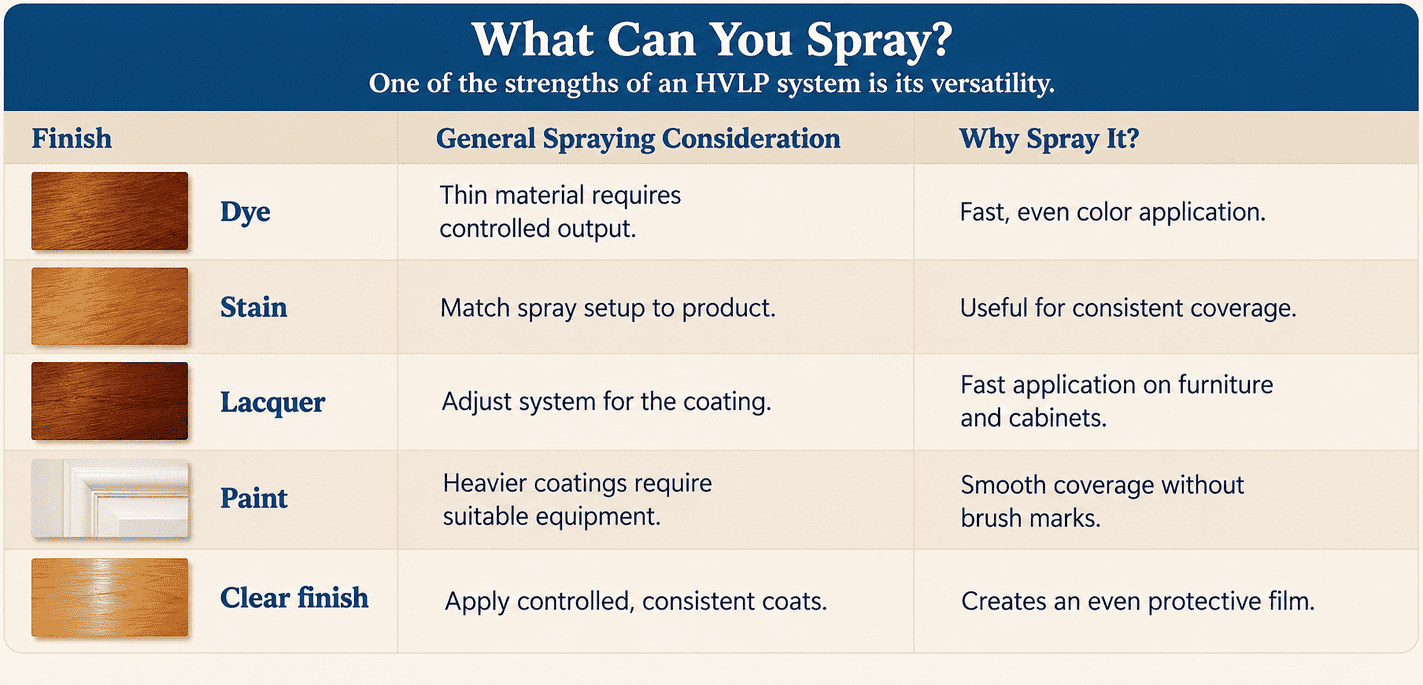
Always use a spray system, needle/nozzle setup, and finishing schedule appropriate for the specific product you're applying.
Add Spraying to Your Finishing Toolkit
An HVLP sprayer doesn't replace every brush, rag, or other finishing technique in the shop.
It simply gives you another option.
When speed, even coverage, or access to complicated surfaces matters, spraying can be an efficient way to apply a finish. And once you understand how to match the spray pattern and turbine output to the material and project, the system becomes much more versatile.
Looking at the Fuji D6?
We've put the Fuji D6 six-stage HVLP system to work on furniture and cabinet projects. Take a closer look at the turbine, T70 spray gun, hose and remote setup, spray adjustments, and our experience using it.
READ THE FUJI D6 REVIEW → See How It Performs in the Woodsmith Shop