


DIY Angle Grinder Chop Saw: Build a Sliding Metal-Cutting Station
As woodworkers, we're pretty comfortable cutting wood to length, ripping boards to width, and shaping parts for our projects. But when it comes to cutting metal, things can get a little more complicated.
Whether you're cutting threaded rod, steel bar stock, or metal hardware for a woodworking project, reaching for a hacksaw isn't always the most appealing option.
That's where this shop-built sliding angle grinder saw comes in.
Using Baltic birch plywood, a few pieces of hardware, and a sliding carriage assembly, this clever project turns an angle grinder into a benchtop metal-cutting station.
A Shop-Built Angle Grinder Cutoff Saw
The Woodsmith Sliding Cutoff Grinder is designed to make cutting small metal parts more convenient and repeatable.
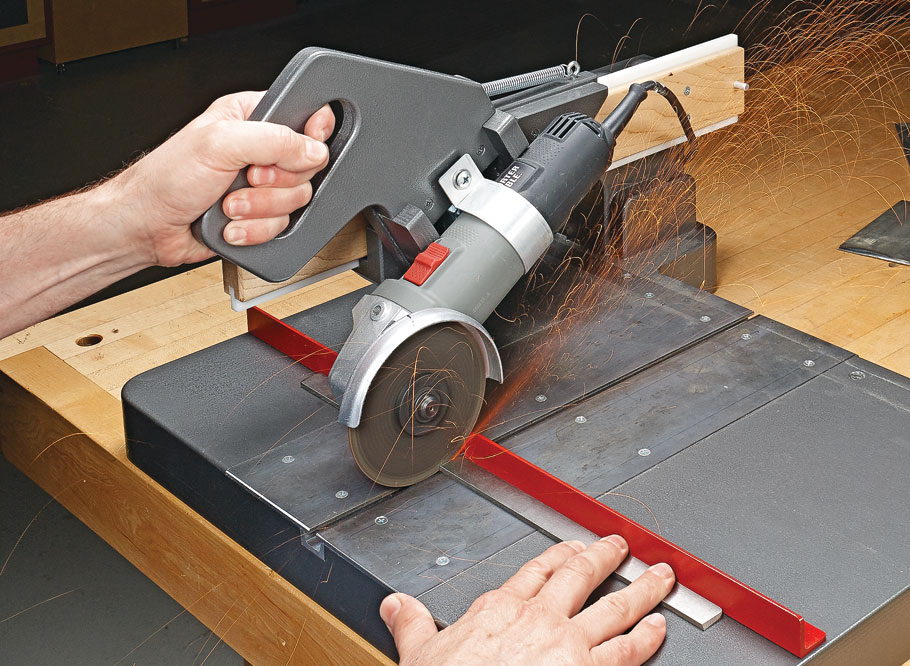
Rather than holding an angle grinder freehand, the grinder is mounted to a carriage that slides along a support arm. The carriage also pivots, allowing the cutting wheel to move down into the workpiece and return to its raised position.
This combination of sliding and pivoting movement is what makes the design different from a basic angle grinder stand.
The project has several key features:
- A sturdy Baltic birch plywood base
- Steel-lined areas around the cutting path
- A two-position fence for different cutting operations
- A sliding carriage with low-friction guides
- A pivoting grinder mount with a return spring
- A separate handle for operating the carriage
Together, these components create a compact metal-cutting station that can be adapted to a compatible angle grinder.
Start with a Sturdy Baltic Birch Plywood Base
The foundation of the sliding cutoff saw is a base made from Baltic birch plywood.
Baltic birch is a good choice for many shop-built jigs and fixtures because of its strength, stability, and consistent construction.
The base provides a solid platform for the support arm and cutting assembly.
But there's another important detail: steel protection around the cutting area.
Steel-Lined Cutting Area
An abrasive cutoff wheel generates hot sparks as it cuts metal. That's an important consideration when building a fixture that incorporates plywood.
This design includes steel plates on both sides of the cutting area, along with a steel channel underneath.
The metal components help shield portions of the plywood base and provide a path for sparks and debris.
However, metal shielding doesn't eliminate the fire hazards associated with abrasive cutting. Sparks can travel beyond the immediate cutting area and ignite accumulated sawdust or other combustible materials.
Before using any metal-cutting setup, clear away sawdust, wood scraps, finishing supplies, and other flammable materials.
Two Fence Positions for Versatile Metal Cutting
One of the clever features of this shop-built cutoff saw is its two-position fence.
The fence can be mounted in different locations depending on the type of cut being made.
Rear Fence Position
The rear position provides room for longer scoring cuts and through cuts.
This arrangement takes advantage of the sliding carriage, allowing the grinder to travel along the cutting path.
Front Fence Position
The forward fence position is intended for smaller parts, such as threaded rod and other short pieces of metal stock.
Moving the fence forward changes the location of the workpiece relative to the cutting wheel.
This flexibility makes the fixture useful for different types of metal-cutting tasks.
Regardless of fence position, workpieces need to be securely clamped. Never rely on hand pressure alone to hold metal stock during abrasive cutting.
A Sliding Arm for Smooth, Controlled Movement
The sliding mechanism is one of the most distinctive parts of this project.
The support arm is built from Baltic birch plywood and incorporates a hardwood rail that guides the carriage.
Low-friction plastic slides help the carriage travel smoothly along the rail.
The video highlights the use of ultra-high-molecular-weight plastic, commonly called UHMW plastic, for the sliding surfaces.
UHMW is well suited to many shop-made sliding mechanisms because it's durable and has a low coefficient of friction.
The result is a carriage that can move back and forth along the support arm without requiring a complicated bearing system.
A Pivoting Grinder Carriage with a Return Spring
The carriage does more than slide.
It also holds the angle grinder on a pivoting mount, allowing the cutting wheel to move vertically into the workpiece.
A return spring brings the grinder back to its raised position after the cut.
This creates two separate movements:
- Sliding motion: The carriage travels along the support arm.
- Pivoting motion: The grinder moves up and down relative to the workpiece.
The carriage also includes a dedicated handle, providing a gripping point away from the cutting wheel.
The exact mounting arrangement must be compatible with the grinder being used. The grinder and wheel manufacturers' instructions determine whether a particular mounting configuration and cutting operation are permitted.
Can You Use Any Angle Grinder?
The project shown in the video uses an inexpensive angle grinder.
Although the fixture's mounting components can be modified to accommodate different grinder dimensions, that doesn't mean every angle grinder is suitable for this application.
Before adapting a grinder, verify that the manufacturer permits the intended mounting arrangement and use.
Important considerations include the required wheel guard, wheel diameter and speed rating, switch operation, and the ability to secure the tool without interfering with its safety features.
Use only cutting wheels rated for the grinder and intended material. A shop-built fixture should never require removing a mandatory guard or defeating a safety mechanism.
If your grinder isn't approved for this type of use, a purpose-built metal cutoff saw is the appropriate alternative.
What Can You Cut with a Sliding Angle Grinder Saw?
For woodworkers, metal-cutting tasks often involve small pieces of hardware or materials used in shop projects.
Examples include threaded rod, steel bar stock, and metal components for jigs and fixtures.
The two-position fence and sliding carriage are intended to accommodate different cutting arrangements.
However, the material, wheel selection, and workholding setup all need to be appropriate for the specific operation.
It's also important to remember that an abrasive cutoff wheel is designed for cutting, not for side grinding or applying lateral pressure.
Use the fixture only for operations supported by the grinder and wheel manufacturers.
Build the Woodsmith Sliding Cutoff Grinder
If you occasionally work with metal in your woodworking shop, the Woodsmith Sliding Cutoff Grinder is an interesting shop-built project.
The design combines a plywood base, steel-lined cutting area, two-position fence, sliding carriage, and pivoting grinder mount into one compact benchtop fixture.
The sliding mechanism and adjustable cutting arrangement are the features that make this project stand out.
Our woodworking plans provide the construction details for the base, support arm, carriage, and other shop-made components.
GET THE STEP-BY-STEP WOODWORKING PLANS → Build the Sliding Cutoff Grinder
More Shop-Built Tools & Jigs
One of the advantages of building your own workshop accessories is being able to create specialized fixtures for the tasks you do most often.
From table saw sleds and router jigs to clamping fixtures and tool storage, shop-built accessories can help make your woodworking more efficient and organized.
Explore more of our favorite woodworking jigs and fixtures to find practical projects for your shop.
SEE MORE PLANS → Explore More Woodworking Jigs & Fixtures


