



Make Replaceable Vise Jaw Faces for Your Bench Vise
A bench vise is one of the handiest workholding tools in the shop. But the metal jaws on a typical vise aren't always the best choice for gripping woodworking projects. They can leave marks on the surface of a workpiece, especially when you're working with softer woods or finished parts.
That's why I like to use wooden vise jaw faces on my 6" clamp-on bench vise.
The problem is that wooden jaws eventually wear out. After years of use, mine had become nicked, scarred, and covered with dried glue.
Rather than simply replacing them with another set of plain wood faces, I decided to make several interchangeable styles for different jobs.
The result is a simple system of replaceable vise jaw faces that can be switched in seconds.
Make the Replacement Vise Jaws
The jaw faces are made from plywood cut to fit the existing metal jaws of the vise.
Plywood is a good choice because it's stable, inexpensive, and easy to machine.
The clever part of this design is how the new faces attach to the vise.
Instead of fastening them permanently with screws, each plywood jaw has T-slots routed into its back face.
These slots fit over the heads of mounting bolts installed in the metal vise jaws.

Rout T-Slots in the Back of Each Jaw
After cutting the plywood jaw faces to size, rout the T-slots on the back of each piece.
A T-slot cutting bit in the router table makes this a straightforward operation.
Position the slots so they align with the existing mounting holes in the metal vise jaws.
The slots allow the replacement faces to slip over the heads of the mounting bolts.

Shop Tip: Check the size and position of the mounting holes on your vise before cutting the T-slots. Vise designs vary, so you'll need to lay out the slots to match your particular model.
Install the Interchangeable Jaw Faces
Installing the new jaws is simple.
Start by threading a pair of hex-head bolts into the mounting holes on each metal vise jaw.
Leave the bolt heads projecting just far enough for the T-slots in the plywood faces to slip over them.
Slide the replacement jaws into position so the bolt heads engage the slots.
The result is a set of removable jaw faces that can be changed without taking the mounting bolts completely out of the vise.

Before clamping a workpiece, make sure the replacement faces are fully seated and securely retained. They shouldn't shift or lift out of position during use.
Three Vise Jaw Styles for Different Tasks
One of the biggest advantages of this system is that you can make several sets of jaws with different gripping surfaces.
I made three styles that cover most of the jobs I encounter in the shop.
1. Plain Plywood Jaw Faces
The first set is simply plywood.
These general-purpose faces work well for everyday clamping tasks and help prevent the metal vise jaws from marking a workpiece.
They're also inexpensive to replace when they become worn or damaged.
2. Cork-Faced Jaws for Delicate Parts
For more delicate workpieces, I made another set of jaws with cork applied to the gripping surfaces.
The cork provides a softer contact surface that helps protect finished parts and woods that are easily dented.
It's a useful option whenever you need a firm grip without leaving marks.
3. V-Groove Jaws for Round Stock
The third set features V-grooves cut into the gripping surfaces.
The grooves help cradle round workpieces, such as dowels or other cylindrical stock.
This makes it easier to hold round parts securely while drilling, shaping, or performing other shop operations.
A Simple Upgrade for Any Bench Vise
A few pieces of plywood and a T-slot router bit are all you need to make this handy vise upgrade.
The interchangeable design allows you to switch between plain wood, cork-faced, and V-grooved jaws without removing the mounting hardware.
And when a set becomes worn or covered with glue, you can replace it without rebuilding the entire system.
It's a simple way to make your bench vise more versatile while protecting the projects you're working on.
Build a Versatile Swivel Vise
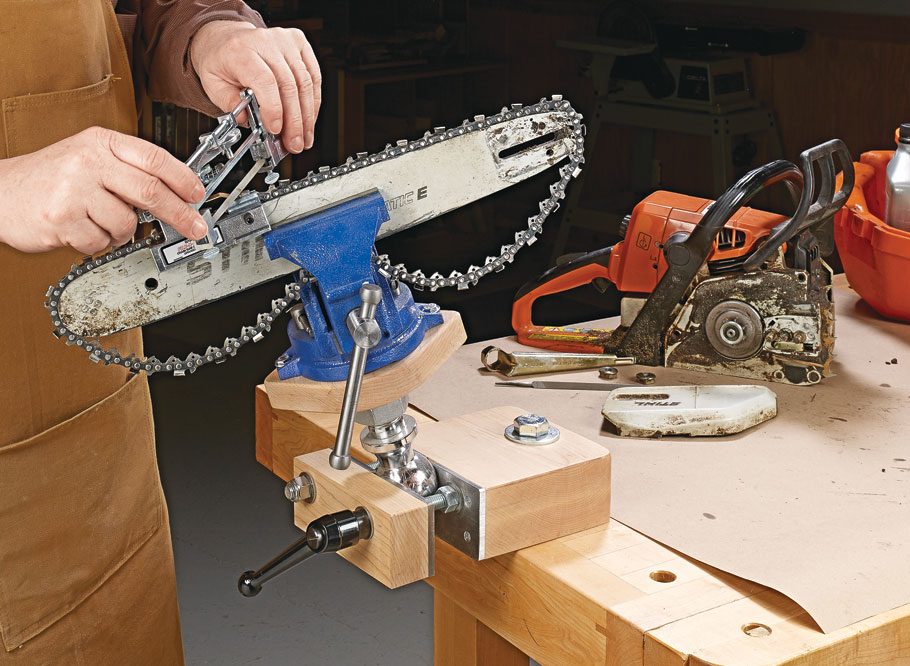
This shop-built swivel vise uses a standard hitch ball to let you rotate and tilt a workpiece into the perfect working position. A quick-release handle makes adjustments easy, while the clever mounting system fits existing workbench dog holes for quick installation and removal. Plus, the quick-change design accommodates multiple accessories without taking up permanent bench space.
GET THE SWIVEL VISE PLANS → Position Your Workpiece at Just the Right Angle


