


DIY Bench Vise: A Compact Workbench Upgrade for Better Workholding
A sturdy bench vise is one of the most useful accessories you can add to a woodworking workbench. But a traditional face vise isn't always the best solution, especially when you're working on small parts, cutting precise joinery, or shaping detailed components.
This shop-made woodworking bench vise offers a practical alternative. Its compact design, elevated jaws, and removable mounting system make it a versatile addition to almost any workbench. Best of all, it provides the solid workholding you need without permanently taking up valuable bench space.
In the video above, Woodsmith's Phil Huber demonstrates the features of this compact bench vise, including its adjustable clamping mechanism, interchangeable jaws, and two convenient ways to attach it to a workbench.
Want to build one for your shop? Check out the step-by-step Bench Vise woodworking plans for detailed drawings and construction instructions.
Why Add a Removable Bench Vise to Your Workbench?
A traditional face vise is ideal for holding boards and larger workpieces. However, its position along the edge of the workbench can make detailed woodworking uncomfortable.
When you're cutting dovetails, fine-tuning a joint, carving, or shaping small parts, you often need to lean over to get a clear view of your work.
This compact bench vise solves that problem by raising the workpiece above the workbench.
The elevated position brings your work closer to eye level, reducing the need to bend over and allowing you to work more comfortably.
It also improves control when using chisels, files, rasps, and other hand tools. Instead of reaching down toward the workpiece, you can work from a more natural standing position.
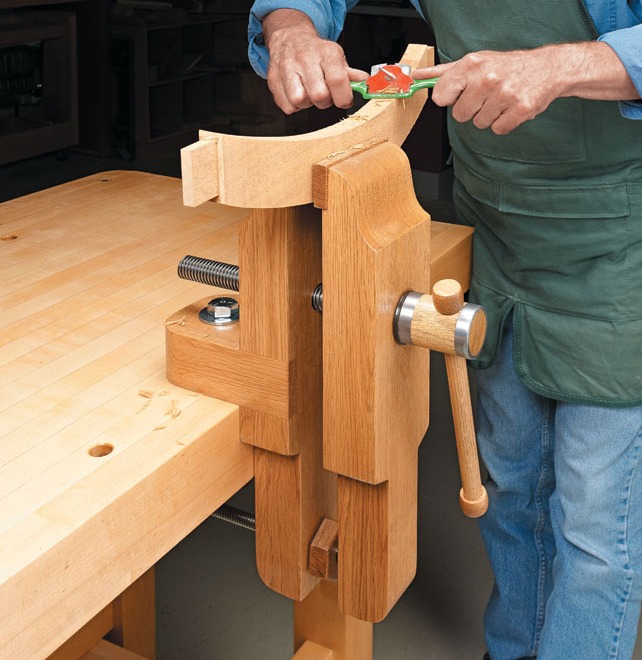
Compact Jaws Provide Better Access to Your Work
One of the most distinctive features of this woodworking vise is its narrow, profiled hardwood jaws.
Unlike the broad jaws found on many traditional bench vises, these jaws are shaped to provide additional clearance around the workpiece.
This makes it easier to approach your work from different angles without the vise getting in the way.
For example, when shaping a curved furniture component with a spokeshave or rasp, you can change your tool angle while maintaining a secure grip on the workpiece.
The compact jaws are also useful for cutting joinery, refining small parts, and working on projects that require frequent repositioning.
Despite their smaller size, the thick hardwood construction and threaded clamping mechanism provide a strong, reliable hold.
Two Easy Ways to Mount the Bench Vise
A major advantage of this design is that it doesn't need to remain permanently attached to your workbench.
The vise can be installed when needed and removed when you want your full work surface available.
Mounting with a Bench Dog Hole
If your workbench has standard 3/4"-diameter bench dog holes, you can secure the vise using a steel bolt.
The bolt passes through the mounting bracket and into a bench dog hole. A large wooden nut underneath the bench locks the vise in place.
This provides a secure attachment without drilling additional holes or modifying your workbench.
Mounting with a Bar Clamp
Don't have bench dog holes? That's not a problem.
A bracket on the back of the vise allows you to attach it to a sturdy work surface using an ordinary bar clamp.
This mounting method makes the vise useful on a variety of benches and worktables.
It's also a practical option for woodworkers who want additional workholding without installing a permanent vise.
Adjustable Clamping with Acme Threaded Rods
The vise is based on a traditional European workholding design and is built primarily from thick solid oak.
Its clamping mechanism uses two Acme threaded rods.
The upper threaded rod moves the jaws together to grip the workpiece. A second threaded rod near the bottom of the vise features a large adjustable wooden nut.
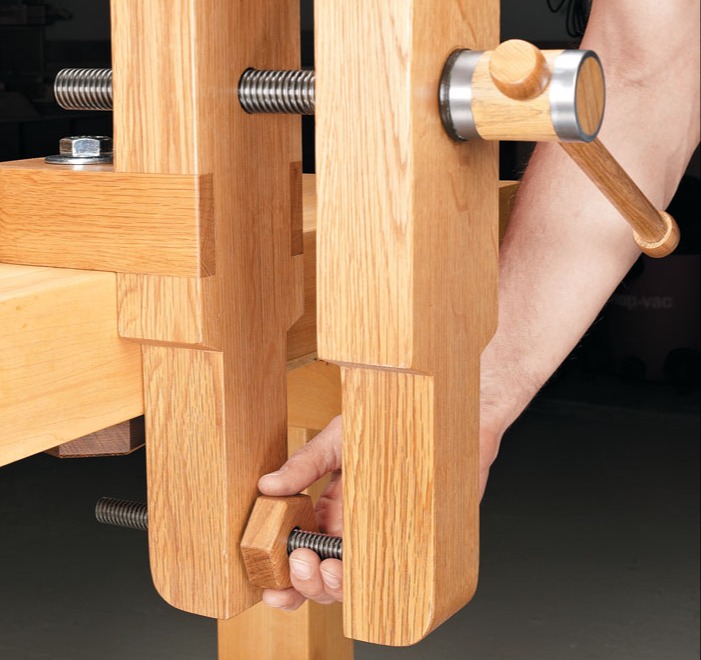
This lower nut acts as a fulcrum, allowing you to adjust the relationship between the jaws.
By positioning the nut correctly, you can keep the jaws parallel and apply even clamping pressure to the workpiece.
The result is a secure grip that works well for a variety of woodworking operations.
The threaded rods also provide precise adjustment, making it easy to accommodate workpieces of different thicknesses.
Leather-Lined Jaws Protect Your Workpieces
Strong clamping pressure is important, but you don't want the vise to damage the wood you're holding.
To help prevent dents and marks, the standard jaw faces are lined with leather.
The leather provides a slightly cushioned gripping surface that conforms to minor irregularities in the workpiece.
This is especially helpful when working with finished surfaces, delicate components, or softer woods that might be damaged by bare hardwood jaws.
The leather also provides additional friction to help hold the workpiece securely.
Interchangeable Jaws for Holding Round Stock
Flat jaw faces work well for boards and furniture parts, but round workpieces present a different challenge.
Dowels and other cylindrical pieces can slip or rotate when clamped between flat surfaces.
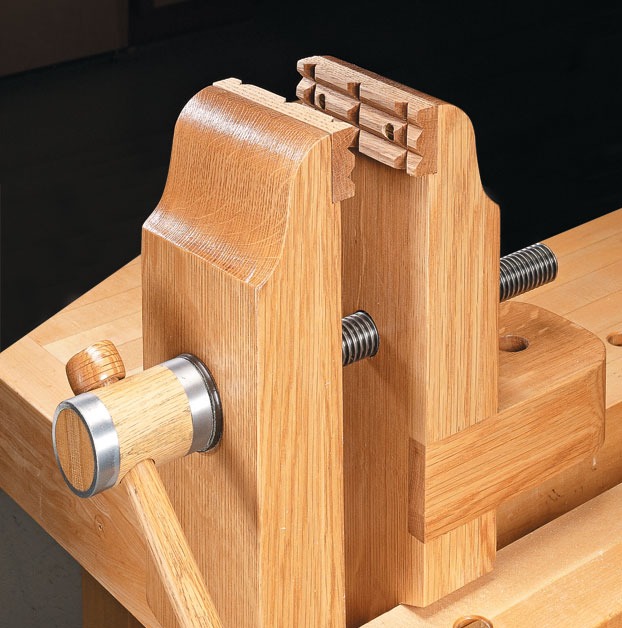
To solve this problem, the vise includes an optional set of interchangeable jaw faces with V-shaped grooves.
These grooves run both vertically and horizontally, allowing you to secure round stock in different orientations.
Whether you're shaping a dowel, refining a small turned component, or working on another round workpiece, the V-groove jaws provide a more secure grip.
A Practical Workholding Upgrade for Hand-Tool Woodworking
One of the advantages of this bench vise is its versatility.
It combines several useful features in a single shop-made accessory:
- Elevated workholding for improved comfort and visibility.
- Compact, profiled jaws that provide better access to the workpiece.
- Removable mounting that works with bench dog holes or a bar clamp.
- Adjustable clamping pressure using Acme threaded rods.
- Leather-lined jaws that help protect delicate surfaces.
- Interchangeable jaw faces for gripping round stock.
These features make the vise particularly useful for hand-tool woodworking, furniture making, carving, and other operations where accurate workholding is essential.
And because the vise is removable, you can use it alongside a traditional face vise rather than replacing the one already installed on your workbench.
Build Your Own Woodworking Bench Vise
You don't need a large or complicated workbench to enjoy the benefits of reliable workholding.
This compact, shop-made bench vise provides the clamping power of a traditional vise while raising your workpiece to a more comfortable height.
Its hardwood construction, adjustable jaws, and flexible mounting options make it a useful addition to almost any woodworking shop.
Ready to add one to your workbench?
GET THE STEP-BY-STEP WOODWORKING PLANS: Build a Better Bench Vise
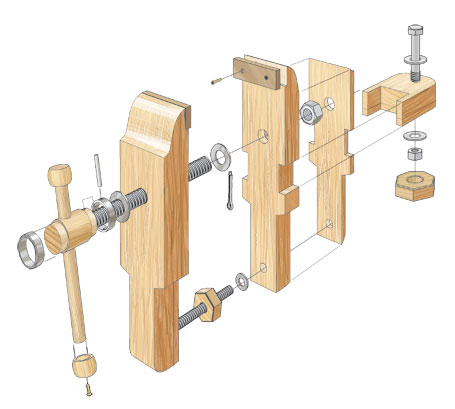
Get the complete Woodsmith woodworking plans, including dimensioned drawings and step-by-step instructions for building this versatile bench vise.


