


How to Cut Decorative Spline Slots with a Biscuit Joiner
Decorative splines are a great way to dress up the corners of a mitered box. Besides adding an attractive detail, the splines reinforce the miter joints and make the corners stronger.
Most woodworkers cut spline slots using a table saw and a dedicated cradle jig. But while building several small boxes, I realized there was another way to get the job done.
Why not use a biscuit joiner to cut the spline slots?
After all, a biscuit joiner is designed to cut accurate slots in wood. All I needed was a simple attachment that would position the tool at the corner of a box and allow me to make evenly spaced cuts.
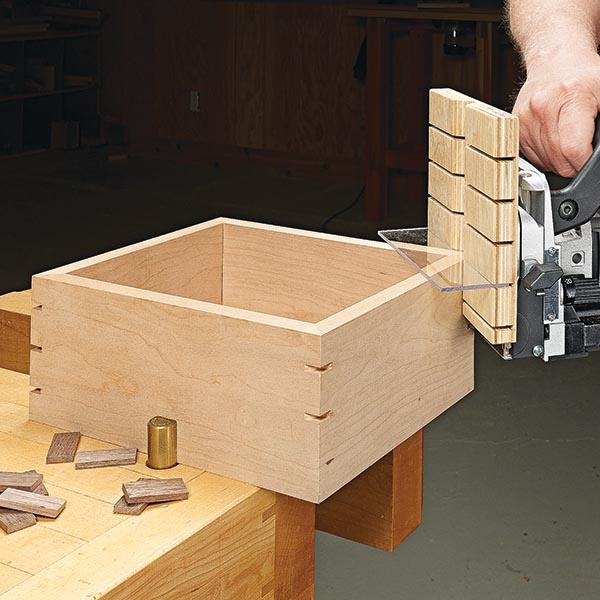
The result is this easy-to-build plywood jig that attaches directly to the biscuit joiner's fence.
Build a Simple Biscuit Joiner Spline Jig
The jig starts with a piece of plywood. Its main feature is a vertical V-groove that fits over the corner of a mitered box.
This groove holds the jig at the correct angle while the biscuit joiner cuts across the corner.
Cut the 90° V-Groove
Start by laying out a centered V-groove on the front face of the plywood blank.
I cut the groove at the table saw with the blade tilted to 45°. A couple of passes completes the two sides.
The important detail is that the finished V-groove forms a 90° opening.
This allows the jig to wrap around the corner of the box and register against both adjoining faces.
A snug, consistent fit helps keep the biscuit joiner properly positioned for each cut.
Add Kerfs for the Indexing Bar
Next, cut a series of evenly spaced horizontal kerfs across the front of the jig.
These kerfs hold a removable acrylic indexing bar that determines the position of each spline slot.
On my jig, the kerfs are spaced 1" apart, allowing me to cut a series of uniformly spaced splines.
I used 1/8"-thick acrylic for the indexing bar. This allows the kerfs to be cut with a single pass over a standard table saw blade, provided the blade produces a matching kerf.
The acrylic bar should fit snugly in each kerf without excessive movement.
Finally, draw a vertical centerline down the back of the jig. This reference line helps align the attachment with the biscuit joiner's fence.

Attach the Jig to the Biscuit Joiner
With the plywood attachment complete, it's time to position it on the biscuit joiner.
The jig attaches to the joiner's existing fence with screws.
For my setup, I positioned the jig so the bottom indexing kerf is 3/4" above the top of the biscuit joiner blade.
This places the first spline slot 3/4" below the top edge of the box.
Use the centerline on the back of the jig to align it with the joiner fence before fastening it in place.
Make sure the attachment is secure and doesn't interfere with the blade guard or the plunge mechanism.

Cut Evenly Spaced Spline Slots
Once the jig is installed, cutting the spline slots is straightforward.
First, insert the acrylic indexing bar into the kerf corresponding to the location of the spline slot.

With the box secured, position the jig over the corner so the V-groove registers against the two adjoining faces. The indexing bar establishes the height of the cut.
Then plunge the biscuit joiner to cut the spline slot across the mitered corner.

To cut another slot, move the indexing bar to the next kerf and repeat the process.
The evenly spaced kerfs make it easy to create a consistent pattern of decorative splines on each corner of the box.
For the best results, make a test cut in a scrap mitered corner first. This lets you check the slot position and depth before cutting into your finished project.
Be sure to keep your hands clear of the blade path, clamp the work securely, and disconnect power before adjusting the jig.
A Handy Alternative to a Table Saw Spline Jig
One of the best things about woodworking is finding new uses for familiar tools.
With this simple plywood attachment, a biscuit joiner becomes a convenient tool for cutting decorative spline slots in mitered boxes.
The V-groove keeps the joiner aligned with the corner, while the removable acrylic indexing bar makes it easy to space the slots evenly.
It's a practical alternative to building a dedicated table saw cradle jig, especially when you're making small boxes or adding decorative details to mitered corners.
More Ways to Strengthen Miter Joints
A biscuit joiner isn't the only way to add decorative splines to a box. If you prefer working at the table saw, a shop-made spline jig offers another accurate way to cut slots across mitered corners.

Learn how to build a Table Saw Spline Jig for Mitered Boxes and discover another method for adding strength and visual interest to your woodworking projects.
EXPLORE THE TABLE SAW SPLINE JIG → Build a Table Saw Spline Jig for Mitered Boxes


