


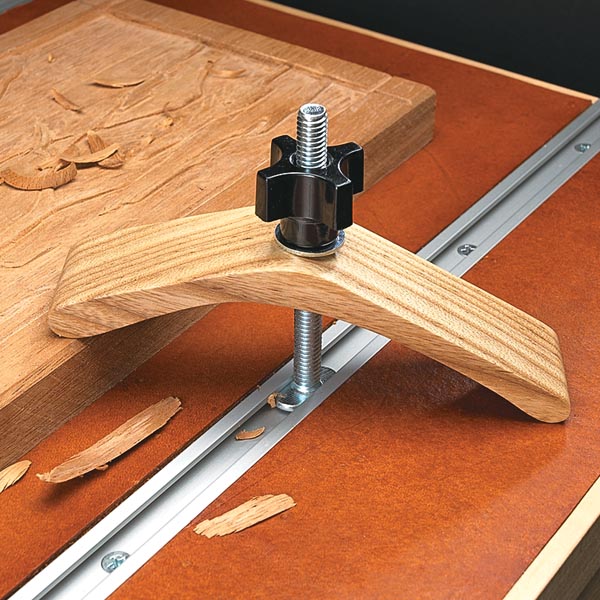
How to Make a DIY T-Track Hold-Down Clamp
Holding a workpiece securely is essential for accurate woodworking. Whether you're sanding, routing, drilling, or assembling a project, a workpiece that shifts can make the job more difficult and affect the quality of your results.
A T-track clamping system is a great way to add versatile workholding to a workbench or assembly table. And while there are plenty of commercial hold-down clamps available, you can make a useful version from a small piece of hardwood and a few common hardware components.
This shop-made T-track hold-down clamp is inexpensive, easy to build, and adjustable to accommodate a variety of workpieces.
The curved hardwood arm provides clamping pressure, while a flange bolt, washer, and threaded knob make it easy to secure or release the workpiece.
How a T-Track Hold-Down Clamp Works
The design of this hold-down is simple but effective.
One end of the curved hardwood arm rests on the tabletop, while the opposite end presses down against the workpiece.
A flange bolt passes through a slot in the hold-down and engages the T-track installed in the work surface.
Tightening a threaded knob and washer on the bolt draws the center of the hold-down toward the table.
This creates downward pressure at the end of the arm, holding the workpiece firmly against the surface.
Because the bolt slides along the T-track, the clamp can be positioned wherever it's needed.
And the elongated slot in the hardwood arm provides additional adjustment for different workpiece thicknesses.
Materials and Hardware for the Hold-Down Clamp
You only need a few materials to make this shop accessory.
- Hardwood blank for the hold-down arm
- Flange bolt sized to fit your T-track
- Flat washer
- Threaded knob
- T-track installed in your workbench or table
Any suitable hardwood can be used for the clamp body. The most important consideration is the direction of the wood grain.
Why Grain Direction Matters
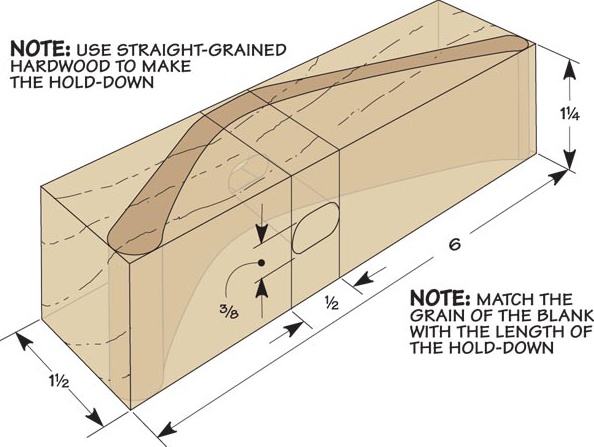
When laying out the hold-down, orient the grain so it runs along the length of the clamp.
This helps the arm resist splitting when clamping pressure is applied.
If the grain runs across the narrow sections of the curved arm, the wood may be more likely to crack under load.
Choose a straight-grained hardwood blank and avoid knots or other defects in the area surrounding the slot.
How to Build the Hardwood Hold-Down
The hold-down can be made with common woodworking tools, including a drill press, band saw, chisel, and file.
The key is to lay out the curved profile accurately and complete the adjustment slot before cutting the outside shape.
Step 1: Lay Out the Hold-Down Pattern
Start by transferring the hold-down profile from the drawing to the side of your hardwood blank.
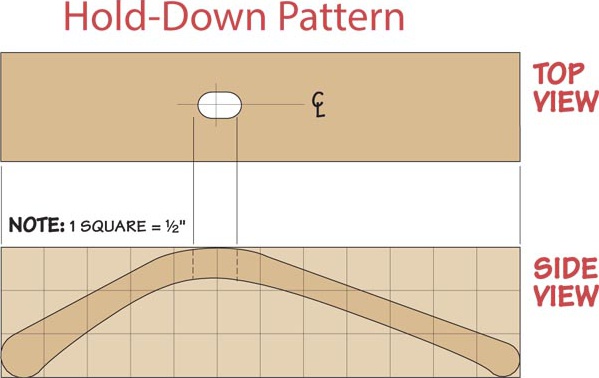
You can enlarge the pattern on a copier and attach it to the blank, or lay it out by hand using the grid marks in the drawing.
Be sure to orient the grain along the length of the hold-down.
Mark the location of the adjustment slot at the highest point of the curved profile.
Step 2: Drill the Adjustment Slot
It's easier to create the slot while the blank still has straight, square edges.
The slot needs to accommodate the flange bolt while allowing the hold-down to move as it's adjusted.
Start by drilling a series of overlapping holes along the slot layout using a drill press.
Keep the holes aligned and stay within the layout lines.
Then use a sharp chisel and file to remove the remaining waste and straighten the sides of the slot.
Test the fit with the flange bolt. It should slide freely through the slot without excessive side-to-side play.
Step 3: Cut the Curved Profile
With the slot complete, move to the band saw to cut the outside profile.
Follow the layout lines, leaving a small amount of material for final shaping.
The curved shape provides the leverage needed for the hold-down to press against the workpiece as the knob is tightened.
Step 4: Sand the Hold-Down Smooth
Use a sanding block or other suitable sanding tools to smooth the sawn edges and refine the curved profile.
Remove any sharp corners that could be uncomfortable to handle.
Pay particular attention to the ends of the clamp, where the hardwood contacts the tabletop and workpiece.
How to Use the T-Track Hold-Down Clamp
Once the hold-down is complete, installation takes only a few seconds.
Slide the flange bolt into the T-track on your workbench or assembly table.
Position the hold-down over the bolt so one end rests on the tabletop and the other end contacts the workpiece.
Place a washer over the bolt and thread on the knob.
Tighten the knob until the hold-down applies enough pressure to secure the workpiece.
The curved arm acts as a lever, transferring the tightening force into downward clamping pressure.
To release the workpiece, simply loosen the knob and slide the hold-down out of the way.
For larger workpieces, use multiple hold-downs to provide support at several locations.
Where a Shop-Made Hold-Down Comes in Handy
A T-track hold-down is useful for a variety of woodworking tasks.
Sanding and Surface Preparation
Secure small boards or project parts to the tabletop while sanding.
The hold-down keeps the workpiece from sliding without requiring a large bar clamp.
Drilling and Layout Work
A hold-down can help keep workpieces in position during layout and suitable drilling operations.
For drilling, use appropriate workholding and ensure the clamp provides sufficient restraint against rotation or lifting.
Routing and Other Bench Work
The hold-down can secure workpieces for certain routing operations where the clamp can be positioned safely away from the cutting path.
Always check that the router bit and base have adequate clearance around the clamp.
Assembly and Glue-Ups
T-track hold-downs can also be useful for holding parts in position during assembly.
They're especially handy when working with jigs, fixtures, or assemblies that need to remain stationary.
Tips for Better T-Track Clamping
A few simple details will help you get the most from this shop-made accessory.
- Use straight-grained hardwood. Proper grain orientation helps prevent the arm from splitting.
- Match the hardware to your T-track. The flange bolt must engage the track securely.
- Use a washer under the knob. This distributes the tightening pressure and helps protect the wood.
- Keep the slot smooth. The bolt should move freely through the adjustment slot.
- Avoid overtightening. Apply only enough pressure to hold the workpiece securely.
- Protect delicate surfaces. A thin protective pad can help prevent marks on finished or easily dented wood.
- Keep clamps clear of cutting tools. Position the hold-down away from blades, bits, and other moving parts.
An Inexpensive Upgrade for Your Workbench
Good workholding doesn't have to be complicated or expensive.
This simple hardwood hold-down turns a T-track-equipped workbench or assembly table into a more versatile clamping station.
With just a hardwood blank, flange bolt, washer, and threaded knob, you can make an adjustable clamp that keeps workpieces firmly in place.
And because the hold-down is easy to build, you can make several to keep on hand for different woodworking tasks.
It's a practical shop-made accessory that you'll find yourself reaching for again and again.
Build a Versatile Multipurpose Worktable
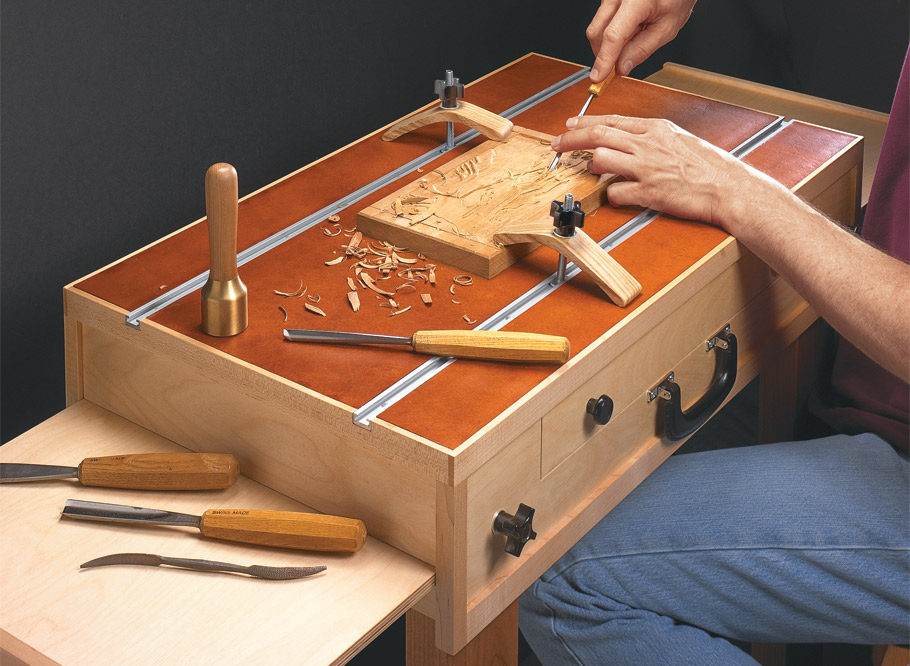
A T-track hold-down is even more useful when paired with a worktable designed for flexible clamping and assembly. Explore this multipurpose table project and add a versatile work surface to your shop.
GET THE STEP-BY-STEP PLANS ➜ Build the Multipurpose Table


